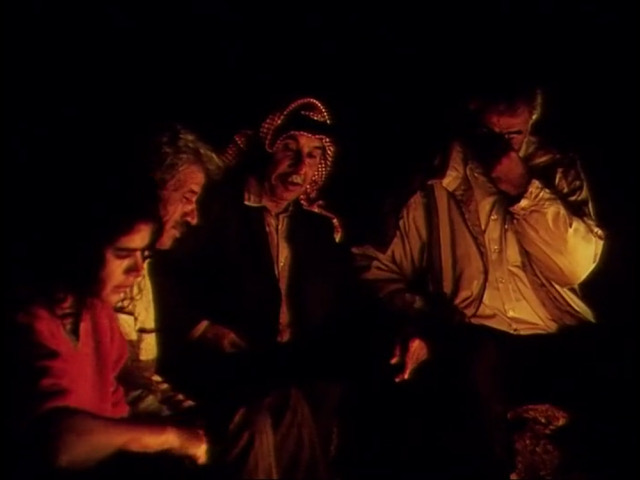
One day after the September 1982 massacre at the refugee camp of Shatila in Beirut, Jean Genet visits the site. Suffering from throat cancer and having written nothing for years, he begins to write about this disturbing experience. It leads to his final book, Prisoner of Love, in which he reflects on the Palestinian revolution, its defeat and the loss of one’s homeland. In the film, a young French woman of Algerian origin, reading the book, returns to the landscapes of the Palestinian resistance and the refugee camps full of exiles, in search of Genet.
EN
“Love and death. These two terms very quickly come together when one is written. I had to go to Chatila to perceive the obscenity of love and the obscenity of death. The bodies, in both cases, have nothing left to hide: postures, contortions, gestures, signs—even silences—belong equally to one realm and the other. The body of a man of thirty to thirty-five lay face down. As if the whole body were nothing but a swollen sac in the shape of a man […]”
Jean Genet
“As always when one makes a film about a writer, one is first confronted with a text and a form of writing. And there is a problem of images: what to show in relation to the text? How can the text itself be used? How can it be enriched, surpassed, taken elsewhere? In this particular case, it concerns an immense writer, one of the great poets of the French language of the century. A man infinitely complex, harsh and fragile. A man who knew neither his mother nor his father. Who was abandoned at birth and never knew a mother’s love, the affection of a home. As a result, he always detested his origins and his homeland, France, which constantly and violently reminded him of everything he had been deprived of from the outset. Who was never able to rid himself of a certain bitterness, a despair from which only writing, poetry – and later, to some extent, fame and his political engagement – could rescue him. An engagement always radical, without measure and without compromise. Genet loved those who had suffered as he had, those who had been dispossessed, like him, of their origins, those whose identity had been stolen. He himself having been, radically, a victim in his own body and flesh of this same fundamental injustice. This will be a film about a man now gone, who is in the process – or rather, who was in the process – of writing his final book. A film in the form of an inquiry into the birth of this book and into everything it recounts, but also, and above all, into why this book exists. Then it will be a film about a man who desperately seeks a new homeland, a homeland forever, but also a family, and first of all, without knowing it, a mother.”
Richard Dindo
NL
“Liefde en dood. Deze twee termen verbinden zich vrijwel onmiddellijk zodra er één wordt opgeschreven. Ik moest naar Chatila gaan om de obsceniteit van de liefde en de obsceniteit van de dood te ervaren. De lichamen hebben in beide gevallen niets meer te verbergen: houdingen, verwringingen, gebaren, tekens, zelfs stiltes behoren evenzeer tot de ene wereld als tot de andere. Het lichaam van een man van dertig tot vijfendertig lag op de buik. Alsof het hele lichaam niets meer was dan een gezwollen zak in de vorm van een mens […]”
Jean Genet
FR
« L’amour et la mort. Ces deux termes s’associent très vite quand l’un est écrit. Il m’a fallu aller à Chatila pour percevoir l’obscénité de l’amour et l’obscénité de la mort. Les corps, dans les deux cas, n’ont plus rien à cacher : postures, contorsions, gestes, signes, silences mêmes appartiennent à un monde et à l’autre. Le corps d’un homme de trente à trente-cinq ans était couché sur le ventre. Comme si tout le corps n’était qu’une vessie en forme d’homme […] »
Jean Genet
« Comme toujours quand on fait un film sur un écrivain, on est d'abord en face d'un texte et d'une écriture. Et on a un problème d'image. Que montrer par rapport au texte? Comment se servir du texte lui-même? Comment l'enrichir, le dépasser, aller ailleurs? Dans ce cas précis, il s'agit d'un écrivain immense, d'un des grands poètes de la langue française du siècle. Un homme infiniment complexe, rude et fragile. Un homme qui n'a connu ni sa mère, ni son père. Qui a été abandonné dès sa naissance et n'a jamais connu l'amour d'une mère, l'affection d'un foyer. Qui de ce fait a toujours détesté ses origines et sa patrie, la France, qui lui aura toujours violemment rappellé tout ce qui lui a manqué dès le départ. Qui n'a jamais pu se défaire d'une certaine amertume, d'une désespérance, de laquelle l'a sauvé seulement, dans la mesure du possible, l'écriture, la poésie, et plus tard, un peu, la gloire, et son engagement politique. Engagement toujours radical, sans mesure et sans compromission. Genet a aimé ceux et celles qui ont souffert comme lui, ceux qui ont été spoliés comme lui de leurs origines, ceux et celles auxquels on a volé leur identité. Ayant été lui-même et radicalement victime dans son propre corps et dans sa propre chair, de cette même injustice fondamentale. Ce sera un fùm sur un homme aujourd'hui disparu, qui est en train, ou plutôt, qui était en train d'écrire son dernier livre. Un film en forme d'enquête sur la naissance de ce livre et sur tout ce qu' il y raconte, mais aussi et d'abord sur le pourquoi de ce livre. Puis ce sera un film sur un homme qui cherche désespérément une nouvelle patrie, une patrie pour toujours, mais aussi une famille, et d'abord sans le savoir, une mère. »
Richard Dindo