

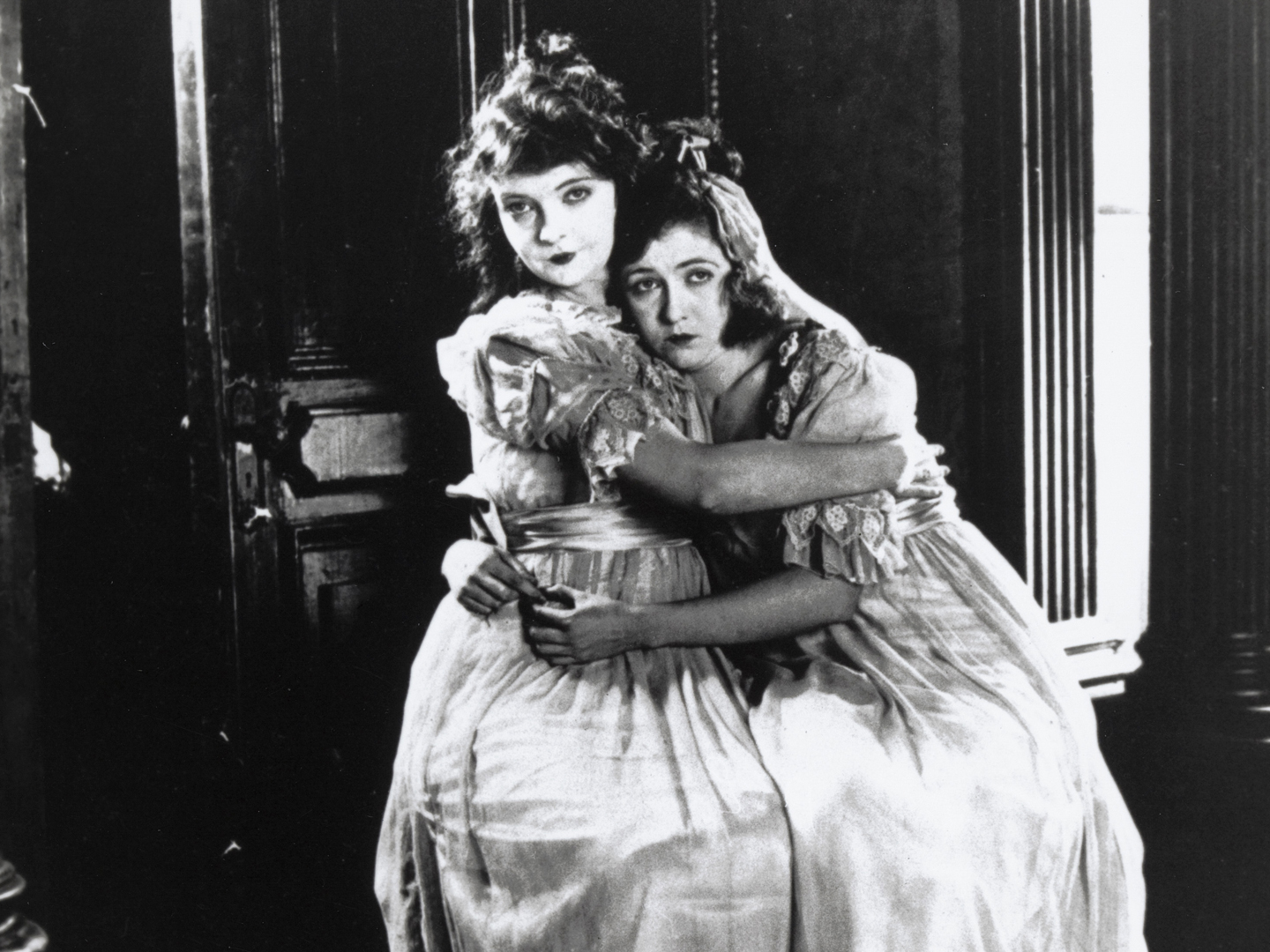
Two orphaned sisters are caught up in the turmoil of the French Revolution, encountering misery and love along the way.
EN
“Why is it so essential to see the great classics of silent cinema on television? Because with their intertitles (that tell) and their images (that show), they prove that a true filmmaker can only be one that shows. Griffith is not only a giant because he has set out once and for all, and for everybody, the two or three basic hypotheses of cinema, but because he has shown things that we have never seen again since. Borderline things, always. Things stretching toward their limit. Innocence that calls for sullying. Cruelty that calls for lynching. Widespread warfare that calls for peace. Griffith filmed like boxing, before and after the limit. His only goal is to capture the face of the condemned who, once pardoned, believes he’s already dead. ‘He has’, write James Agee, ‘an incommensurate appetite for violence, cruelty, and for this twin brother of cruelty: a kind of obsessional sensibility which, if we followed it, could become almost repulsive.’ Griffith as an obsessional shower, halfway between Dickens and Bataille.
Those who went to bed at 2 a.m. on Monday morning know what Orphans of the Storm (1921) is about, its reversal of reversals. The impossibility to forget the incredible sentence by Henriette Girard, condemned to death, asking the Committee of Public Safety to speak less loudly since her sister ‘who’s blind’ is in the audience. The impossibility to reunite the two orphan girls as long as democracy hasn’t triumphed in France. Robespierre’s throat-slashing gesture and Danton’s cavalcade. The debauchery of the aristocrats later followed by the dance of the mad populace. Of all the Hollywood films on the French Revolution, Orphans of the Storm is not only the most staggering, it’s also the least frivolous.”
Serge Daney1
- 1Serge Daney, “Griffith shows us a thing or two,” Serge Daney in English, 31 August 2017. First published in Libération on 8 November 1988. Reprinted in Devant la recrudescence des vols de sacs à main (Aléas, 1991).


