

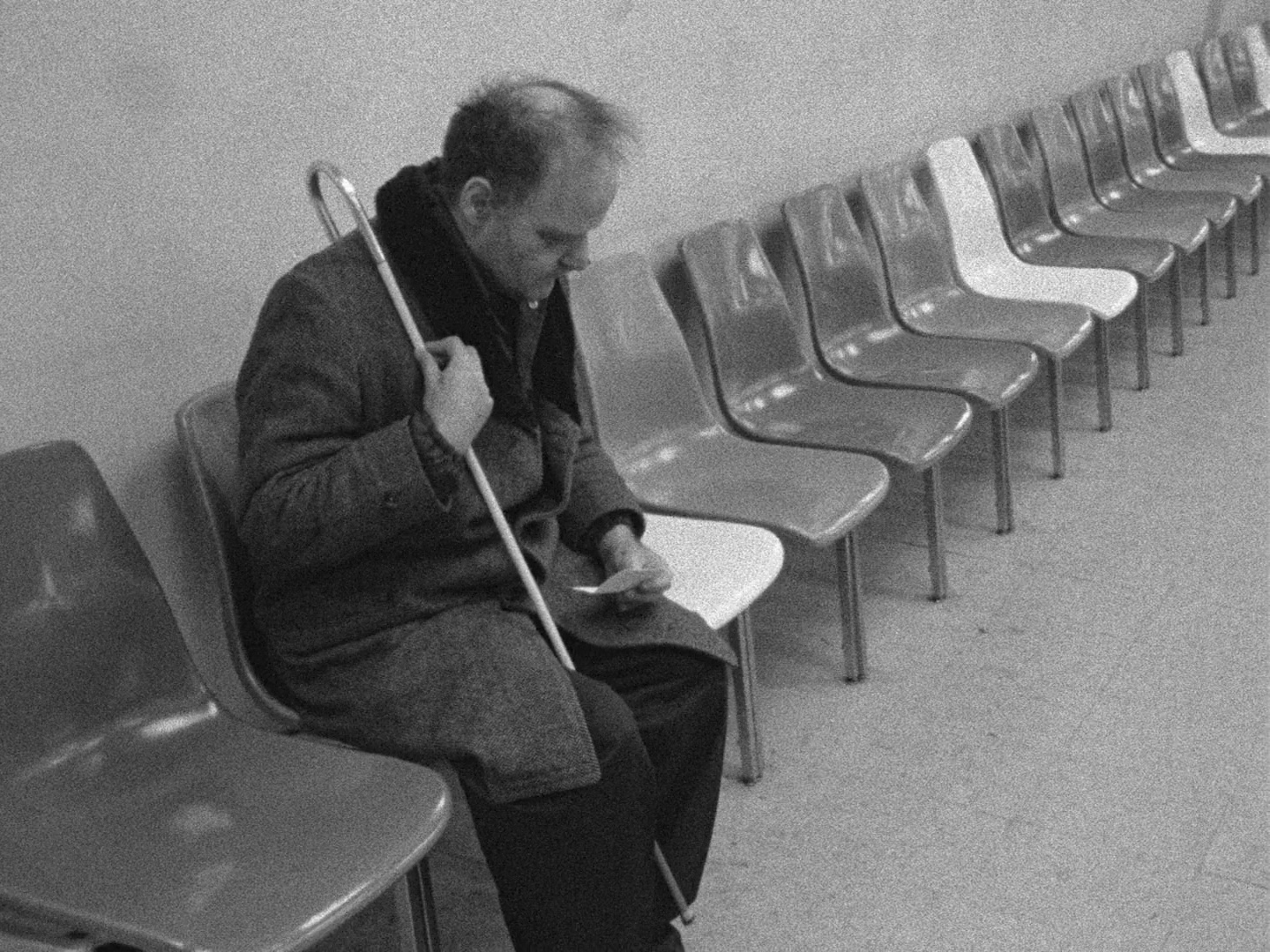
Welfare shows the nature and complexity of the welfare system in sequences illustrating the staggering diversity of problems that constitute welfare: housing, unemployment, divorce, medical and psychiatric problems, abandoned and abused children, and the elderly. These issues are presented in a context where welfare workers as well as clients struggle to cope with and interpret the laws and regulations that govern their work and life.
EN
“In Tuticut Follies and Welfare, as in the rest of Wiseman’s films, there is never any pretence that what we see constitutes the main or only story. On the contrary we are thoroughly aware that other scenes could have been shown, that a nearly infinite number of other films could have emerged from within the selected field. The filmmaker exercises the choice of what to look at and how long to sustain that gaze, and in doing so makes us fully conscious of the power inherent in that choice. We are invited to think about the logic of the structures he establishes. The cutting is the (supposedly absent) commentary just as it is the governor of rhythm and duration and narrative form. The films are as much meditations on editing as on what is edited. It is not the least of their genius to have made palpable – indeed breathlessly involving – the notion of film editing as an existential decision.”
Geoffrey O’Brien1
“What has distinguished Wiseman from facile humanism or mere sympathy is a streak of what can only be called black comedy. Everyone who knows his movies has a favourite moment. [...] Wiseman has an infallible eye for contradictions, absurdities; he will catch anyone whose rhetoric doesn’t fit the situation he has to deal with. Welfare, which I’ve often thought is Wiseman’s greatest film, gives full account to the messes that poor people can get caught up in; they are sent around from one office to another, and they press forward with powerful choral laments. In such cases, the anger is directed less at social arrangement than at the nature of life, which, at its most harrowing, can be inexorably comical. In spirit, Wiseman at such moments is close to such artists as Kafka and Tadeusz Borowski.”
David Denby2
“Wiseman’s work is, precisely, pared of their exaggeration and caricature, pared likewise of special pleading; but that does not necessarily makes it less terrifying. It would not be hard to read Welfare in the light of absurdism – and in case the point where missed, one of the welfare clients, Mr. Hirsch, is there to emphasize it, in speech that might have been written for a play of his own devising: ‘I’ve been waiting for the last hundred-and-twenty-four days since I got out of the hospital, waiting for something – Godot. But you know what happens in the story of Godot. He never came’.”
Geoffrey O’Brien3
“The comedy in Wiseman’s films is “in the jugular vein” of dark humourists such as Terry Southern, Kurt Vonnegut, Vladimir Nabokov, Bruce Jay Friedman, and Joseph Heller and reminiscent of the absurdist drama of Samuel Beckett and Eugene Ionesco. Wiseman has claimed that a collection of Ionesco’s essays on playwriting was ‘the best book I ever read about filmmaking’. In both traditions, contemporary life is seen as largely purposeless and illogical, engendering a metaphysical anguish that humour helps to contain.”
Barry Keith Grant4
“Wiseman never uses narration, explanatory titles, music, or commentary of any sort. He is stubbornly unhelpful; he will not shape, in any easy way, our responses to his films. Instead, out of the many hours of film that Wiseman shoots in any given institution, he creates an elaborately patterned mosaic of scenes that suggest not only the life of the hospital, police force, housing complex, school or boxing gym that is his subject, but also his own complicated response to it. As he would be the first to admit (on this subject he is eloquent), his response is always subjective. It cannot be anything else. A filmmaker is not omniscient, and he exercises taste and judgment every time he focuses on one matter rather than another. The final edited version of the footage is a representation of what he has experienced, observed, and felt. The choice and arrangement is always subjective.”
David Denby5
“The disparate episodes spill over with the contradictory meanings imparted to them by their participants. The hapless Mrs. Johnson, trying to cut through walls of red tape, being finally unforgettably counselled by another client [...]; the bored young black policeman amusing himself by debating at extraordinary length with a racist mugging victim; the complex multiple confrontation, a staggering instance of mise-en-scène not so much imposed as discovered, of a client, her daughter, an unsympathetic welfare worker, a policeman, and a supervisor: the summarize all that is going on in any one of these scenes would be the work of many pages, a whole volume perhaps, and no two observers would agree on what had been observed.”
Geoffrey O’Brien6
“In the last forty-one years, I have met him many times, and I have talked to him on the telephone quite a bit, but the impressions I formed then of his temperament haven’t changed at all. What immediately became apparent was his rare combination of patience and stubbornness. He has never altered his working methods – never enlarged the size of his crew, or cut down the amount of footage he takes, or discovered any shortcuts to getting his meaning across. Some audiences have been dismayed by the extreme length of films like Near Death, Welfare or High School II, but Wisman’s feeling is that there is no way to dramatize the complicated situations that people find themselves in without running conversations and conflicts at length. For Wiseman time has an almost moral component.”
David Denby7
“Wiseman’s films tend to emphasize the human face as dramatically and insistently as those of Ingmar Bergman, while his periodic insertion of hallways and streets shots is a stylistic device as consistent, and as important, as Yasujiro Ozu’s cutaways. Auteurists like to quote Jean Renoir’s remark that a director always makes the same film; Wiseman, similary, says his documentaries about institutions ‘are always the same film, by and large,’ and that they ‘are all one film 50 hours long’.”
Barry Keith Grant8
- 1Geoffrey O’Brien, “A Great Book of Instances,” in Frederick Wiseman, red. Joshua Siegel & Marie-Christine de Navacelle (Museum of Modern Art, 2010), 120.
- 2David Denby, “Comfort for the Tough-Minded,” in Frederick Wiseman, red. Joshua Siegel & Marie-Christine de Navacelle (Museum of Modern Art, 2010), 102.
- 3
O’Brien, “Book of Instances,” 118-119.
- 4Barry Keith Grant, Voyages of Discovery: The Cinema of Frederick Wiseman (University of Illinois Press, 1992).
- 5
Denby, “Tough-Minded,” 97-98.
- 6O’Brien, “Book of Instances,” 119.
- 7Denby, “Tough-Minded”, 100.
- 8
Grant, Frederick Wiseman, 4.

