

Liberal Delusions
On Aaron Sorkin’s The Social Reckoning (2026)
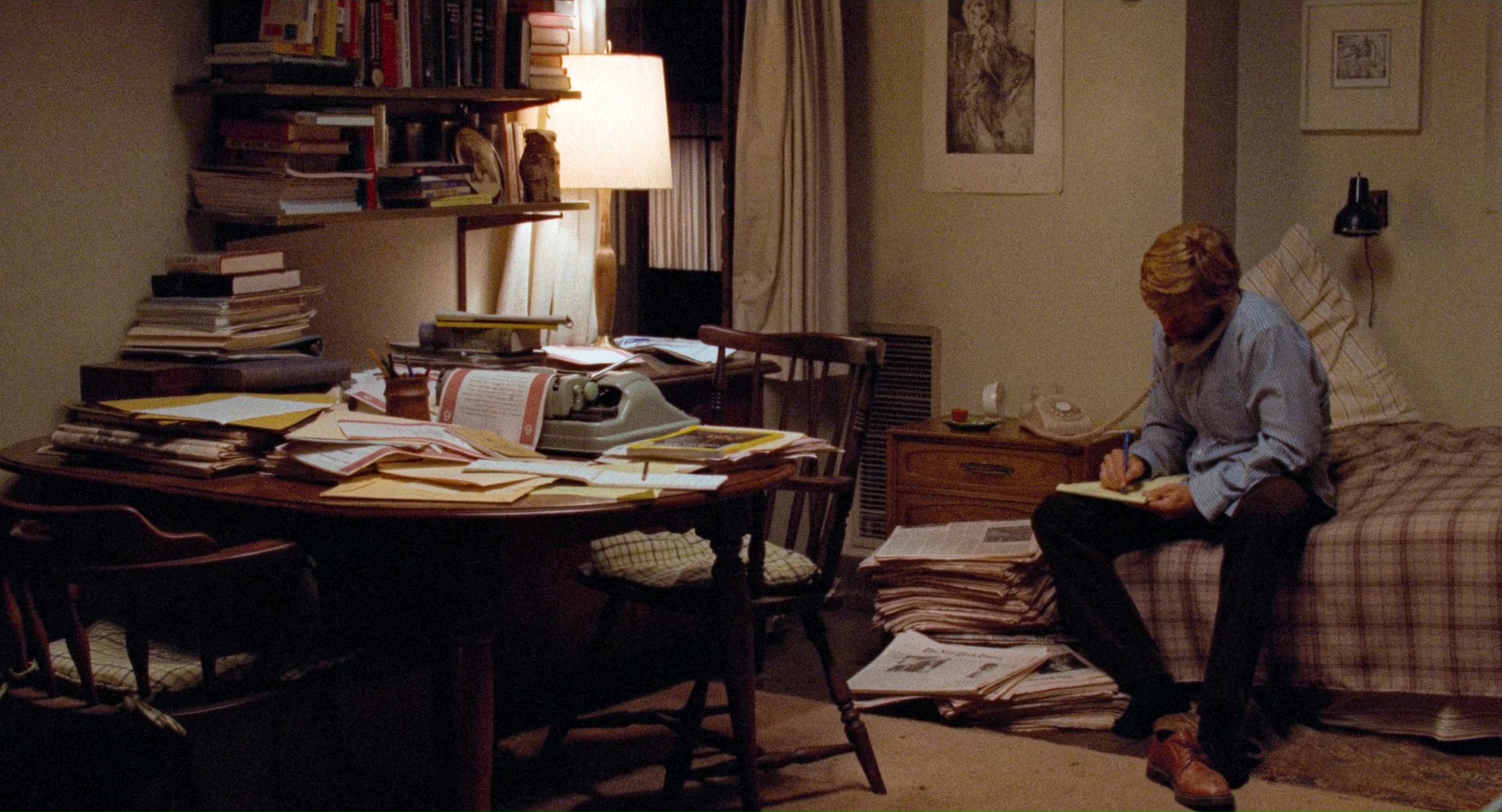
In the final scene of Alan J. Pakula’s All the President’s Men (1976), Bob Woodward and Carl Bernstein, played by Robert Redford and Dustin Hoffman, sit at their desks at The Washington Post, typing their Watergate story while a television broadcasts Richard Nixon’s 1973 inaugural address. There is no dramatic climax, only a relentless and painstaking investigation which would culminate in Nixon’s resignation in August 1974 following the scandal. The originality of Pakula’s classic lies in the fact that its journalists are not heroes in any conventional sense. Instead of thrilling action sequences, the film offers long phone calls, dull conversations, library research, typewriters and close-ups of notebooks filled with barely legible scribbles. Truth does not emerge along a straightforward path. It is produced through the patient cultivation of sources, the corroboration of evidence and the verification of facts. The film thus embodies a central promise of the liberal public sphere: that an independent press can hold political power accountable and enlighten the public opinion.
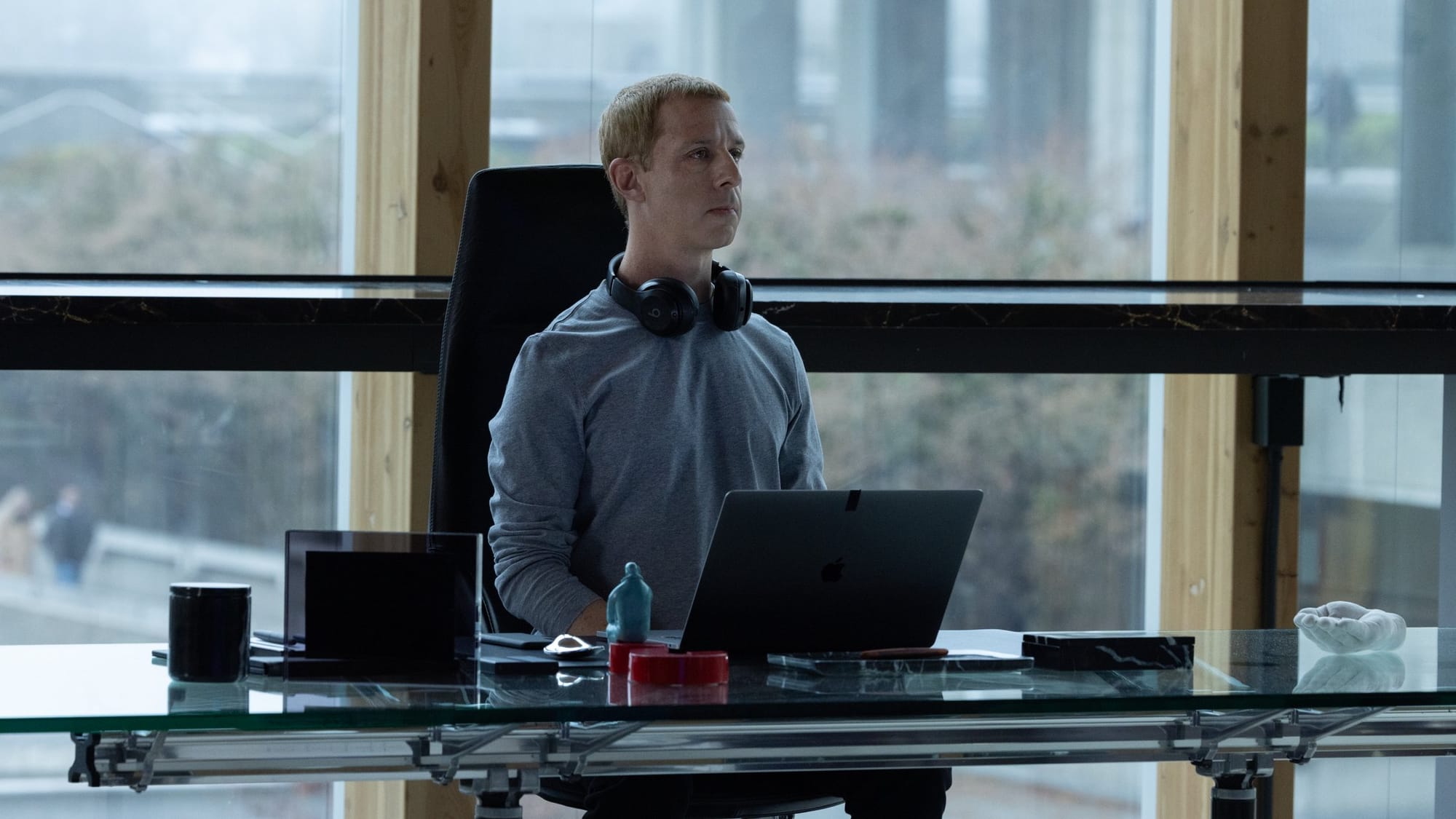
Fifty years later, Aaron Sorkin’s The Social Reckoning (2026) attempts to revive this ideal. Conceived as a follow-up to David Fincher’s The Social Network (2010), for which Sorkin wrote the screenplay, the film shifts its focus away from Zuckerberg himself to examine the platform’s effects on political discourse. Its diagnosis is far from subtle: by ending with the January 6 assault on the Capitol, the film’s flat and unoriginal mise en scène draws a direct line between Facebook and Trump. Although with a non-linear narration, the film opens and closes itself with the same character. An ex-Bernie Sanders supporter convinced that “the DNC had rigged the nomination” turned by Facebook’s algorithm into a pro-Trump white supremacist that, by the end of the film, storms the Capitol. If Fincher’s film depicts social media as emerging within an increasingly atomised society, Sorkin reverses the causal relationship: platforms are now actively shaping society and politics. A stiff, detached Zuckerberg, played by Jeremy Strong, encapsulates this transformation shouting to a concerned former investor that “we are the public square.”
Sorkin’s film thus seeks to capture how, in the half-century separating All the President’s Men from The Social Reckoning, the very structure of the public sphere has changed. In a political arena increasingly mediated by digital platforms, traditional news organizations have lost much of their gatekeeping power, while the circulation of information is increasingly governed by the imperatives of virality, polarization, and engagement. Although social media has democratised the production and dissemination of content, it has also sidelined many of the rules and procedures that were central to Pakula’s classic. The shift from a world in which everyone was a reader to one in which everyone is an author has transformed the institutions and power relations that shape the production of information. Rather than the press, a handful of tech billionaires now appear to be fuelling a digital civil war. Within such narrative, Sorkin’s explicit reference to Watergate in the film offers both a diagnosis and a remedy. In a society poisoned by misinformation and lies, fact-checking and the mediating role of traditional news organizations are presented as means of resisting the current “assault on truth” led by Big Tech.
This rather unoriginal and widespread narrative, however, suffers from major blind spots. Of course, traditional news has lost considerable ground to social media platforms and other digital players. Since last year, a majority of Americans have gotten their news from social media rather than news websites or print newspapers. Yet less convincing is the claim that this shift is the main driver of political turmoil. In the case of the 2016 US presidential election, for example, there is limited evidence that misinformation was a decisive factor in Trump’s victory.1 A study published in Nature found that articles from unreliable sites accounted for 5.9% of visits to news websites by American citizens during the election. But when the broader media environment is taken into account, fake news represented “just 0.1% of US citizens’ media diet.”2 Consumption of unreliable sources is furthermore concentrated among a small group of users. On X, for example, 1% of users accounted for 80% of exposures to fake news sources during that same election.3 More importantly, perhaps, when it comes to political information, citizens spend relatively little time reading news altogether. While 41% of Americans say they are online “almost constantly,” most reportedly spend less than thirty seconds a day reading news.4 This is, on average, considerably less time than they spend on online shopping or even porn. In other words, the defining characteristic of citizens in the digital age may not be misinformation but rather a lack of information.
Such a narrative therefore produces its own delusions. The most obvious is a romanticised representation of journalism and its role in democracy, a theme that was already the focus of Sorkin’s series The Newsroom. This is far from specific to Sorkin – think of Steven Spielberg’s The Post (2017) – and reflects a blindness to how news production itself has been reshaped over the last thirty years by concentrated corporate ownership, an increasing reliance on private sources of funding and the pressure of profitability. In the early 1990s, shortly after Noam Chomsky and Edward S. Herman published Manufacturing Consent: The Political Economy of the Mass Media (1988), around two dozen firms controlled “nearly the entirety of media experienced by most U.S. citizens”5. By 2025, that number dropped to six major corporations dominating much of the media landscape.6 A transformation captured by Michael Mann in his much more original The Insider (1999). There, he offers a far more pessimistic version of the familiar trope of the journalist as truth crusader and his endangered source. Battling to expose the nefarious practices of the tobacco industry, Lowell Bergman, the CBS producer played by Al Pacino, finds himself struggling against his own news organization. Fearing a lawsuit, the network refuses to broadcast the full story, apprehensive about the consequences on an impending sale of CBS to another company. Here, the obstacle to the free flow of information is no longer simply political or private power but also a media sphere increasingly shaped by corporate and commercial interests. At the end of the film, Pacino quits the show, raising the broader question of how private media ownership can conflict with the public’s right to know.
Today, the situation is hardly better. The constraints weighing on mainstream media mean that investigative reporters who break original stories are far from representative of the profession as a whole. “My bias,” says the journalist played by Jeremy Allen White in Sorkin’s film, “isn’t that tech is taking journalism jobs. It’s that you’re doing it so badly.” Yet over the past two decades, the quality and originality of content produced by mainstream media have themselves declined dramatically. In a study of French media, Julia Cagé, Nicolas Hervé, and Marie-Luce Viaud analysed the content published on news websites in 2013. Their database of 2.5 million articles showed that “64% of the information published online is nothing more than copy-and-paste” from another article.7 Only 21% of articles published that year were genuinely original. In other words, the pressures of immediacy, declining newsroom staffing, the imperative to attract online traffic, and the need to generate advertising revenue had already turned journalists into something resembling primitive AI agents.
The popularity of The Social Reckoning’s narrative, then, lies in the political function it serves for both liberals and tech entrepreneurs, rather than in its accuracy. For Silicon Valley moguls, despite their apparent uneasiness with the subject, it works as the perfect sales pitch for their business model. The idea that platforms can change – or even control – political behaviour through “psycho-targeting” is precisely what they sell to advertisers. In other words, the entire economic model of Facebook, Instagram, and X relies on the public perception that they have created a machine capable of convincing anyone of anything.8 Denying this would be damaging to an advertising industry that accounts for most of their revenue. Which is to say that Sorkin’s film will likely increase rather than undermine Meta’s stock price.
For centrists, it offers a convenient external culprit for the shortcomings of the kind of post-historical centrism they have supported over the past decades. It is, in other words, MAGA for liberals. Such a view unsurprisingly comes from Sorkin. His celebrated series The West Wing, which ran from 1999 to 2006, captures precisely this liberal understanding of politics without the masses. Politics is represented primarily through the president, senior advisers, political strategists, and policy experts. Which is to say, politics is what happens in the West Wing. Citizens are largely absent, and their concerns can only be addressed through elite deliberation rather than through collective action that shapes political agendas from below. Sorkin’s lament therefore amounts to a nostalgia for the Obama years, shaped by a conception of change largely divorced from power relations and highly sceptical of projects aimed at radical institutional and economic transformation.9 The recent surge in politicisation and activism on both sides of the political spectrum can therefore only be interpreted as irrational outbursts of anger disconnected from reality. The last scene of the film perfectly captures such view. By alternating sequences of the assault on the Capitol and Zuckerberg’s team watching scenes of chaos unfolding on screens filled with algorithms, the film depicts a world of highly manipulable crowds. The Bernie Sanders volunteer turned into a proto-fascist by Facebook offers a representation of citizens as passive actors, devoid of any agency and reason. The world Sorkin longs for, a longing that shapes The Social Reckoning, is one in which we return to the post-politics of the nineties where people are mostly absent from the “public sphere” and leave decisions about their lives to “competent” elites – that is, to people like him.
- 1
See, among others: Rodolfo Leyva, Charlie Beckett, “Testing and Unpacking the Effects of Digital Fake News: On Presidential Candidate Evaluations and Voter Support,” AI and Society 35, nr. 4 (2020): 969–980; Hunt Allcott and Matthew Gentzkow, “Social Media and Fake News in the 2016 Election,” Journal of Economic Perspectives 31, nr. 2 (Spring 2017): 211–236.
- 2
Ceren Budak, Brendan Nyhan, David M. Rothschild, Emily Thorson, and Duncan J. Watts, “Misunderstanding the Harms of Online Misinformation,” Nature 630 (June 2024).
- 3
Nir Grinberg, Kenneth Joseph, Lisa Friedland, Briony Swire-Thompson, David Lazer, “Fake News on Twitter During the 2016 U.S. Presidential Election,” Science 363, issue 6425 (January 2019): 374–378.
- 4
Jennifer Allen, Baird Howland, Markus M. Mobius, David M. Rothschild, Duncan Watts, “Evaluating the Fake News Problem at the Scale of the Information Ecosystem,” Science Advances 6, issue 14 (3 April 2020).
- 5
Noam Chomsky and Edward S. Hermann, Manufacturing Consent: The Political Economy of the Mass Media (Pantheon, 2002 [1988]).
- 6
“How US Media Consolidation Endangers Press Freedom,” Committee to Protect Journalists, https://cpj.org/2026/04/how-us-media-consolidation-endangers-press-freedom/.
- 7
Julia Cagé, Nicolas Hervé and Marie-Luce Viaud, L’information a tout prix (INA, 2017).
- 8
See David Karpf, “On Digital Disinformation and Democratic Myths,” MediaWell, December 10, 2019.
- 9
Corey Robin, “The Obamanauts”, Dissent, Fall 2019.
Image (1) from The Social Reckoning (Aaron Sorkin, 2026)
Image (2) from All the President’s Men (Alan J. Pakula, 1976)

