

Looking at Animals: Karl Kels
In his essay De l’hypnose à l’animal (2009), Raymond Bellour quotes from a rather obscure text by French philosopher Étienne Souriau from 1956, titled L’Univers filmique et l'art animalier, in which the latter points out that in the sixty years since the birth of cinema, the horse – once the animal force behind both transportation and warfare – has gradually disappeared from that role. Instead, the galloping bronco came to signal cinema’s growing romance with animals, gaining popularity in front of the camera in Westerns. At the end of the nineteenth century, the horse had already played a pivotal role in the birth of cinema and its technological development. Proto-cinematic experiments like Eadweard Muybridge’s zoopraxiscope and Etienne-Jules Marey’s chronophotography found it to be a suitable subject for analysing animal locomotion. Beyond the technological and representational realms, as Bellour highlights in Souriau’s discernments, there remains the sphere of feeling, and thus the metaphoric, in the relationship between animals and cinema. Above all, there exists a theriomorphic, material relationship: gelatin – made of collagen extracted from animal body parts – is an essential ingredient of (analogue) film. It is thus fair to say that a primordial connection exists between animals and cinema.
Silent cinema, scientific films, Hollywood productions, and documentaries are all populated by animal imagery, often to an extent that might not be immediately apparent. One notices it only when one looks for it, much like viewing eighteenth- and nineteenth-century paintings in a museum, where unsuspecting animals regularly creep into group portraits unnoticed. Quite naturally, art history – and to a lesser but nonetheless significant extent, film history – has attended to animal presence across genres. In recent years, intensified debates around anthropocentrism critiquing the imposed abstractions of nature and culture have invigorated animal-themed artistic practices, curatorial projects, and artists’ moving images. A renewed consideration of the entanglements between human and non-human life is impending, a deterritorialization of historical distinctions urgent, or to borrow a Deleuzian term, “becoming animal” is upon us.
Through a mix of cultural neglect and self-absorption, experimental cinema has often remained outside vital contemporary discourses, for better or worse. Take for example its most towering figure, Stan Brakhage. Between the late 1950s and early 2000s, in nearly twenty films dealing with animals, Brakhage, more radically than anyone else, rendered amorphous the distinctions between looking and being looked at, subject and perception, human and non-human. Yet his work is rarely addressed from this vantage point. Surveying the repertoire of experimental and artists’ films for animal presence inevitably brings up many other formidable names. The most atypical figure who might feature in such a hypothetical catalogue could be the Berlin based experimental filmmaker Karl Kels, whose fascination with the zoological inspires both awe and admiration.
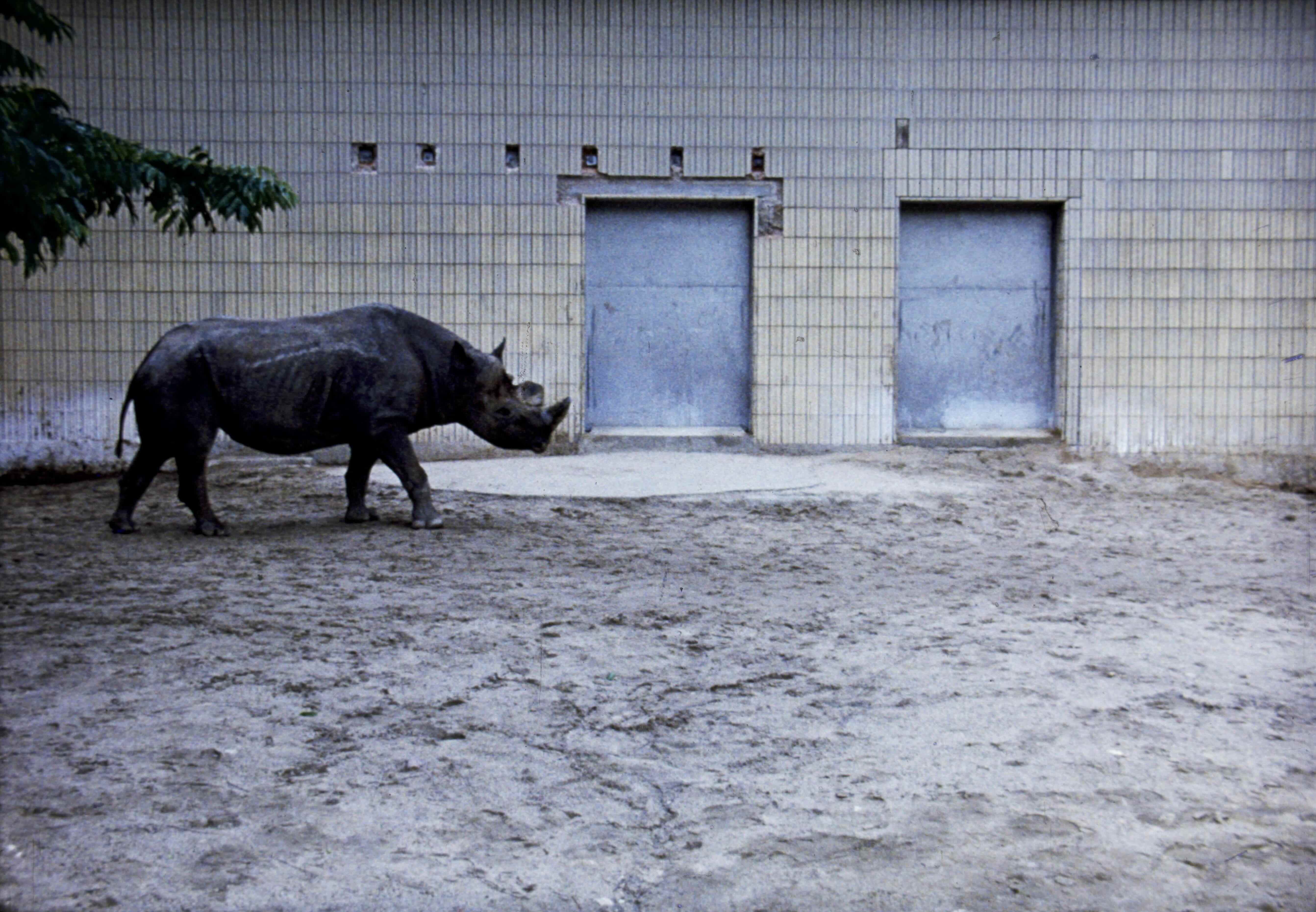
Kels observed and filmed rhinoceroses (Rhinoceros [1987], Cage [2009]), hippopotamuses, and elephants (the eponymous films from 1993 and 2001 respectively) in the zoos he frequented over many years. The rhinoceros films were structured using metric montage, borrowing its operative principle from the musical notion of metre. By employing variations and repetitions on a precise count of frames, Kels created a staccato rhythm in the editing. In contrast, Hippopotamuses and Elephants subvert the more commonly practiced continuity editing. Taken together, these films attest to Kels’s deep engagement with the history of cinema: the Lumière brothers as recorders and reproducers of events, and Georges Méliès, as a conjurer of fantasies. Having studied under Peter Kubelka at the Städelschule in Frankfurt, Kels was acutely aware of the “magic wand” that is montage. Kubelka, who theorised metric montage, indicated how editing can express meaning not merely as a result of collision between shots, but rather, when carefully utilized, between frames. Operated at the level of frames, montage – rupturing the space-time continuum – is freed from subservience to narrative. Rather than working stealthily, it makes itself apparent. In Rhinoceros, Kels initially filmed a single movement of two rhinoceroses over several days, using a precise camera position on eight separate occasions. This movement was the animals’ movement indoors through a single door at a designated time. A couple of years later, Kels returned to the same scene and discovered that the enclosure now had two doors. Since it was winter, the animals remained indoors, and Kels merely recorded the two closed doors, emulating the camera framing from two years earlier as closely as possible. Later, he had the chance to film one rhinoceros entering through one of the two doors. Armed with these three documentary elements that provided the necessary variation – one door with two rhinos, two doors without rhinos, and one rhino and two doors – Kels edited the footage rhythmically, creating an illusion of spatial consistency on which different temporalities are overlaid. The illusion of always observing the same scene unseparated in time only holds if one does not scrutinise it closely. The markers of time – the foreground of the doors, the colour and texture of its metal, the walls on which they are set, and variations in light – remain visible albeit in a constantly shifting field of vision, openly testifying to the passage of time.
In Hippopotamuses, Kels adopts a different filmic grammar than in Rhinoceros, even though some preoccupations, such as repeatedly filming a space from a fixed position with variations in time, are retained. Shot at the Schönbrunn Zoo in Vienna, the film depicts a family of three hippos moving through two doors connecting their enclosure to a pool outside. The shots of the hippos are intercut with human presence – caretakers tending the enclave. The film was shot on 35 mm black-and-white stock, and Kels, having familiarised himself with film development, printed the film himself. The wider gauge, compared to Rhinoceros shot on 16 mm, ensured a grainless texture. Black-and-white emphasises shape while colour depicts volume. Shooting 100 feet rolls limited the maximum duration of a shot to just over a minute (versus three minutes in Rhinoceros). Kels avoided shooting 400 feet rolls to prevent unwanted cuts when spooling down from 400 feet to 100 feet for darkroom development. The shots consistently frame transitions between stasis and motion, avoiding cuts during movement. Disciplining the content of shots in such a manner also meant that many of them, despite their photographic appeal, had to be discarded. Once these minute-long shots were developed, Kels’s observant eye searched for the infinite realisable possibilities created by editing the unstaged documentary reality – events, objects, movements – into a plastic orchestration of time, producing something far greater than the sum of its parts. Consider the sequence of five frames below. In frame 1, a caretaker faces the door as if inspecting it; frame 2, the door slides open; frame 3, the young hippo walks out; frame 4, two caretakers plaster the wall; and in frame 5, the adult hippo is seen coming out. These frames are only indicative of longer shots, but when similarly framed shots are stitched together, they approximate aspects of continuity editing, without actually adhering to it. Apart from the unlikely event of caretakers and hippos inhabiting the same place simultaneously, changes in wall texture and the size of hippos make it clear that Kels is interested in playfully exploring the liminality of real and filmic time. He does not privilege the more aggressive plasticity of metric montage, nor its illusionary counterpart – continuity editing. This sequence exemplifies one of many fantastical elements that inhabit Hippopotamuses, that carry over into the feature-length Elephants.


Elephants was filmed over a period of five years. During the course of shooting, the elephants seen in the film were relocated from their enclosure to another building, first replaced by apes and later by pandas. These incidents find their way into the film not in any discernible chronological order, but as a means of densifying the narrative. Through parallel editing, Kels generates all sorts of humorous interspecies interactions within a matrix of temporal and spatial alterities featuring different movements, shifts in light intensities, and variations in the scale of animal sizes. Roughly thirteen minutes into the film, there is a seeming shot-countershot sequence involving the apes and the zoo visitors. The shots are interwoven to suggest a mutual exchange of glances – a kind of mirroring effect – where the animals are not only looked at, but also look back. “In medieval iconography, the ape holds a mirror in which the man who sins must recognize himself as simia dei (ape of God)”, Giorgio Agamben once observed, further adding that “if animal life and human life could be superimposed perfectly, then neither man nor animal – and, perhaps, not even the divine – would any longer be thinkable.” The animal’s gaze at the visitors may well be a construction here – their stare back at the anthropological machine par excellence, the camera, a make-believe moment. What else could it be? John Berger, in his influential essay from 1977, Why Look at Animals?, offered his verdict rather bluntly:
“The public purpose of zoos is to offer visitors the opportunity of looking at animals. Yet nowhere in a zoo can a stranger encounter the look of an animal. At the most, the animal’s gaze flickers and passes on. They look sideways. They look blindly beyond. They scan mechanically. They have been immunised to encounter, because nothing can any more occupy a central place in their attention.”
Having spent years on Hippopotamuses and Elephants, working with montage and splicing film together on the Steenbeck to fabricate micro-narratives, Kels eventually grew weary of the process and began exploring new compositional possibilities. In his film Sidewalk (2008) – comprising forty-nine muted black-and-white shots of a New York City pavement, totalling half an hour – he appended the shots according to their duration, from the shortest to the longest, without concern for any graphic resonances. His next zoo film, Cage (2009), is a quasi-Structural work. It consists of only two takes: one in which the rhinoceroses enter and the door closes behind them, and another in which the door opens and the rhino refuses to go in. Confused, it runs around in the enclosure. The film involves progressive print generation, repeated six times in the laboratory, resulting in material degradation in terms of detail, and also, somewhat surprisingly, loss of film grain. The two takes are used in full but divided in segments of six frames each. Between every such segment, there are thirty-six frames of flickering duplicated material – six clusters of six frames each – arranged intuitively (hence the term “quasi-Structural”). The film unfolds on three interrelated levels: first, the two basic shots with their intercepted linear continuity; second, the progressive deterioration of the interstitial material as the film advances; and third, a loosely developing narrative – from the agitated movement of the rhino within the frame to its eventual absence in the later part, leaving only the two steel doors standing. Kels had previously used print generation in his remarkable short film Starlings (1991), where he created a grainy palimpsest of a flock of birds forming astonishing configurations in the sky, with a crescent moon in the background.
Kels’s austere zoo films – devoid of sound, with minimal camera movement, and often stripped of the distraction of colour – also possess a certain documentary value: they offer genuine insight into animal behaviour. Films such as Elephants and Hippopotamuses leave unresolved a set of primary oppositions, between objective representation and construction, documentation and creativity, reality and fiction, scientific knowledge and artistic intervention. Muybridge’s animal motion studies, by contrast, were firmly rooted in scientific investigation. Situated between observation and knowledge, his photographs analytically challenged the paucity of the mid-air galloping horse iconized through the history of painting. The genre of scientific and documentary films on animals often operates with a similar conviction to Muybridge’s: that everything about animals can be made intelligible through rational understanding. What exactly then are we to gain from the films of Karl Kels? In L’Art: Entretiens réunis par Paul Gsell (1911), Auguste Rodin remarked of Muybridge’s photography that in reality it is the artist who is truthful, and the photograph a lie, because time never stops. Rather than claiming any objective truth or scientific veracity, Kels seeks to represent (not re-present) the complexities of animacy, as only art can.
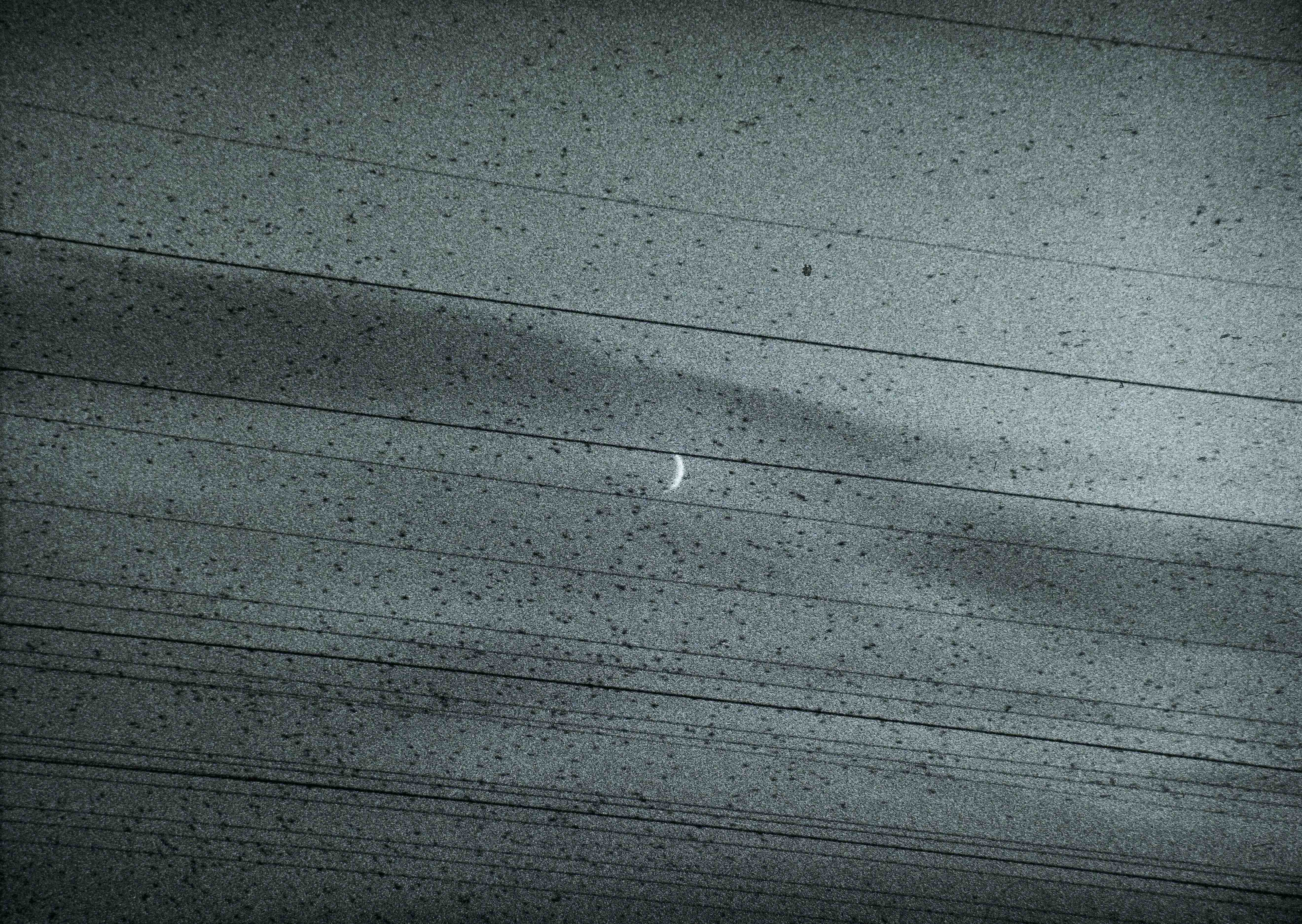
Image (1) from Rhinoceros (Karl Kels, 1987)
Images (2), (3) and (5) from Hippopotamuses (Karl Kels, 1993)
Image (6) from Starlings (Karl Kels, 1991)

