

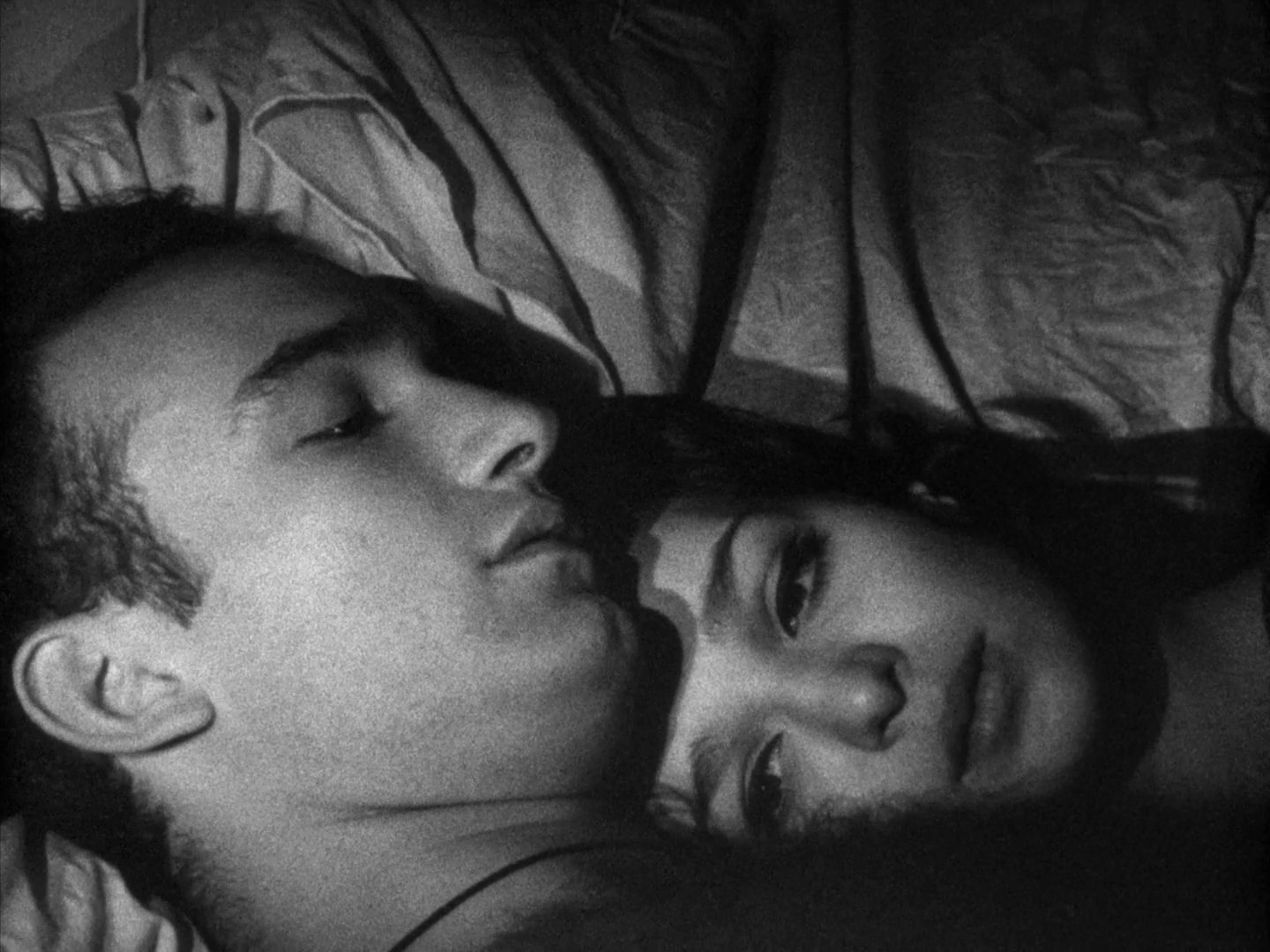
Shadows revolves around a romance in New York City between Lelia, a light- skinned black woman, and Tony, a white man. The relationship is put in jeopardy when Tony meets Lelia’s darker-skinned jazz singer brother, Hugh, and discovers that her racial heritage is not what he thought it was. Shot on location in Manhattan with a mostly nonprofessional cast and crew, Shadows is a penetrating work that is widely considered the forerunner of the American independent film movement.
EN
“Shadows began as a dream in a New York loft on 13 January 1957. I dreamed up some characters that were close to the people in the class, and then I kept changing the situations and ages of the characters until we all began to function as those characters at any given moment. One particular improvisation exploded with life. It was about a black girl who passes for white. It was a basic melodramatic situation in which she was seduced by a young man, who then realized that she was colored. I chose a situation like this so that the actors would have something definite and emotional to react to. The wild dream grew that this improvisation could be captured on film. Until dawn that morning, the dreamers talked.”
John Cassavetes1
“It didn’t matter to me whether or not Shadows would be any good; it just became a way of life where you got close to people and where you could hear ideas that weren’t full of shit. We had no intention of offering it for commercial distribution. It was an experiment all the way, and our main objective was just to learn. Not one actor was paid for his services, nor were the technicians given anything. What kept us going was enthusiasm. We were working for the fun of doing something we wanted to do. It is more important to work creatively than to make money. We would never have been able to finish if all the people who participated in the film hadn’t discovered one absolutely fundamental thing: that being an artist is nothing other than the desire, the insane wish to express yourself completely, absolutely.”
John Cassavetes2
“Cassavetes defends ‘the individual expression,’ which radically distinguishes itself from the ‘point-of-view film’ or the ‘thought-provoking film.’ That is because ‘individual expression’ means much more than aesthetic orientation: it is based on a civil understanding of the artist’s role in society. In that sense, ‘individual’ is not to be confused with ‘subjective’ and positions the artist, not as a private person but as a citizen.”
Nicole Brenez3
“There is a great need in the cinema for truthfulness, but truth is not necessarily sordid and not necessarily downbeat. Unfortunately, the art films have dealt mainly with the evils of society. But society is more interesting than rape or murder. I think you can do more through positive action than in pointing out the foibles and stupidities of man. Yes, any man is capable of killing any other man, we know that, we don’t have to stress that. To say that it’s right and normal, to continue to say it, to have society and the Establishment confirm that view, is wrong. Art films reach for the most obvious fallacies of society, such as racial prejudice. That’s been a fault of the art film – devoting itself to human ills, human weaknesses. An artist has a responsibility not to dwell on this and point it up, but to find hope for this age and see that it wins occasionally. [...] Shadows is a realistic drama with hope – a hopeful picture about a lower echelon of society in the United States – how they live, how they react. The people are hopeful. They have some belief. I believe in people.”
John Cassavetes4
“Even more than being interested in figures in marginal positions, Cassavetes was interested in marginal feelings. To use his own phrase, he was determined to give voice to the ‘small feelings’ that he believed American corporate values (in life and filmmaking) ignored or suppressed. His entire oeuvre is an effort to honor the lost of forgotten impulses in life, the tiny pulsing of emotional confusion or discovery that most other films simply omit. In his opinion, to bring them to consciousness, in a film or a life, is to begin to resist the vast forces of homogenization deployed throughout American culture, which is why the plots of his films almost always involve forcing characters to confront their lost or forgotten feelings.”
Ray Carney5
“I adore the neo-realists for their humaneness of vision. Zavattini is surely the greatest screenwriter that ever lived. Particularly inspirational to me when I made Shadows were La Terra Trema, I Vitelloni, Umberto D and Bellissima. The neo-realist filmmakers were not afraid of reality; they looked it straight in the face. I have always admired their courage and their willingness to show us how we really are. It’s the same with Godard, early Bergman, Kurosawa and the second greatest director next to Capra, Carl Dreyer. Shadows contains much of that neo-realistic influence.”
John Cassavetes6
“Reductive moral categories like truth and falsehood, honesty and deceit, can be used to describe the behavior of characters in most Hollywood movies because they have an essentializing notion of meaning. Characters clearly, easily and repeatedly “speak” (in both the visual and verbal senses of the term) a few simple, essential qualities, and viewers just a easily decode their "speech" into simple moral and psychological terms. In those films, stylistic surfaces or characters’ actions and words directly and unproblematically allow us to read reductive intellectual and emotional depths. Surfaces reveal essences, and the essences revealed are absolutely clear and unambiguous. The character knows his essential state of being. Other characters know it. The viewer knows it. Things are never this simple in Cassavetes’ work. Even love between two characters is not a pure, clear, definitive emotion. There is simply no stable, resolving depth behaviors can be tracked back to, and therefore moral judgments can never be made in the reductive way other films encourage.”
Ray Carney7
“Cassavetes creates a different kind of viewer than other films. We are asked to become faster, more intuitive, and more nimble in our responses. We must learn to live in a stimulatingly shifty world, leaping along us to get a handle on events and characters in most other films only gets in the way here. As with one’s first experience of bebop, the first time out the experience can be bewildering, but once we get the hang of the new rhythms and pacings, it becomes invigorating and profoundly enlightening. This is film not as storytelling, but as ‘an experience you are put through’ – a process of limbering up one’s capacities of perceptiveness and sensitivity. Cassavetes’ ‘creative writing’ is an attemp to elicit the viewer’s ‘creative reading’. The viewer is educated to stay open and one the move.”
Ray Carney8
- 1
John Cassavetes, “Shadows and Johny Staccato (1957-9),” in Cassavetes on Cassavetes, ed. Ray Carney (Faber and Faber Unlimited, 2001), 55.
- 2
Cassavetes, “Johny Staccato (1957-9),” 57.
- 3
Nicole Brenez, cited in Violeta Kovacsics, “Nicole Brenez – Investigating the Movement,” Sabzian, 15 December 2021.
- 4
Cassavetes, “Johny Staccato (1957-9),” 59.
- 5Ray Carney, The films of John Cassavetes: Pragmatism, Modernism and the Movies (Cambridge University Press, 1994), 33.
- 6Cassavetes, “Johny Staccato (1957-9),” 61.
- 7Carney, Movies, 50 - 51.
- 8Carney, Movies, 70.
NL
“Cassevetes zou nooit worden beschouwd als een geëngageerd politiek cineast, maar zoals acteur Peter Falk aanstipt ‘besloot een jonge twintiger, jaren voordat iemand had gehoord van Martin Luther King, toen de zwarten in het zuiden nog achteraan in de bus moesten zitten, om zijn eerste film te maken over de relatie tussen een blanke man en een zwarte vrouw. Iemand zei dat John het daglicht een uur eerder zag. Dat is waar’.”
Julie Decabooter en Ivo De Kock1
- 1
Julie Decabooter en Ivo De Kock, “John Cassavetes: niets dan liefde,” Filmmagie, 2009, nr. 600 (2009): 47-53.

