

This Thing Called Language
A Conversation with John Smith
For the past fifty years, John Smith has been making himself at home in the ambiguous realm of image and language. He worked within and parallel to the London Film-makers’ Co-op in his early years, adding to the collective’s structural approach to cinema an equal concern with the construction of narrativity. In Associations (1975) images from magazines accompany a spoken text on linguistic theory, pushing the visual pun to the extreme. His best-known film, The Girl Chewing Gum (1979), hilariously takes on the manipulative nature of the voice in documentary film. A fascination with ambiguity and an “idiosyncratic wit” characterizes his diverse body of work and, in nearly every film, one theme stands out: domesticity. Films like Hackney Marshes (1977), The Black Tower (1987) and Blight (1996) take buildings as the starting point for constructing and deconstructing the exchange between the narrative and the purely audiovisual. Inhabited, haunted, shapeshifting, or disappearing altogether, they are landmarks that consolidate both collective and personal memory. Inside, looking out, the glass windowpane vibrates with the tension between one’s own little world and the one outside. In all seriousness, he creates a game in every film, deconstructing the givens of words, sound and images, remaking them with humour, even when laughter seems inappropriate. But do we not rejoice most of all when dissonance peaks and the ambiguity of the visual and linguistic open the window, letting the light in, to see what’s going on, letting the clamour outside in, to hear what they are saying? As the cinema theatre erupts with laughter, we recognize, within the chuckle of a neighbour, one world within the other. Relief and discomfort arrive at the same time, hinting that the faulty language we call home is in fact the best we have.
Sabzian spoke to Smith during Courtisane Festival 2026.

Sabzian: Your most recent film, Being John Smith (2024) is a still film. You use pictures, spoken words and captions to create a story about your name, which you share with countless others in the world. It is a diary film, where we are together with you in your editing studio, attending a film being made. At the same time the outside world breaks into your home, as if suddenly you realize there must be something more important to talk about. How does this happen in your work process?
John Smith: My recent works are more overtly political than twenty-five years ago. That's because daily life has become so much more politicized. For me, there was a big shift, around 9/11, or more precisely when Britain joined the U.S. in invading Afghanistan. And I realized, although it’s an embarrassing thing to admit, that things have much more impact on me if my country is involved in them, I feel some kind of indirect responsibility. Things really changed at that point.
With Being John Smith, it happened very fluidly. I started putting the material together, finding images that would work with the text. And the first caption that you see in the film says that I’m worried that this film is going to be too conventional, just voice-over accompanied by illustrative images. That’s what I felt at that point. I thought, “where am I going with this? I don’t want to make a film like this.”
It’s normally something you would say in a feedback situation but leave out of the film.
It’s obviously intended to be a little humorous in the way in which I say it, especially when the next caption card says I’m worried it’s not going to have my usual formal inventiveness and wit. So there’s this dialogue between voice-over and captions. And I thought that I could build on this idea of expressing doubt, which led to expressing concern about whether it’s worth making art at the time that we’re in, and how we can feel enthusiastic about making anything.
Do you find this question has become harder over time?
Not really. Except, when I started making films, I was mostly interested in experimenting with visual aesthetics. My early film Leading Light (1975) follows sunlight traveling around a room. I lived in an attic room, which had quite a small window, so you’d get this window-shaped pool of light, which would travel around the room. And I made a film over the course of the day, following the sunlight, letting nature determine what I looked at, and then formal ideas developed from that. It had nothing to do with anything other than an aesthetic appreciation of life. I find it difficult to do that now without saying, “Oh, this room looks nice, but there are people outside who are living in the street who’ve got nowhere to go.” One feels a kind of responsibility to reflect on something other than one’s own privilege.
In Being John Smith, you talk about how you had wanted to stand out from the other John Smiths in your youth. What was it that made you decide to become a filmmaker?
It was quite accidental. I admire people who do lots of different things in life. I think I still don’t really know what I want to do when I grow up. I’m getting really old now, and all I’ve done is make films. I got into film before I went to art school, when I was only about sixteen years old back in the late ’60s. Some friends and I started doing light shows for rock bands, even though we hadn’t found a rock band to project for yet. I loved psychedelic imagery with oil projection and things like that.
A friend’s father had a photographic shop in East London, selling second-hand film and photographic equipment. We could get 16 mm projectors from him for bargain prices. I immediately became fascinated by this machine, not least because I’d been taking still photographs for quite a while. My father was a very enthusiastic amateur photographer and got me interested in the photo camera, the simplicity of this analogue machine. You can see how it works. You take the lens off and you see the shutter. And you can do the same thing with a film camera and projector. I found it magical that this thing would project 24 still images per second and create the illusion of movement.
We could also get educational films from my friend’s father’s shop. I still remember the titles of two of these films I got hold of. One was called Your Skin, and the other was called Your Hair and Scalp. They were scientific films to be shown in schools, a mixture of animation of hair follicles growing and footage of men in white coats in laboratories doing experiments. The projectors that we had couldn’t play soundtracks, so you had to guess what the images meant. It was fascinating to imagine what might be going on in these films, especially the laboratory or engineering scenes. I love this idea of realizing how mutable, how ambiguous images are until you give them a context.
One of the things I did with the films in the light show was to project two or three loops of film simultaneously. I’d make loops from a bit of the film that I liked and project it, and sometimes superimpose one on top of the other or put them next to each other. And I got really interested in the fact that when you see these images together, you can’t help but make connections between them. One image might be of a tomato and the other one might be a laboratory. You think: “That’s how they’re doing tomato experiments”. It’s quite extraordinary how the mind connects things. Because we grow up with mainstream cinema, where we’re trained to associate images.

From this fascination for how a machine works you grew fascinated by the ambiguity of images, of how a film structure can create associations in the mind of the viewer, as we can also see in Associations (1975). There’s always this tension between image and words, between the structural elements of film and narrativity.
I’m interested, whether we’re working with still images, moving images, speech captions, or sounds, in how those individual elements are the building blocks of meaning. So I think of all the sounds and images that make up a film as words in a sentence, that can suggest different meanings depending on the ways they are arranged. That’s one of the reasons why I rarely have images of people speaking in my films, enabling me to choose which sounds and images I put together. I am fascinated by ambiguity. And if you extend that philosophically, I’m interested in the fact that we all see the world differently. But we have this thing called language, which kind of reassures us that maybe we see things the same way, but we can’t really know. There are lots of things which are subjective. Language has this pretence that it can objectify. It’s the best thing we’ve got for sharing things with each other. But it’s also important to be suspicious. A lot of the humour in the films comes from ambiguity. I’m showing you one thing, but I’m telling you something else.
You’re questioning the authority claim of language in film, how it’s supposed to fix meaning. In your work it’s a malleable, vivid and indeterminate thing. You often parody the notion of the voice-over, in a way that reveals its power to trick and tell us what to think. In The Girl Chewing Gum (1967) the voice literally commands what happens in the image. The image shows a regular street with people passing by. However, the voice-over commands the images, as if he is the director.
Well, when I made the film, I was thinking very much about documentary, both still and moving image. How you can put a caption with a still image indicating what an image means. The power of language is so strong that even if that image is completely ambiguous, if we have a caption or a voice telling us it means one specific thing, it can be hard to question what we are being told and ask ourselves “what is this image really telling me?”
I made The Girl Chewing Gum at a time when there were laws in England called the Sus Laws. Sus is short for “suspicion” and gave the police the power to stop and search people that they felt were suspicious. This is back in the mid-1970s when nine out of ten policemen were white and racist. If they saw a group of Black kids in the street, they would assume they looked suspicious simply because they were Black. That’s why I have the white boy supposedly robbing the local post office.

You play with different modalities of the voice in your films. And especially in The Black Tower (1987) the voice is a character, an unreliable narrator. Can you talk about how you employ these different narrators in your work?
Well, it’s interesting you say that the voice is a character in The Black Tower, because one of the reasons I use my own voice is that, to me, my voice doesn’t have any character.
Yet you are a performer.
Definitely. But I think it’s an illusion I create for myself because I know my own voice so well. It’s a lower-middle-class London accent. But I don’t even hear it, which enables me to work with my own voice. The Black Tower is one of the few films with quite a few people listed in the credits. Almost all of them are people who auditioned for the voice-over that in the end I decided against. I went through many trials. At first, I really didn’t want to use my own voice, because the story is a kind of pastiche horror story. I asked a very old-school dramatic radio actor to do the voice. He did it very well, but it completely dominated the film. Then I wanted someone who couldn’t be easily placed in terms of their societal background. So I recorded the voice of another artist-filmmaker, who had a weird kind of French-Cockney accent which I really liked, only he turned out to be a terrible performer.
I think my own voice is fairly flat most of the time. I’m not very expressive. What counts are the words, not the person. Whatever the accent, you should never know anything about that person. You have to imagine them. This is really important to me because I don’t want to make dramas. I want the drama, but I want it to come from the construction of the film, not through the events represented or an expressive interpretation. In The Black Tower, I am playing with the contrast between drawing you into this imaginary conventional narrative while also regularly reminding you that you’re looking at a construction.
How do you develop this construction? Do you work starting from a written text, or do you build the film through filming and editing?
It varies. I generally build the films over time. For The Black Tower, I wrote the script after I shot a lot of the footage, because the narrative grew out of the specific locations from which I could see the tower. I started gathering images where I could see the tower above a high wall for instance, and figured that that could be a prison. Then I would build a bit of narrative around it. From another location, I could only see trees surrounding the tower. So the tower goes to the countryside. That became the basis of the story. I was fortunate that I could see it across a graveyard, so that enabled me to introduce death into the narrative. It was the view from my bedroom window when I moved into a house in East London in the early 1980s. So every day I’d see The Black Tower. I looked out my window and got interested in the changing light on top of it, in its non-reflectiveness. That was what fascinated me to begin with. The film was made over about three years.

In Slow Glass (1991) you turn your association game on the notions of reflection and speculation, referring both to sight and thought. The commentary combines a history lesson on glass manufacturing with a sort of autobiography, meandering like a pub conversation. The voice feels like a voice-over, but it’s also clearly situated within the scene, in a pub, as if it is a voice-off. It’s somewhere in the ambiguous space in between those two. Inside the film reality and outside.
I think I had difficulty getting that to work as well as I wanted. I wanted to convey the situation that you’re in a pub, with the conversation going on while you’re looking at the table and all you see is a hand entering the frame now and then. I wanted it to be a character in a pub that just ends up talking to you and in the beginning it’s interesting, but then you can’t seem to get away from them. You want to escape but they just keep telling you stuff. The funny thing is that many people think it’s a documentary, that it’s a real person that I interviewed. But it’s completely constructed, largely autobiographical material drawn from my childhood. I wrote it with Ian Bourn in mind, an artist friend who makes a lot of work based on monologues.

In Blight (1996), you transform the dominant nature of music in film. The music, the chopped-up interviews, and the precisely composed images of the demolition work continually exchange their functions within the construction of the film. Language and music would usually create a kind of blanket over a fragmentary composition of images. Images would be rupturing, and text sewing together. Here, however, text becomes a rupturing element. The different elements shift in and out of their usual function of creating a context, wavering between the structural and the narrative without fixed roles.
I very rarely use music in my films because I’m scared of its emotional manipulation. But in this case an opportunity had come up. The BBC was commissioning collaborations between filmmakers and composers, offering a very good budget. The composer Jocelyn Pook was my friend and she proposed to collaborate. We tried some things but we weren’t happy with any of it. I was already shooting material for Blight and she saw some of it and proposed to try something out. I was rather precious about it as I had a fixed idea of what I wanted to do. But in the end I gave in.
One of the things I hate about music for film is that the film is so often basically finished before a composer is brought in. With this film, however, we could both work on it right from the beginning. I didn’t record any sync sound. I recorded all the shots of bricks falling and pieces of wood splintering in my back garden, then synchronized them to the film. I really like doing that kind of work with sound because you there’s nothing superfluous. You just have the sound that you need, which gives the film a bit more intensity. Then I gave all those sounds to Jocelyn. I had used them in a very literal way, but she re-used the same sounds very differently. I’m really happy that it’s impossible to separate the music from the other sounds in that film, they are woven together in a seamless composition.
It feels like a requiem for the houses that are being demolished. Again the notion of home is very present, the violence of the home’s insides turned outwards.
Well, we both lived in houses that were being demolished. So we had strong feelings about it. When I started working on the film, I was still living in my house while the other houses around me were being knocked down. I knew a lot of people living in the street. During the process of the demolition of the house, you’d see the inside of the house, you’d see the wallpaper of a particular neighbour. And when you start tearing down a house, you don’t just see wallpaper, you see its layers. You see the history of the house, as things are peeled away and something else is revealed underneath. I found this rather obscene, this exposure of people’s private lives for everyone to see. It was a really powerful thing for me. I wanted to create a kind of monument to those houses.
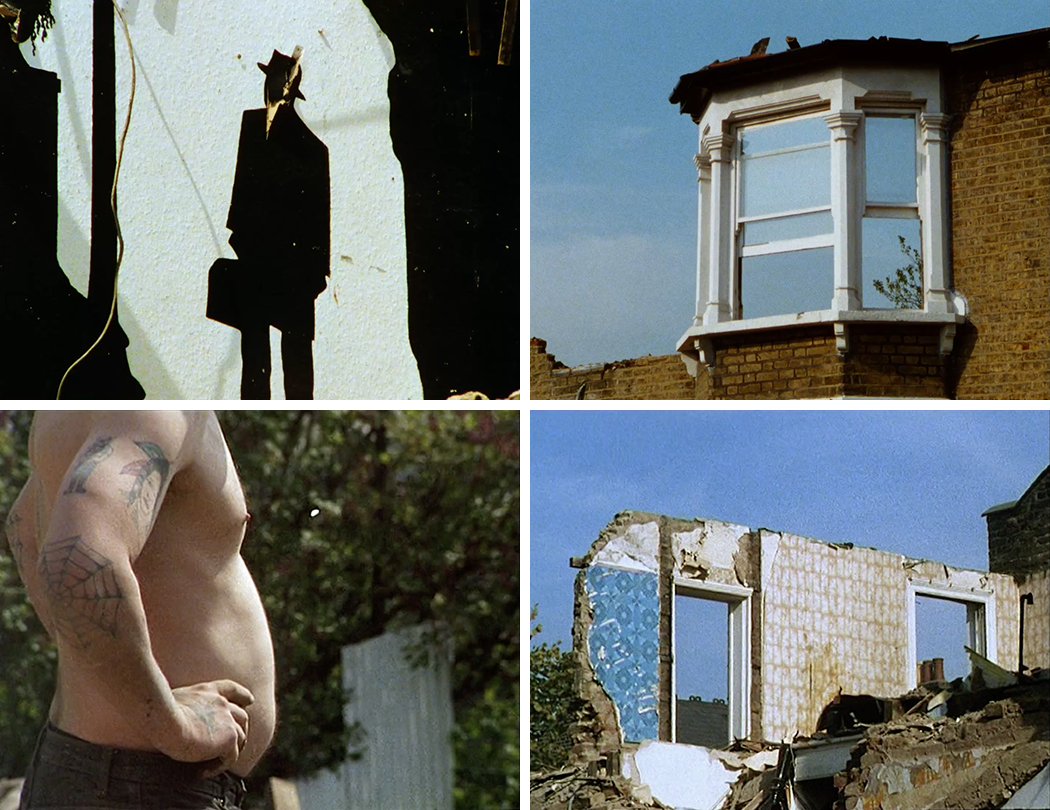
I remember clearly the day that I decided to start shooting the film. When I left in the morning to go teaching, the house next door was still intact. The people who lived there had already moved out. When I came back in the evening, it was half destroyed. When I went into my back garden, I saw this copy of the poster for The Exorcist painted as a mural on the wall. And I said, “that’s got to be the beginning”. Because I was thinking about the mutability of images. Seeing this guy in a silhouette with a trilby hat and overcoat and a briefcase, I imagined him as the government official, the faceless official from the Department of Transport who wants to exorcise the area and replace the people with cars.
And then when I did start filming the demolition workers, I noticed this spider web tattoo on one worker’s elbow. It reminded me of the motorway network around London, with its roads radiating from the centre, as you see on a map in the film final’s shot. When I started interviewing people, I didn’t ask people specifically about that situation. I asked what they remembered about places they could no longer return to. One person said “when I was a child, we had a toilet outside in the garden. And it was really awful because whenever I went to the toilet, there were spiders in the toilet. I had to get my father to come and kill the spiders for me.” I’m recording this, and I couldn’t believe my luck. I’m constructing the film in my head as she’s talking, around this theme of the spiderweb.
Like the tension between daily life and politics, there’s also one between seriousness and humour in your films. Do you view laughter as a form of resistance?
I think humour is a pretty serious thing. We can become immune to what is happening in the world around us and we have to find new ways of addressing it. Three years ago, when the genocide first started, when I made Being John Smith, I added the text ‘Stop the Genocide’, which some people found quite shocking. Now, in most places apart from Germany, it’s quite acceptable to talk about a genocide in Palestine. But, unbelievably, it is still going on. In my Hotel Diaries, I talk about the horrors of what was happening in Gaza back in 2007 and mix them with humour. I hope that presenting something in a different way doesn’t undermine its seriousness. It actually has the opposite effect, by creating discomfort.
I don’t know if I could survive in the world we inhabit now without humour. For me, humour is a very important way of coping with what’s going on around us. The humour in my films just sort of happens, usually because of my interest in ambiguity. I don’t start out intending to make a funny film. But humour very often arises when we create an unexpected situation, or present an image of something very ordinary and describe it as being something other than it is.

Images (1) and (2) from Being John Smith (John Smith, 2024)
Images (3) from The Girl Chewing Gum (John Smith, 1976)
Images (4) from The Black Tower (John Smith, 1987)
Images (5) Slow Glass (John Smith, 1991)
Images (6) from Blight (John Smith, 1996)
Image (7) from Hotel Diaries (John Smith, 2001-07)

