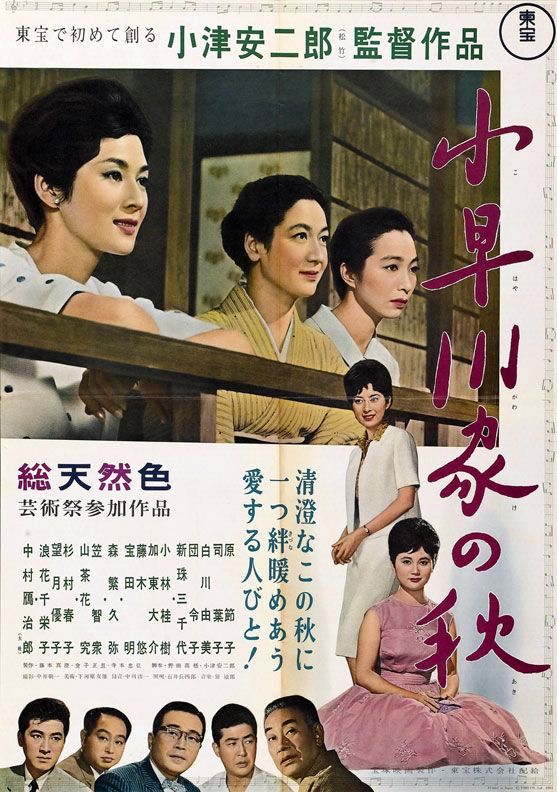
The family of an older man who runs a small sake brewery become concerned with his finances and his health after they discover him visiting an old mistress from his youth.
EN
“When I talk about the film director Ozu Yasujiro, it is only natural for me to call him Ozu-san because of two unforgettable memories I have of him. The first one took place more than thirty years ago in January 1963 at a restaurant in Kamakura.The Shochiku Ofuna Studio Directors’ Club, to which Ozu-san and I belonged, held a New Year's party there. I clearly remember that night as if it were yesterday because I have often thought about it. Among the fifteen or so film directors who were at the party, Ozu-san was the oldest member and was sitting at the "highest" seat in the back of the room, right at the tokonoma (the alcove in Japanese-style rooms). I was the youngest and was sitting in the ‘lowest’ seat, right next to the exit.
When the party started, Ozu-san came and sat down with me, pouring sake into my cup without speaking. From then on, until the party ended, Ozu-san and I drank sake together without exchanging many words. Because of that, the New Year's party, which should have been a happy occasion, was more like a funeral for me.
However, I know very well why Ozu-san did such a strange thing. The previous autumn, 1 had written a critique of Ozu-san's latest film. The End of Summer [Kohayagawake no aki, 1961] for a magazine, asserting that it did not feel like an Ozu film. The End of Summer had scenes meant to cater to younger audiences. Because I myself was young, I was sensitive to his intent, and pointed this out. Instead of arguing with me, Ozu-san silently offered me sake. This was his very Ozu-like response. Ozu-san was that kind of a person.
At one point in the evening as Ozu-san was getting a little drunk he casually said to me, ‘After all, film directors are like prostitutes under a bridge, hiding their faces and calling customers.’ This was a typical Ozu-san expression filled with playfulness and humor. Most likely, Ozu-san was metaphorically saying that film has everything to do with commercialism. Simultaneously, he must have been asking me whether it is possible to make films outside of commercial influence.
Of course, I do not know what his true intention was in using this metaphor. Maybe I was not meant to understand it, because Ozu-san always spoke about everything in a joking manner and did not want his words to be taken seriously.”
Yoshida Kiju1
- 1
Yoshida Kiju, Ozu’s Anti-Cinema, translated by Daisuke Miyao and Kyoko Hirano (The University of Michigan: Ann Arbor, 2003).