

“Official history is a myth, and myths are made with fiction.”
A Conversation with Lucrecia Martel
Twenty-five years after becoming a leading figure of the New Argentine Cinema, and eight years after her latest feature film, 2017’s historical epic Zama, premiered to universal acclaim, Lucrecia Martel continues to push boundaries in her work and reinvent herself as a filmmaker. Indeed, very few of the directors who can lay claim to the title of being a living legend are so adept at late-career shifts. But beyond her status as a canonical contemporary auteur, her idiosyncratic gestures – such as presiding over the jury that controversially awarded Todd Philips’s Joker at the 2019 Venice Film Festival – Martel has built a unique body of work that has walked the delicate tight-rope between being heavily anchored in contemporary reality and harshly criticizing larger historical and social phenomena.
More than a decade in the making – and five years after winning the top development award at Locarno’s 2020 edition dedicated to The Films After Tomorrow – Nuestra Tierra [Landmarks] marks what, at first glance, might be seen to be a shift in Martel’s larger body of work: from her meticulously crafted fiction films that explore the tensions within Argentina’s middle class and its fraught relationship with its colonialist past to documentary work (also see her 2021 short, Terminal Norte) that allows for a more open process, and a more explicit approach in terms of politics. However, one must not be fooled by this surface-level difference: this latest entry in her filmography is perfectly congruent with the larger themes that have permeated her entire body of work.
Nuestra Tierra weaves itself around the 2009 murder of Javier Chocobar, a leader of the Chuschagasta community in Northern Argentina, during an illegal, armed attempt at grabbing Indigenous land. Starting from the grainy footage of the crime, and the lengthy legal proceedings to bring his killers to justice, the film uses the case as a jumping of point to explore both the history of the Chuschagasta community and the topic of Indigenous political struggles and organising, as well as to draw attention to the class and racial divides that continue to plague Argentine society as a direct consequence of its colonial past. And it does so by combining a vast array of footage, both original and found, shot on myriad types of cameras, creating a visual tapestry that speaks deeply to the current moment in audiovisual history.
We sat down for a talk with Lucrecia Martel in October 2025 at the 63rd edition of the Viennale, discussing how Nuestra Tierra echoes political concerns found throughout her body of work, the pitfalls of thinking of cinema in terms of fictions versus documentary, the trappings of both style and of the film industry, and how to integrate a very diverse array of imagery into a cohesive whole.

[The interview was initially conducted in Spanish. The answers that Ms. Martel spoke in English are in italics.]
Sabzian: There’s been quite a lot of discussion around Nuestra Tierra as a supposed shift from fiction to documentary in your work. But I’ve always seen this as a false dichotomy, and I imagine you might feel the same.
Lucrecia Martel: Yes.
I was really struck by how the film continues the overarching themes in your work – chiefly, the legacy of colonialism and postcolonial structures within Argentine society that have been seemingly erased by modernity, or absorbed into society in more subtle, less overtly violent forms. At the same time, another major concern here is class structure. How have these themes, which have preoccupied you from the very beginning, found their way into Nuestra Tierra?
Look, I entirely agree that there is a continuity of interests with the things I did before. Perhaps, in this film, a sense of urgency emerged from encountering the pain and the needs of that community. It was an urgency that felt different from what I experienced when making my fiction films. This difference was also shaped by the circumstances the country was going through: a succession of economic crises and an ever-increasing precariousness of the population. As such, the urgency was of a different nature. I don’t know if I could have made a fiction film about this. That’s one thing. Let’s consider that I had used the same tools as in fiction for the narrative construction. Even then, I think there was something in the very matter of the trial, and in all the material my team and I were gathering; not just me, but collectively: the photographs, the documents. There was something in there that felt extremely rich. If I had tried to transform all of that into fiction, I would have lost a lot of that richness. That’s why I ultimately decided to make a documentary film. I did consider, for a moment, whether I should make a different kind of film.
Then there’s another thing about fiction. Let’s say that once you’ve made extensive use of the resources fiction offers, something within historical discourse becomes very visible: the patterns of history. The official history of any country is a myth, and myths are made with fiction. In that sense, I found the language of fiction very useful for untangling the myth of the nation’s foundation.
I was thinking about this particular scene towards the end of the film where you cross-examine the historians cited by the defence attorneys of the murderers, and who are cited incorrectly.
Yes.
I see a direct connection between what you’ve just said and the fiction of history, both in what these historians say and in how their work is so easily misappropriated. At the same time, throughout the film, there are moments when other films are casually mentioned in the conversation by the characters, Ben-Hur for instance. Did you choose to include these references to enter into a kind of dialectical exchange with those films, or to underline the way cinema fuses with our everyday lives?
That simply happened. Those comments were very casual. I wasn’t asking them anything about cinema. It’s inevitable that, in such a critical moment – and perhaps this always happens – I feel a strong sense of responsibility in producing a public discourse. Like a film, right? And what does that entail? What was my commitment to the people, to my contemporaries? When one has that doubt about whether you’re using your strength for good, something inevitable emerges: the film also becomes a reflection on cinema. Whenever I have conversations with people from the community or with others, and cinema comes up, or is simply mentioned, I’m struck by the remarkable place that cinema holds in our imagination. How does it operate? How does it make us think? How does it leave us with phrases that we then use to complete our own discourse? As such, cinema is an incredibly powerful source. Yes, Ben-Hur, but for a person from such a community, someone who had a childhood without a family, for whom cinema was a place of happiness, the fact that that film, that mainstream Hollywood film, helped them reflect on another part of themselves shows just how terribly powerful cinema can be. And it’s not so simple to say what kind of cinema is good and what kind is bad. That, to me, seemed truly extraordinary.
As such, for me, the film, beyond the historical questions, is also a reflection on my own work. I’m someone who ended up making cinema. I never even said that I wanted to be a director or anything like that. But, well, it became my work. And it’s a reflection on what this work is, how powerful it can be.
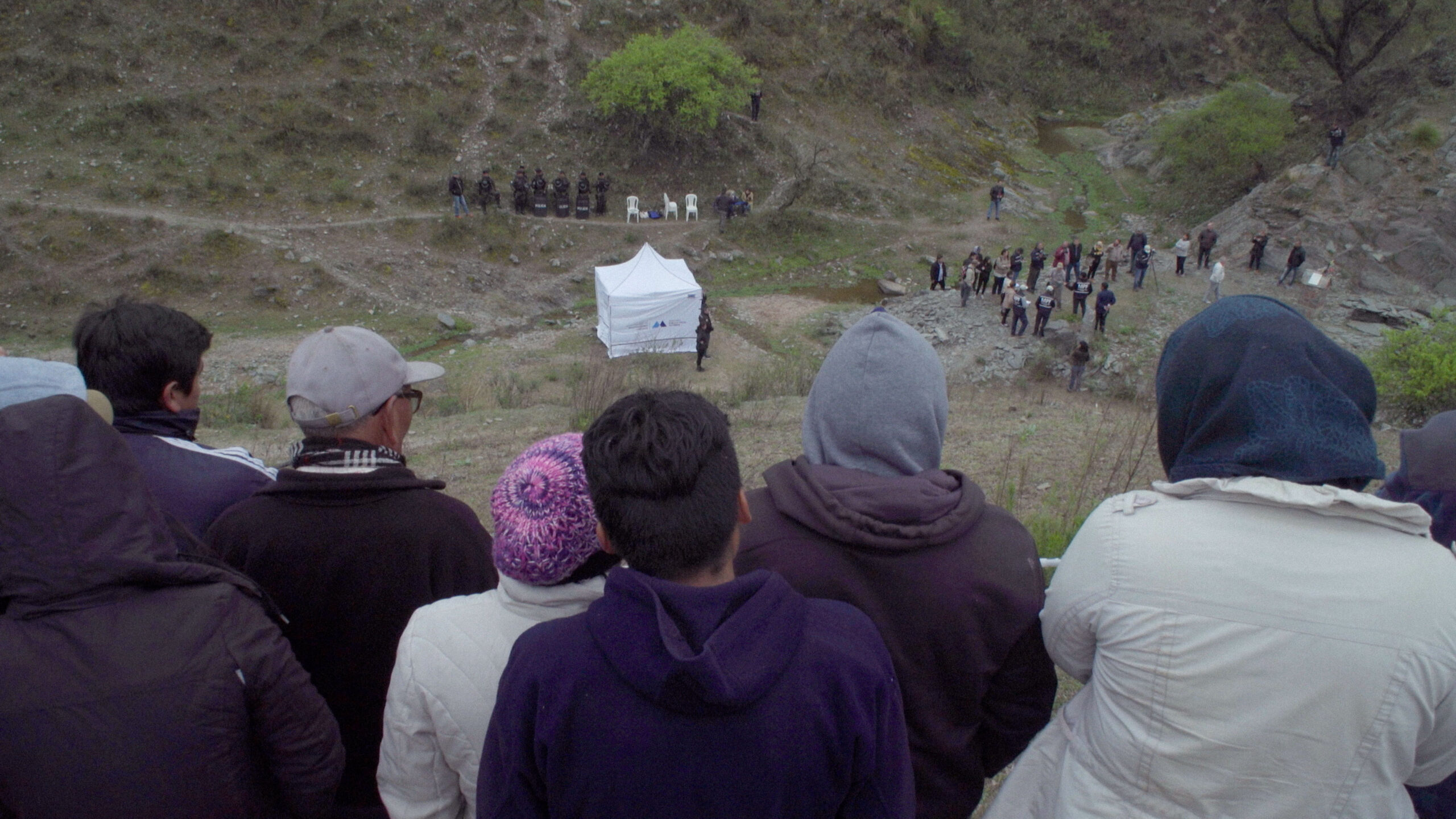
I think it’s dialectical with many things, including forms of imagery that are not usually considered “cinematographic”, especially the drone footage. At yesterday’s Q&A, you mentioned the shot in which a drone camera that you had bought collapsed after an eagle collided with it, noting that it was a very expensive shot for you.
(laughs) That was the most expensive! In my life!
For a long time, many in cinema were very cautious, if not outright opposed, to the use of drones in their films.
Me too, me too.
Here, you use both found footage from police drones and drone footage you shot yourself, creating a dialectical relationship with images generally used for surveillance and violent purposes. Yet you repurpose the same equipment for something entirely different, with many shots lopsided or upside down. I’m curious how you view this relationship, how cinema can transform a type of image that, at its core, can be extremely violent.
I think one of the challenges for us, contemporaries, is what we do with technology. Because it wasn’t necessarily invented for the well-being of citizens but rather for surveillance, control, or punishment. Our challenge, I believe, is to take this technology which was not created to serve people’s needs, but rather business interests or military purposes, and find ways to turn it around in the community’s favour. Generally, when you make a film about community problems, directors are naturally interested in engaging with people, having conversations, and so on. Yet, on that scale, it’s easy to lose sight of why those people are at risk. It’s because they live in such a beautiful place. And for those with money, it’s insufferable that the people who don’t have money live in a place so beautiful. I also felt I had to transmit this, because it can’t be explained without addressing ideas connected to capitalism and the free market. But it’s also about sheer pettiness: not wanting others to do well, not believing that they can enjoy beauty, not being able to tolerate the idea that you have money and yet they live there while you live in an apartment. And for me, this was conveyed using the drone. On top of everything, what challenges me is that a camera originally designed for war or police work can become a tool that serves the people. It’s as if… I don’t know how you could transform a war tank into something useful for a human being, but maybe there’s a way.

You repeat the footage of Javier Chocobar’s killing several times. It’s gripping material because the image works through absence, the act itself isn’t shown. It’s cinematic in that sense. What is seen is the floor, a pause, an abstraction: the rocks on the ground, and the low resolution of the image gives it an almost impressionistic quality when viewed on the big screen. At the same time, you make your manipulation of the material evident through repetition, zooming in…
Or slowing down.
Yes. It’s also a way of repurposing these kinds of archives. It adds yet another layer to the imagery the film works with. What was it like for you, as a filmmaker, to work with this type of material? I imagine it must also be emotionally very challenging to work with these images.
You see, something that always really bothers me, something I can’t stand in cinema, is forcing the grain or turning images to black and white to achieve some effect. I absolutely detest that. To me, it feels like a form of impotence, a way of trying to make things seem stronger than they are. It’s like saying, “I don’t know what to do with this, so I’ll put it in black and white, or I add grain.” I’ve always avoided that in my own films.
But this time, it happened without my giving it any thought. On the contrary, I had nothing but this [material], which already had a certain definition. I therefore needed to expand it, to slow it down. All these decisions stemmed from the desire to achieve clarity for the spectator, to allow them to share in the problems of these families and, more broadly, of my nation. To me, this seems essential. Because I have never worried about style, not even in my fiction films. Style, to me, seems something stupid, something noticed mainly by those who know little about cinema. Style is not something one imposes on the world. It emerges only when one observes the world and, starting from the world itself, imagines an audiovisual order through which its story can be told. Style then appears, not as an intention, but as a consequence, as an effect.
I can’t recognise what “my style” is. When I see a film, I can’t say, “Oh, it has my style,” because I simply don’t perceive things that way. What happens instead is that I become immersed in a matter and begin to understand how it must be shown in order to be shared with others. This comes from a desire, from a will for people to see the injustice at work in this trial, or the terrible violence contained in that video, one that we all saw in Argentina, or almost all of us, and then we all forgot about it.
And then there’s something crucial. The people represented in these images are not actors who are paid, who finish shooting a film and go back home to lives untouched by what they have performed. No, some of those people will never be able to get up again, because they’ve died. They will never be removed from those problems. Their images therefore carry a different meaning. It’s no longer a question of representation or the emotion it produces. The image is subsumed by life itself.
The scene where the community watches the footage while crying is very powerful. I assume they’ve seen it many times before, right? Yet it remains very raw, because they’re watching a loved one die: their uncle, their husband, their brother.
Exactly. The first time I went there, there was a tiny part in the film that clearly came from long ago, when you could tell everyone was younger. I had the video with me on my computer, and many people in the community had never seen it, even though two years has already passed. They had never seen those images. Some hadn’t watched them because they were family members and didn’t want to, and others simply didn’t have access. The footage was on the internet, and they had no way to view it. For me, that was like a sign, a tremendous alarm about that material itself.
Then came certain decisions. For example: neither the photos nor the footage were altered, I kept them in their original formats. I didn’t want anything in the film to hide the fact that the images were manipulated. I did reframe the video and the photos, because one has to show the limits – their emotional, intellectual, and ideological limits.
If I had filmed the archival material as if it were untouched, something which I had considered, it would have been like telling the spectator: “This is the pure truth.” And it isn’t that. That’s why I framed all the archival elements in a way that they would occupy the entire screen: to make it clear the footage had become part of the film but also remained something else. There are kinds of things that I don’t know if every spectator will notice, but the people in the film will.

I want to connect this to what you said earlier about not having a style that you cultivate. At the same time, your thoughts underpin a film that is highly conscious of who is telling the story, who holds the camera, and to what end. I’m thinking not only about the state footage but also of how you counterbalance it with images from within the Chuschagasta community, which form the basis for a large part of Nuestra Tierra. Some function as photo-souvenirs, like the images sent back home by those who moved to Buenos Aires, or the ones that were later coloured. And they’re all kept by an elderly woman who seems to act as their guardian, preserving these photos and videos. I was curious about how you worked with her and the material.
It took ten years for that woman to trust me enough to show me those photos. Ten years. What kind of film, what kind of commercial or industrial cinema, allows you to wait ten years? Or even gives you the possibility of having ten years at your disposal before someone decides to confide in you? That simply doesn’t exist. This is why it’s often so difficult to reconcile cinema with industrial methods of production. Sometimes it’s possible, sometimes it isn’t. I was able to wait, perhaps, because I could also live from teaching classes, from earning money elsewhere, or by making a fiction film. Someone who only makes documentaries might not be able to wait ten years. What would they live on? So it was a privilege that I had the power to wait. I didn’t know she had that box of photos. But I knew that things were missing. I sensed that, as time passed, more things would surface. And exactly ten years after I met her, she told me she had some photos. And then they appeared.
This connects directly to your question. All of those photos… whoever took them had an idea of what they were doing. Take, for example, the traveling photographer: he takes a photo of a family, the family enjoys it, and the photographer hopes to return and have a place to stay. The photo is a transaction. This isn’t an anthropologist studying Indigenous people, nor a left-wing militant; it’s a traveling photographer trying to make a living.
That photo carries also all of that history within it. And at the same time, it carries another truth: that no one else was taking photographs there. So everything becomes complex, like what we were saying about Ben-Hur. The ways in which humanity represents itself are so complex. If we’re strict, if we say that only one kind of cinema should exist… What we resist, as a species, is the imposition of a single narrative form. Especially the kind associated with commercial movies. A lot of what is happening to us today, this fear that we have, this terror about the future, has something to do with that. When we let one way of seeing the world become dominant…, that’s dangerous.
Absolutely. Thinking about the film’s structure, I was fascinated by your very particular choice to begin with these outer-space images. It made me think of Andrei Ujică’s Out of the Present (1995).
I’m going to tell you something. I’m sure you’ve seen a lot more cinema than I have.
No, that’s impossible.
No, absolutely possible. Because I’ve never been a cinephile. I found in cinema a way to share with my contemporaries, but I’ve never had a crazy passion for cinema. If I could have chosen another career, or another way of life, I would have.
You framed the film around the trial of Chocobar’s murderers, particularly through their testimonies. How did you decide to bookend the film with these two specific elements: the images from outer space on the one hand, and these courtroom testimonies on the other? The “heart” of the film is the Chuchagasta community, yet you open with two things that most filmmakers wouldn’t intuitively choose as a starting point.
You know, in January 2025, I was listening to the Misa Criolla. For a long time, I thought that the film needed to contain a vision of the earth seen from outside. Initially, I didn’t know that I would place it at the beginning. When I started thinking about that image, it became clear to me that the sound of that scene had to be closely connected to that small region in that part of Argentina. It was like seeing the place from very far away, from outside the planet, and yet already being deeply tied to that specific territory.
Earlier, you mentioned that the typical, industrialized mode of cinema wouldn’t allow you to spend ten years to gain the confidence of communities like the Chuschagasta. Of course, that means that their stories rarely get told, and if they are told, it’s without their input, in an extractivist manner. It appears the industry itself constantly pushes you away from pursuing these kinds of topics. How do you see these kinds of pressures that filmmakers face, especially if they are women, and if they have a strong political voice like yours?
Look, one thing is the industry of cinema and the financing of films. Another thing is your life, which is short, and the meaning of your life. My work gives sense to my life, so I can’t submit myself to the industry. I have a life, and that life has a limited amount of time. I can’t capitulate to the industry. There’s a limit. I can get angry, of course, but at some point, I have to say: no, I’ll break from all of that, because it’s my life, and the meaning of my work matters.
So no, you can’t spend all your time crying because they won’t give you money, or because you can’t get funding. There will come a day when you realise that time has passed and you didn’t do what you wanted to do. What matters is figuring out how to acquire the resources to do what you want to do. Because what’s truly at stake is time, and one’s time is short. You can’t let yourself be subjected to the industry. That’s insanity. Servility. It’s crazy.
Especially in documentary, where the people you work with may pass away.
Or in fiction, it’s the same. We can’t afford to wait. I don’t belong to the industry. I belong to the human species, which has a life span of a few years on this planet. And in that short time, I want to do what makes sense to me. Sometimes that aligns with the industry, sometimes it doesn’t. But what I can’t do is submit myself to it.

Images from Nuestra Tierra [Landmarks] (Lucrecia Martel, 2025)

