

“Time was the most important material”
A Conversation with Pablo Guarise and Guillaume Maupin
On April 10, 2026, the Maysles Documentary Center in Harlem presented the New York City premiere of The Magic City: Birmingham According to Sun Ra (2025), the first feature co-directed by French-born, Brussels based filmmakers Guillaume Maupin and Pablo Guarise. The film, the latest and easily the most inventive portrait of the jazz pianist/composer/bandleader/cult-icon Sun Ra, focuses on his first three decades in the segregated southern city of Birmingham, Alabama. The pair shot in Birmingham with Birmingham locals, including members of Ra’s family. The screening was followed by a discussion with the filmmakers and programmer Andrew Castillo, which centred less on musical lore and more on the practicalities of making a film in such a distinct setting, as well as a communal and care-based documentary practice. The transcript has been edited for length and clarity.
Andrew Castillo: This is a very unlikely film, in a lot of ways. I very much want to know how it even happened. From the beginning, can you talk a little bit about how you came to work with each other, and how you came to the subject of Sun Ra?
Guillaume Maupin: I was born in 1979, Pablo in 1994, so we’re 15 years apart. I’ve been a volunteer curator at Cinema Nova in Brussels for 25 years, ever since I arrived in the city. I come from a little village near the Atlantic Ocean in France. My friend Kévin Gourvellac, who travelled from Montreal to see the film tonight, comes from the same place. Fifteen years ago, Kévin and I made a film with three other friends, Water Music (2014), with almost no money. We each put in €1,000 euros, and someone gave us an old Renault Espace. We scratched off the “E” so that it read “space,” and we wrote “is the place” underneath. We drove across Europe, from the Atlantic coast of France to the Black Sea in Romania. The film is about swimming, rock ’n roll and folklore. We formed a band, singing folk songs alongside the capitalist folk songs that we all have to swallow, and that we still love: The Beatles, but also Harry Belafonte and Captain Beefheart. We ended up at the Romanian Black Sea shore, where there were a few beach resorts named Neptune, Saturn and Jupiter. So, we stopped in front of Saturn, in our Space car, and we declared that we travelled the space ways.
So, I worked at the cinema, and Pablo was part of the cine-club at the film school where he studied. I always thought, “Oh, those bougie film school kids, they should come to our cinema and see the real deal.” Then one day, they contacted us because they wanted to invite a famous French director, but they couldn’t do it without us. He wouldn’t come just to visit the school. My volunteer colleague said, “So, now you have to work with them.” [Laughter] That’s how we met. The director was very strange, so spending three days with him was like becoming war buddies.
Then Pablo finished school. It was summer, we met for a drink, and he said, “I watched your film. It was really good! Why haven’t you made another one?” I said, “Well, my real job is being a musician, and curating is already a lot of work.” He asked, “If you did another film, what would it be about?” I said, “Sun Ra.” He said, “Who’s Sun Ra?” I replied, “Do you have a minute?” [Laughter] He’ll tell you more, but my first idea was to make a short film about Sun Ra playing on Saturday Night Live. I imagined the day he had: it starts on Saturn, the phone rings, he answers, “Saturn-day Night Live? Of course I will come and play.”
Pablo Guarise: As Guillaume said, I was born in ’94 in the suburbs of Paris. In France, the suburbs are different from those in the US. They can look like places without history, where nothing ever happened and nobody cares. I used to think that too. Later, I started walking around and discovering the history of the area, and realized that a lot had happened there. Since then, I’ve been more sensitive to places that seem like nothing ever happened, but where, if you look closer, you can find history and magic. I left France for Belgium to study cinema and became interested in documentary. The school had a strong documentary tradition, partly because Belgium has a long history of documentary filmmaking and it was easier to make documentaries than fiction films. My thesis film was about a man who disappeared in the south of Belgium. We pretended to be a crew going to the town where he vanished, trying to piece together his life and understand why he disappeared.
When Guillaume and I started collaborating, we began making a short film about Sun Ra playing on Saturday Night Live. We worked on it for about a year and a half. I didn’t know Sun Ra at all; Guillaume introduced me to his music and his history. It became more and more fascinating, and we realized that a short film wasn’t enough. So we decided to make a feature. We thought Birmingham was the right starting point. Sun Ra tried to be discreet about his earthly origins, and we thought this could be interesting as a gateway for those who don’t know him.
Maupin: I already wanted to make a portrait of a city. I had thought about doing it in Wilkes-Barre, Pennsylvania, where I once went on a road trip. It’s the hometown of Herman Mankiewicz, one of my favourite screenwriters. Later, I read a book I wanted to adapt as a series, which I never did, set in Virginia, and thought it would be interesting to make a portrait of a southern US city. So when we decided to make this film, Birmingham felt perfect. When I read John Szwed’s book, Space is the Place: The Lives and Times of Sun Ra [1997], that was the part I was most curious about: What is Birmingham? I had only ever heard of it in connection with 1963 [the movement to end legalized segregation, led by Dr. Martin Luther King Jr.].
In the late ’90s, there were only a few Sun Ra CDs available, and if you didn’t have the vinyl, it was very hard to really know his music. Now more people know him. It’s good that several films about Sun Ra right are coming out now, because then we can start to disagree. [Laughter] Back then, if you said you loved Sun Ra, people would say, “Wow.” Now we can actually start discussing him. Not to determine his size; we White Europeans love doing that. We go to Africa and ask, “How many people live in the village? How many steps do you have to travel to get to the river?” I don’t think we need to determine the size of Sun Ra. We can simply begin to imagine his stature.
I think these films are a sign that we’re entering this new era you mentioned, and what’s interesting is how different they all are. Some of you may have seen Sun Ra: Do the Impossible [2025, Christine Turner], which recently aired on PBS. Drew DeNicola is currently making another film [SUN RA: Door of the Cosmos, forthcoming]. There’s also Robert Mugge’s great film Sun Ra: A Joyful Noise [1980], made with Sun Ra’s participation, some of which we see in your film. There was one made for British TV, Sun Ra: Brother from Another Planet [Don Letts, 2005], and there’s even the experimental film by Phill Nilblock, The Magic Sun [1966]. I wonder how you feel about each of those different takes. Is Sun Ra such a giant artist that he needs all these films, or does it ultimately come down to the filmmaker’s personal perspective?
Maupin: A few things. First, I feel that jazz and cinema never really met properly. There are a few good jazz documentaries, and of course, if you can film people playing, you can make something great. But when you make a film about someone who is no longer there, I hardly know any good films about jazz. It’s very rare. Jazz is simply not very well represented in cinema.
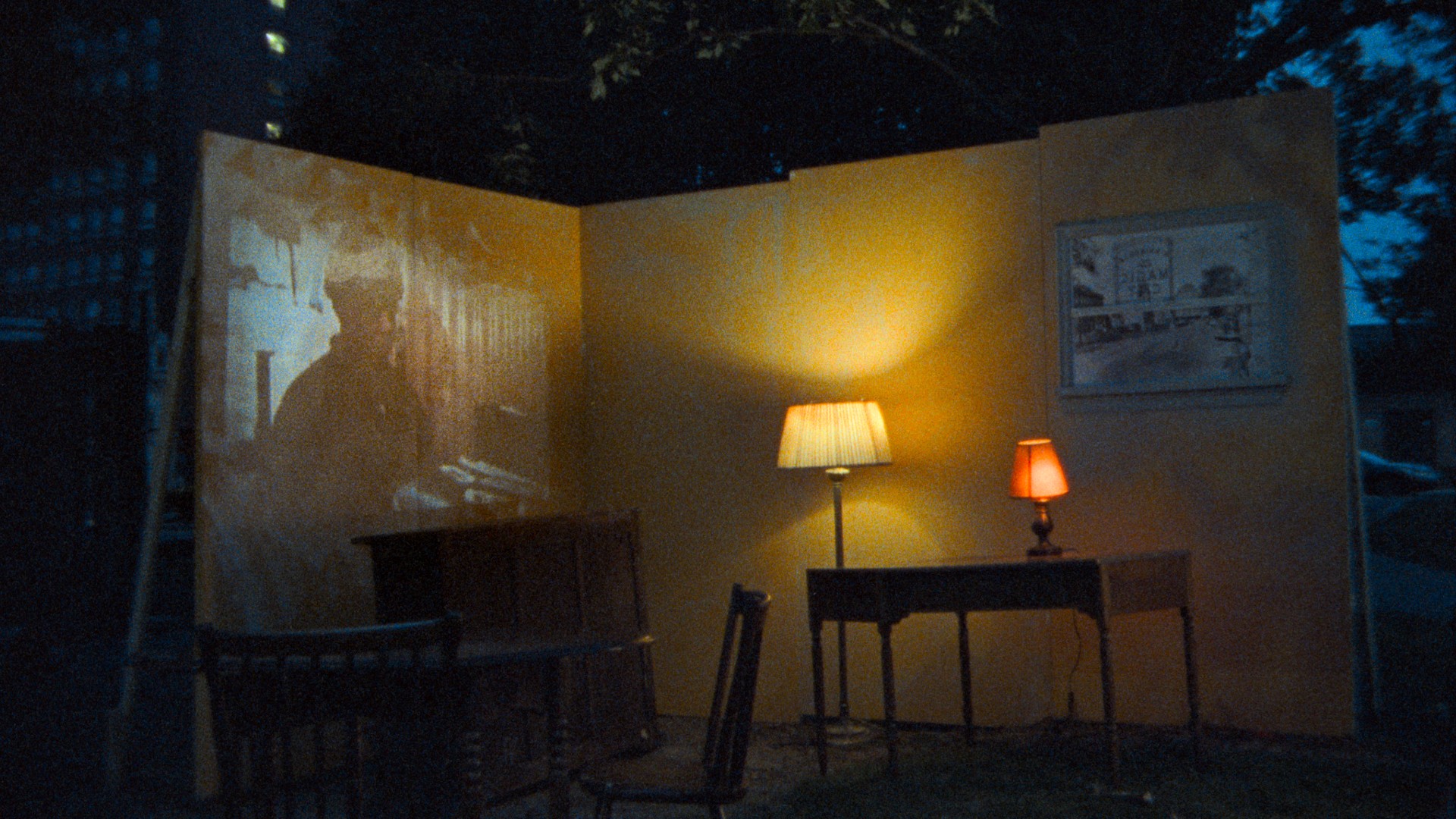
Guarise: Music documentaries often rely on archival footage and talking heads. We wanted to find a different form and get away from that tendency. The film is shot on 16mm, and because film is expensive, we couldn’t shoot much, so we had to write everything very precisely. That led to a long writing process. We wanted the audience to feel like they were traveling through Birmingham, not just seeing and understanding what happened there, but actually feeling the place as it is today, with all the layers of time you encounter when researching a story.
Maupin: In jazz films, it’s often just old nerds talking about jazz. [Laughter] We wanted to have children in the film, teenagers, old people, artists, a whole community. The older white guy playing the mean, racist judge in the film is actually a great, playful hippie artist. He made all the Sun Ra artwork in that scene and immediately said, “Yeah, I’ll do it.” People there really wanted to celebrate Sun Ra, and we thought it was important to do that together with the community. The children playing the Knights of Pythias, the high-school teenagers, the young girl playing Sun Ra’s sister; we were happy to work with people of different races, genders and all ages. And that wasn’t easy, because we were two weird white guys from Europe. [Laughter] With a 16mm camera, trying to make a documentary in a country where documentary isn’t in a great state, partly because of funding…
And the homogenization of documentary. It’s popular, but mostly in this Netflix, cookie-cutter documentary way.
Maupin: The platforms are really trying to redefine the genre. They’re happy to have one film about Miles Davis, one about Zappa. They just want the content. It’s as if people are too lazy to read the Wikipedia page, so they watch a documentary instead. Doing that with Sun Ra would be really sad.
It struck me that you were outsiders in several ways, not just two Europeans in the Deep South with a 16mm camera, but also because you don’t have the credentials of jazz experts. In America especially, the jazz expert is often an academic with a certain status and permission to speak. It can feel almost like a mafia, far removed from the communities that jazz came from. Did you ever experience resistance because you weren’t part of that world?
Maupin: We toured with Elijah Davis, who is the tour guide in the film. Before taking us around, he pulled me aside and asked, “What can you tell me about jazz?” So I started talking, and after five minutes, he said, “Okay, okay!” [Laughter]. But I liked that. I think it’s better when people ask you directly than when they make assumptions. Still, it was hard. It took us two and a half years to be able to enter the high school.
Guarise: We first arrived in Birmingham in December 2021, and we first screened the film there in October 2025, so it took almost four years to complete, of which we spent eight months in Birmingham. People told us, “Wow, that’s a long time,” but it was necessary. We wanted to get to know the place and the people, and not only the things we were filming. We went to churches, clubs, jam sessions…
Maupin: Many clubs! [Laughter]
Guarise: We entered every door we could, because we wanted not only to understand the subject, but to get to know the place. People in Birmingham were a little bit amazed that we stayed so long and went everywhere. After our screening in Birmingham last week, a woman told us, “Your curiosity has been very important to us, because now it’s making us confident.” Time was the most important material. That’s how we gained confidence with the people.
It took us a long time to get into the high school because the principal was never into it. Through a history teacher who also worked at the Birmingham Civil Rights Institute, we finally got access. He asked one of his students to give a presentation about Sun Ra in class, which we recreated in the film.
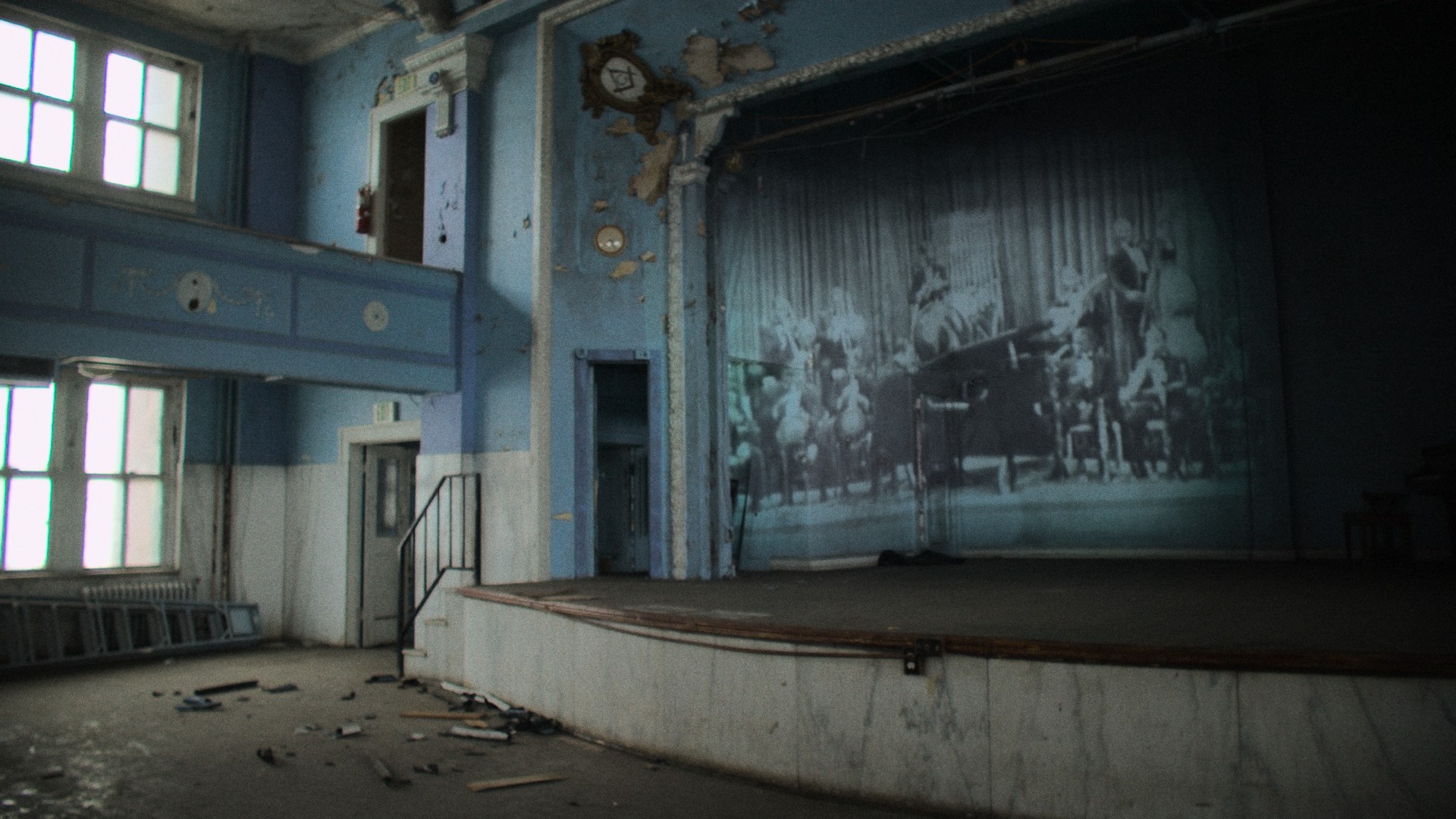
We tried to hide a lot of historical facts for people from Birmingham, tiny things from local history which people from Birmingham could recognize. For instance, there’s an Alexander Shunnarah billboard on 4th Avenue. He’s a local attorney with hundreds of billboards around the city. If you’re from Birmingham, you immediately recognize him. Also, when Justice Jackson is talking, there is a man walking with a big sign until his arm. He’s called Joe Minter; he’s a very important local artist. Someone from Birmingham will know precisely who that is.
How did you collaborate? How did you divide the work?
Maupin: We can’t really separate it like that. We wrote the film together, which was very important.
Often it was the three of us, with our camera operator who worked alone with the 16mm camera, sitting in an apartment, each with a US phone, calling people and trying to make things happen.
Guarise: Because we shot on 16mm, everything had to be written very precise. Every transition and every line was written months before shooting. Nothing was decided on set. It saved time: when you’re two people, it’s better to discuss decisions beforehand than have someone waiting for you on set.
Maupin: And in the south, people have their own priorities. You might think you have a whole day, and someone says, “You have one hour.” Or, “Okay, my daughter will be in your scene, but then she has to go to church.” At the high school, we arrived thinking we had all day to shoot and were told we had an hour and a half. [Laughter]
Everything in the high school was shot in an hour and a half?
Guarise: We had to come back. It was impossible to shoot the scene in that time.
Maupin: We even started going to the school’s softball, football, basketball and volleyball games. The principal couldn’t tell us to leave, we had paid for a ticket. So people were seeing these two weird white dudes, asking, “Do you have a kid in the school?” “No.” [Laughter] We had to go through many awkward moments. But after a while, everyone just thought we were goofy, and we were accepted.
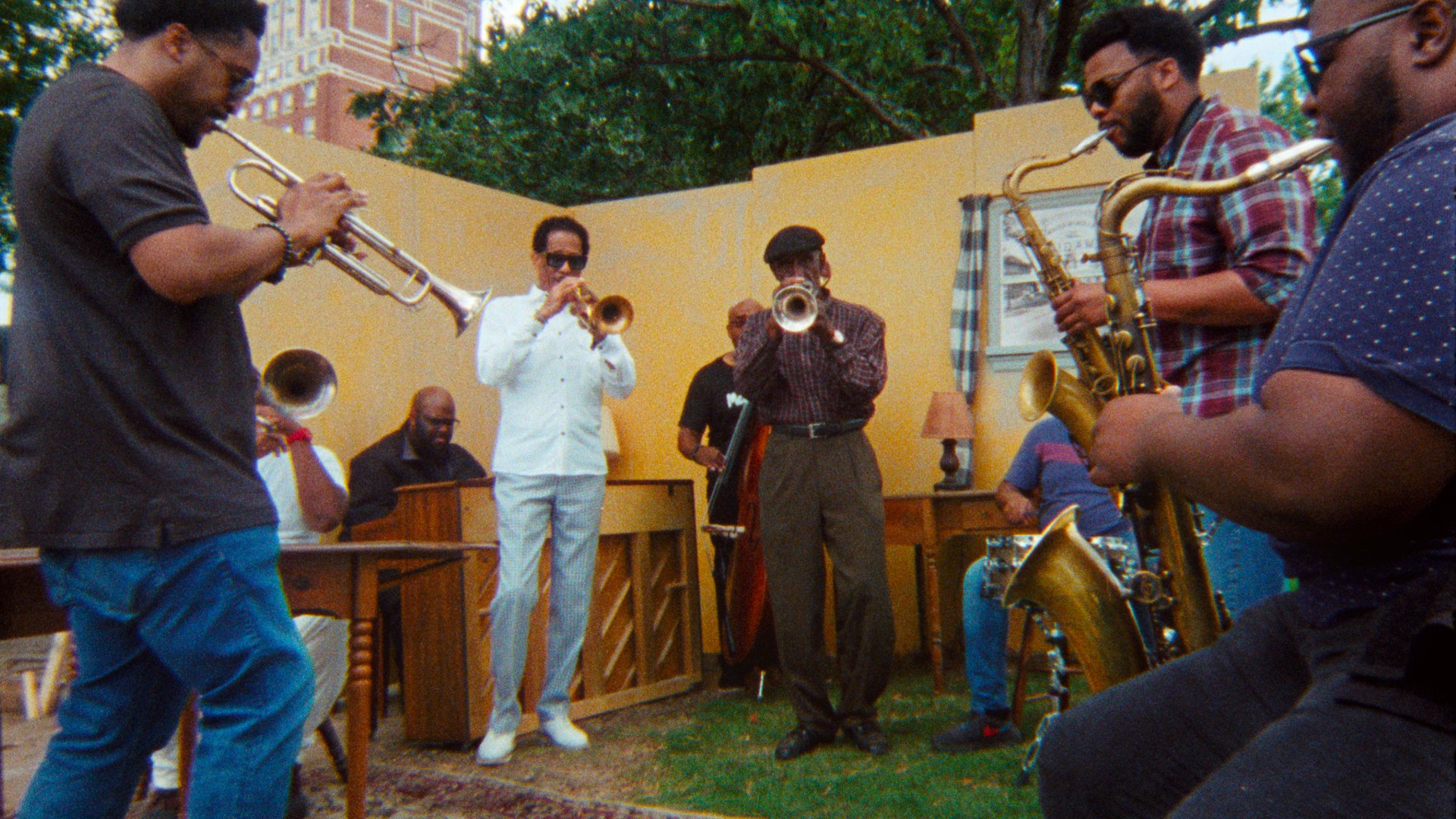
Guarise: There’s a scene where musicians come into the house, playing music. In Birmingham, there was a jam session taking place every Tuesday, led by trumpet player José Carr. We went 13 times, to listen, but also to get to know the people.
Maupin: And to tip them really well. [Laughter]
Guarise: It took time to create confidence. At first, people were a little bit aloof, but then they see you every week.
Maupin: But you were never sure the day before if they would actually show up. They don’t say, “I’ll come.” They say, “Well, we’ll see about that.” [Laughter]
But in the end, they all turned out.
Maupin: Of course.
The film premiered in the United States at the Big Ears Festival in Knoxville, then screened in Birmingham a few days after that, in an outdoor screening which kind of mirrors the finale of the film. Then two days ago, it showed in Philadelphia with [alto saxophonist and Arkestra leader] Marshall Allen, and presumably other people who are associated with the Arkestra and the Sun Ra house. Can you tell us the process of working your way back towards the Atlantic, and how the film’s been received?
Maupin: Actually, the first screening was in Birmingham last August, at the great Sidewalk Film Festival. We wanted the Birmingham audience to see it first. I wasn’t confident showing the film elsewhere without the approval of the people who had trusted us for so long. So we screened it as a work-in-progress, under the title “Sun Ra Documentary.” We came a week early to tell everyone, and they all showed up. It was very beautiful and emotional. People told us, “We feel seen, we feel understood.” After that, we could relax and let the film begin its journey.
We then screened it at Film Fest Gent, the biggest festival in Belgium, then in Brussels. The international premiere was the Thessaloniki Film Festival. If you remember the start of the film’s third chapter in black and white, we see the windows of Birmingham and we hear Greek music. The voiceover says that Sun Ra lived among Greeks, Jews and Italians, so we chose this Greek song. I love this traditional music, so I knew before making this film that this song would be in it, no matter what it was about. The people in Greece freaked out!
In a good way?
Maupin: They were very happy! They said, “So we Greeks had an influence on Sun Ra?” [Laughter]
What can you tell us about the wonderful narrator, Wilhelmina Thomas?
Guarise: Wilhelmina is an oral historian of the city. We met her on our first trip to Birmingham; she was giving tours of the cemeteries. She took us to a large, unmarked space, an African American burial ground, which was very striking, and told us stories about Birmingham that aren’t told in the history books. We immediately felt she was the right person. We wanted to be accurate, and we knew that she would never let us say something dumb. [Laughter] So it was also a security. She knows the place and its history, and she’s a wonderful storyteller.
Maupin: And she loves Sun Ra. At first, we were a bit disappointed that most people who knew Sun Ra seemed to be young white hipsters. Wilhelmina was one of the first Black Americans who told us, “Oh yeah, when I studied in the ’70s I heard Sun Ra, I really liked it. I know he’s from Birmingham, so I’ve studied him for my tours.” She also knows a lot about Angela Davis and was a little girl in 1963, so we could talk with her about all these aspects. It’s also very nice to hang out with Wilhelmina. She connected all these different layers of the story.
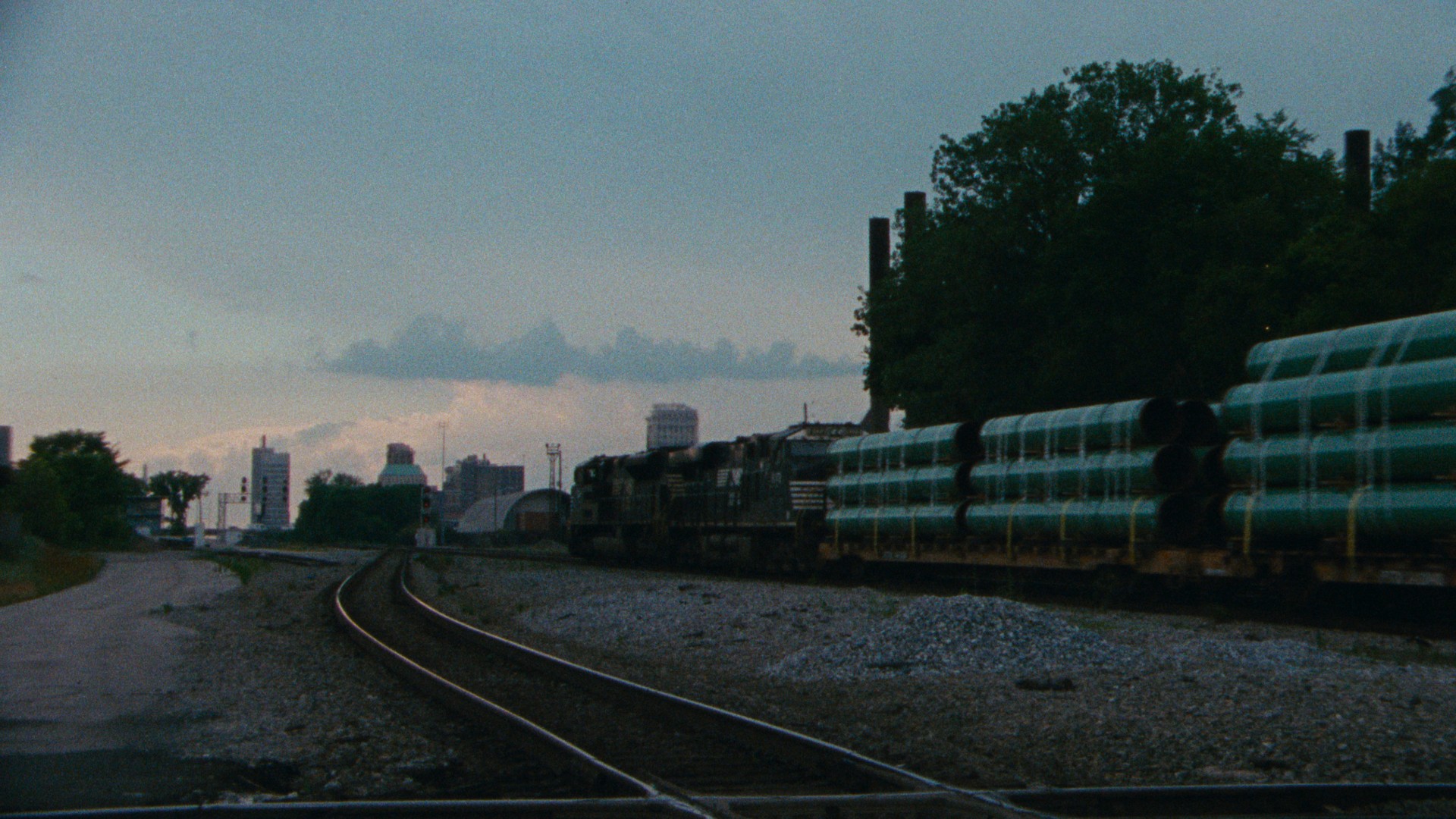
Guarise: She brought us very important information to help us understand Sun Ra. For instance, she told us that he lived near a train station, so he must have heard the rumbling of the trains all the time. It must’ve been a sound that he heard every day, and maybe it is part of his musical landscape, part of his daily life here in Birmingham. And she has a great voice. We didn’t want the voiceover simply to provide information; we wanted it to become a character in the film.
Images from The Magic City: Birmingham According to Sun Ra (Pablo Guarise & Guillaume Maupin, 2025)

