

The World Begins Its Turn
On Souleymane Cissé’s Yeelen
“There are contents that often force us to select forms that are appropriate. It is only after those forms are selected that a film takes on a life of its own, and begins to obey what one has set out to do. For me, film form comes out of this context.”1
Souleymane Cissé
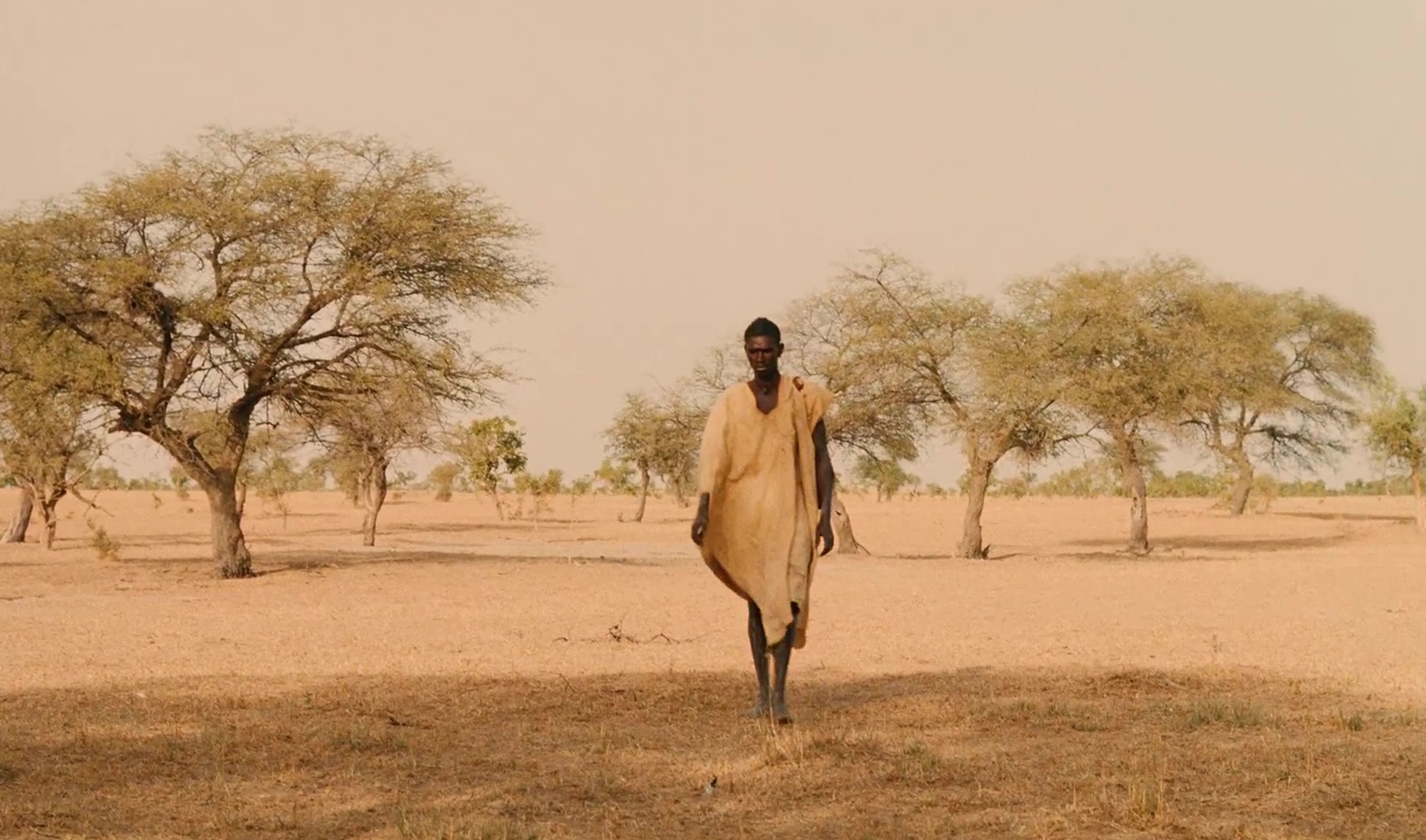
The red-hot sun, enormous, rising on the distant horizon. A stillness before everything else. Yeelen – brightness, light – opens not with a character or a crisis but with the world itself. This is the first and most decisive of Souleymane Cissé’s refusals: to begin where narrative cinema usually insists one must. Instead, we are made to wait, to look, to be reminded that the cosmos predates the story, and that the story – any story – simply emerges from it.
Set in the thirteenth-century Mali Empire, Yeelen follows Nianankoro, a young Bambara man who possesses formidable magical powers and is hunted by his own father, Soma, a corrupt sorcerer of the secretive Komo community who fears his son’s eventual surpassing of him. Urged by his mother, Nianankoro journeys across the West African landscape in search of his uncle, travelling across great distances and moments in time before finally confronting his father.
On the surface, the premise recalls Greek tragedy, with its conflicts between fathers and sons and its anxieties about succession. Cissé, who trained at the VGIK in Moscow and was as familiar with Eisenstein as with Mande oral tradition, was surely aware of these resonances. Yet to read Yeelen primarily through that lens is to reproduce precisely the kind of perception that Cissé opposed. As he told Cahiers du cinéma, he was making the film in response to “an external perception, a perception by white technicians and academics, an alien perception”. The Oedipal frame is one the film briefly invites, and then quietly leaves behind.
What Yeelen insists on is a different understanding of reality altogether. Power in Yeelen is not simply a matter of psychology or personal ambition. It is bound up with nyama, the Bambara concept of a spiritual life force that animates all matter, and whose mastery confers both creative and destructive potential. The Komo custodians, led by Soma, have turned this mystical knowledge into a means of perpetuating their own power. Nianankoro’s journey is then not merely a revolt against his father. It is also a struggle over who will inherit knowledge, and what that knowledge will be used for.
The film’s form follows the same logic. Drawing on the storytelling traditions associated with the West-African griot, Cissé builds Yeelen around an oral-epic rhythm, favouring short, discrete vignettes over extended narrative development. Nianankoro’s quest itself unspools through a series of detours and digressions, with each episode opening onto a different place, set of characters or strand of the story, and each returning in unexpected ways to the larger narrative. His journey takes him to the Fulani kingdom, where he is mistaken for a thief, captured and sentenced to death. Using his supernatural powers, he overcomes the warriors and later helps the Fulani king repel an attack by his enemies. He also cures Attou, the king’s wife, of infertility, and travels with her to the Dogon country, where they purify themselves in a sacred spring and find his uncle Djigui, Soma’s twin brother, whose sermon lasts through the night and ends with the arrival of a new dawn.
Other strands of the story run alongside Nianankoro’s: Soma’s relentless chase, his mother’s prayers to the water goddess, Komo rituals and sacrifices, as well as scenes of work, landscape, and everyday life. The film jumps freely across space and time, disrupting linear development and evoking a constantly shifting legend. At one point, one of Nianankoro’s uncles unexpectedly takes over from his father in the pursuit. Later, Soma tells the Komo community that Nianankoro, using his magical powers, has made his brother disappear, although the film never shows us how. Like an oral tale, the narrative repeatedly moves beyond the confines of the frame: while some events are shown, others are recounted, anticipated, or simply left unexplained.
Though Yeelen is often framed as a departure from Cissé’s earlier social-realist work, it shares with them the use of elemental imagery. Several of Cissé’s films open on a shot of vast, unpeopled landscape. Finyé opens with a swooping aerial shot over water and primeval forest; Baara with mythic images of men crossing a burning landscape; Waati lingers over the open desert. In each case, the landscape is given time to assert itself before the story begins, as though it were already, in itself, a kind of address.
Yeelen also unfolds through eruptions of fire and water, through gusts of wind and unyielding stone and earth. These elements are not simply part of the setting; they repeatedly interrupt and redirect the story. Much of the film is shot in the early morning, capturing shifting modulations of light as it moves across faces and landscapes. Fire in particular is rendered as a force of immense and volatile power, matched only by the purifying force of water.
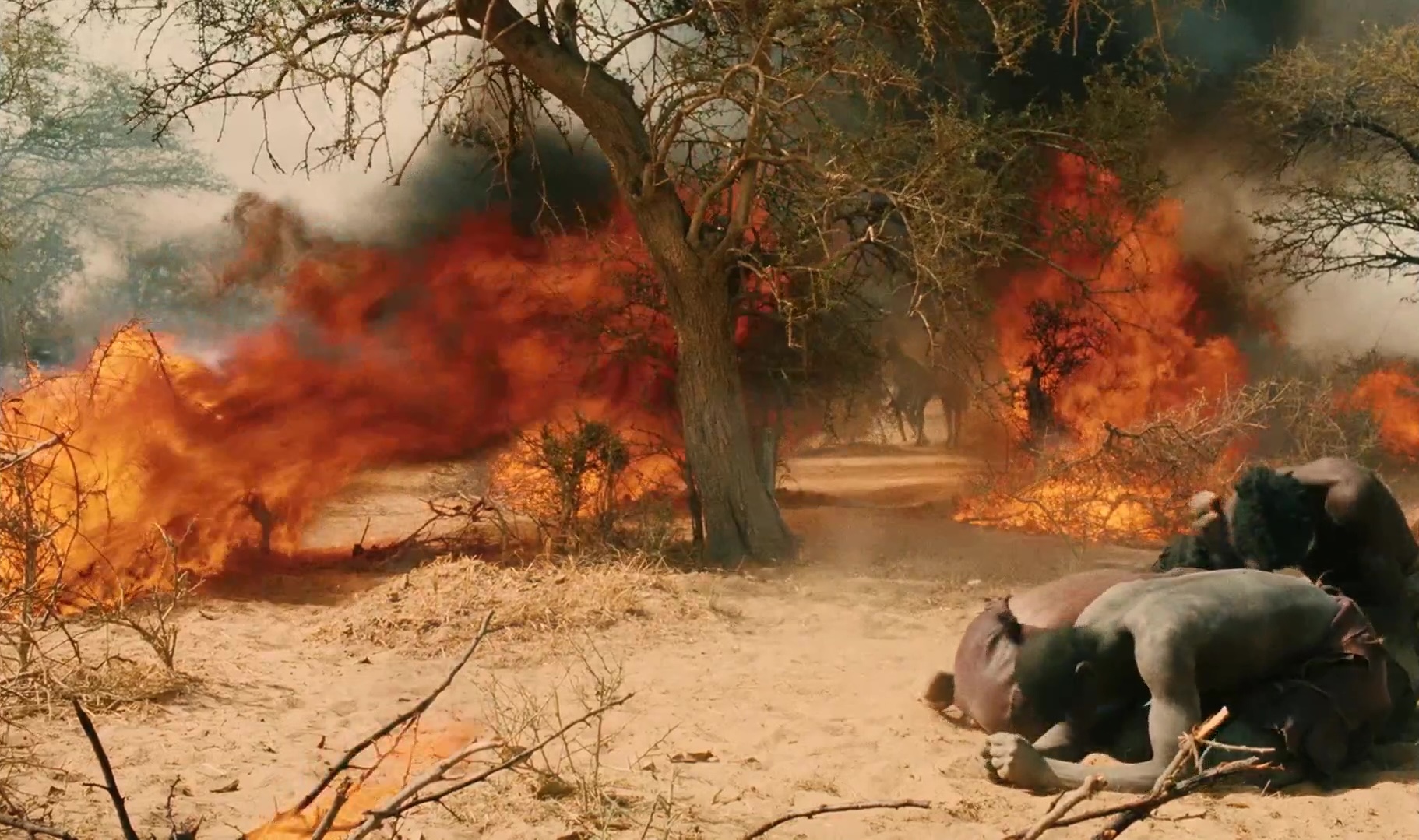
When Soma curses his son, his words thunder through the landscape: he calls on the lakes to dry up, the trees to shed their leaves, and the caves and plains to reveal where Nianankoro is hiding, whether he has gone into the heavens or beneath the earth. Elsewhere, a character describes a cosmology in which ritual gesture and the elements become inseparably connected: the sacred pipe is lit, and the spirit of fire invoked as its smoke rises; when water is needed, the gods of the sky and the earth are called upon, their forces gathering into clouds before falling back to earth as rain.
Cissé’s cinematic choices further this connection, as when a tracking shot suddenly pulls back to reveal a tree whose billowing branches fill the frame. Throughout, Cissé favours this centrifugal movement: lateral pans that zoom outward, trolleys that pull back, widening the image to reveal more of the landscape. Rather than continually narrowing our attention onto the characters, these movements open the frame back onto the world around them. The camera does not merely follow the story; it keeps reminding us of everything that exceeds it.
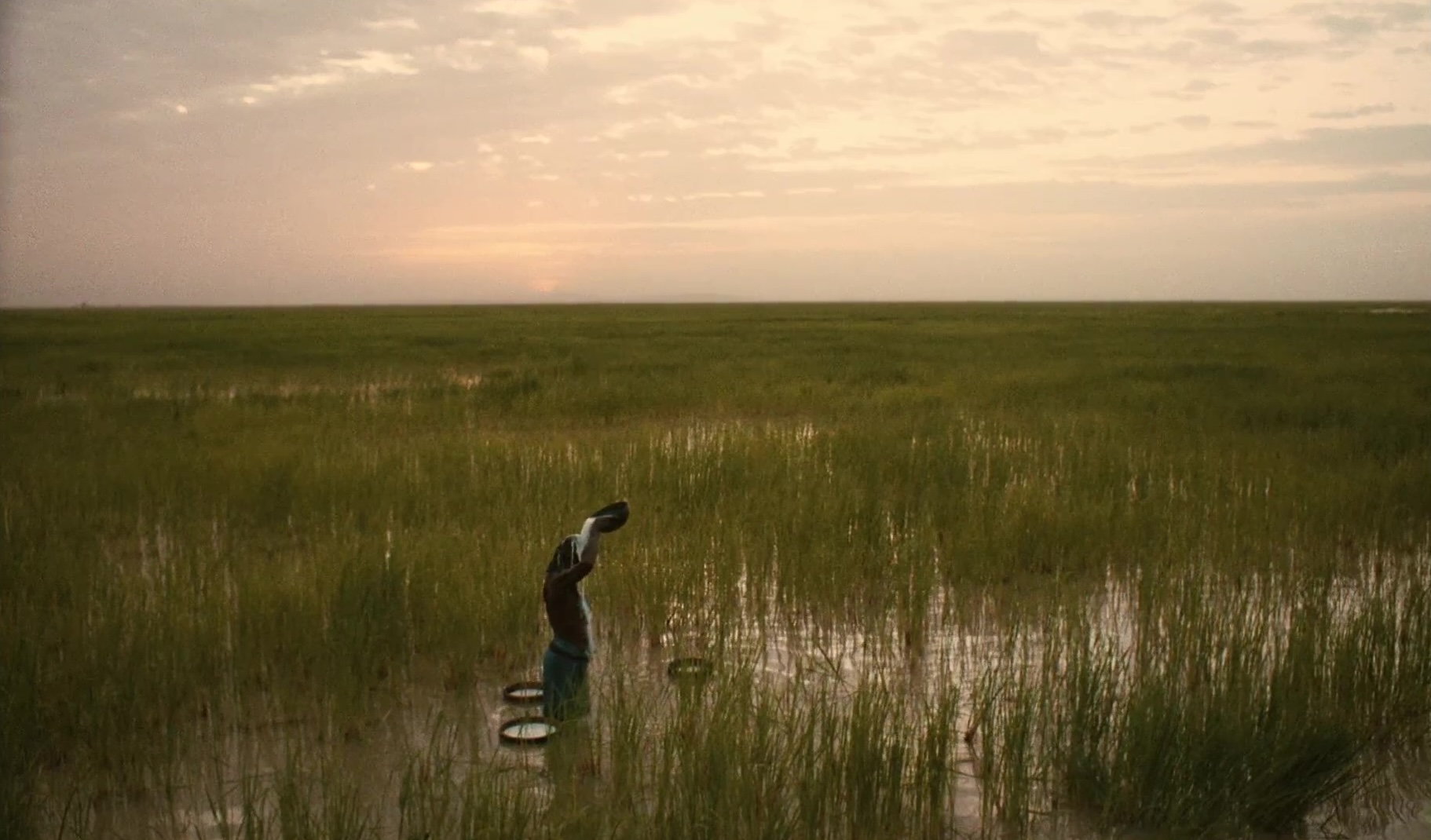
Perhaps the most striking example is the film’s treatment of ritual. Cissé renders rituality vivid not by explaining it, but by allowing it to inhabit the film as part of everyday life. Sequences often thrust the viewer right into the middle of a ritualised action – a chicken being impaled, Nianankoro’s mother pouring bowls of milk over her head – whose significance becomes apparent only much later, if at all. In one of the film’s most memorable sequences, Cissé films a Komo ritual from beginning to end: people gather in a sacred grove, sit, talk, fill jugs, drink, and invoke ancestral spirits. The scene is long and patient, placing on the uninitiated viewer the same trust and demand as the oral tradition: what matters is not that we understand every gesture or know the meaning of every ritual act, but that we are given the time to observe them, and to enter, however briefly, into the world they inhabit.
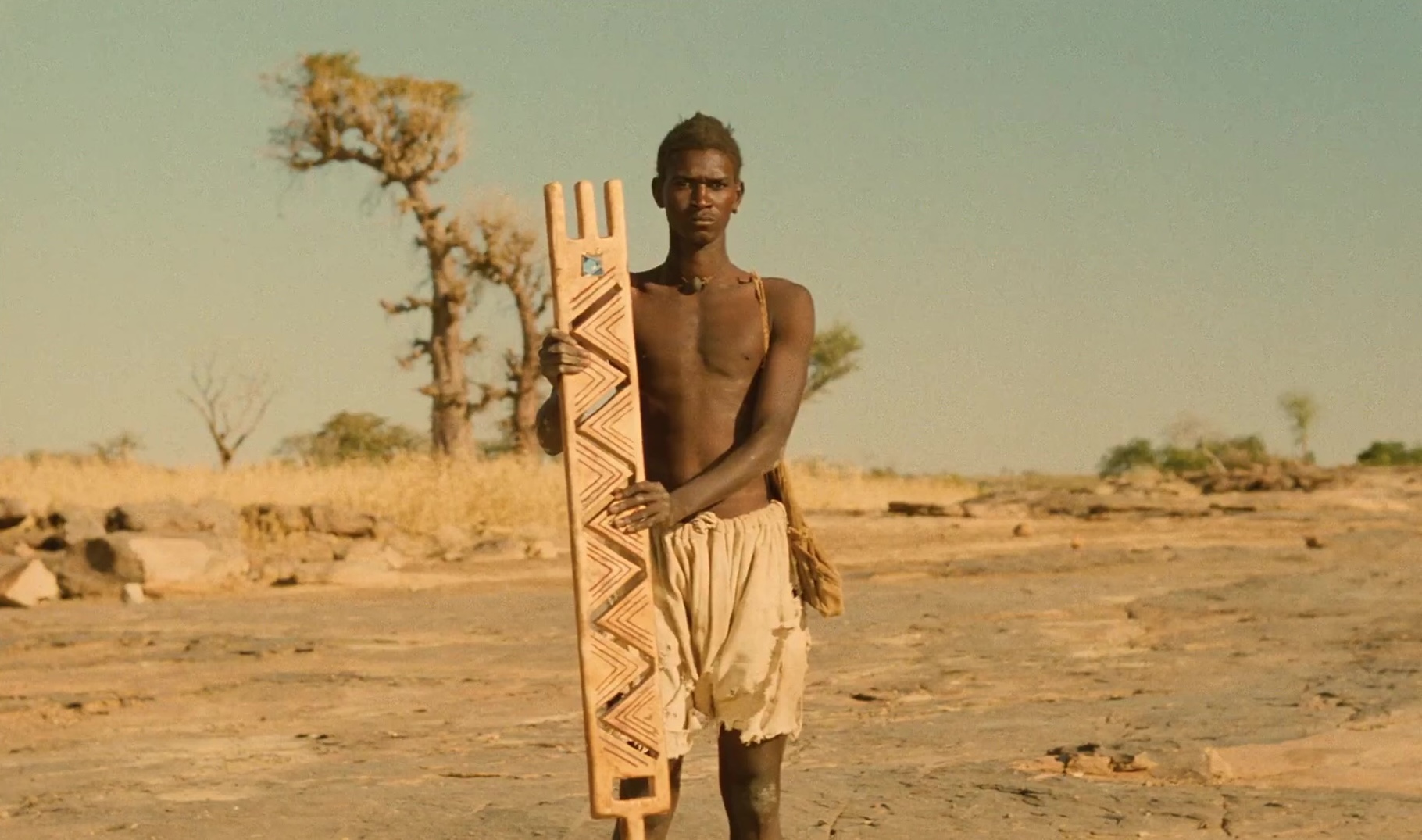
This deliberate opacity is itself a political act, something Cissé was doubtless aware of.2 European ethnographic cinema all too often rendered African rituals “legible” by rendering them strange: through the commentary, the explanatory distance, the scientist’s eye that simultaneously admired and othered. Yeelen refuses that distance. The sacred objects – the wooden Komo post, the wing of Kore – are presented not as curiosities to be explained but as presences to be reckoned with, carrying their own irreducible authority. The film then does not argue for a Bambara cosmology; it simply inhabits it, leaving the viewer to reorient accordingly.
And then the ending. Father and son finally meet. The Kore wing speaks, indicts, and releases a blinding conflagration – yeelen rendered catastrophically literal – that consumes everything. Yet what follows is not simply tragedy. In a continuous tracking shot, Attou and her young son walk through the undulating dunes of a landscape now altered, strangely still. They lift from the desert earth two egg-like objects: the transmuted bodies of Nianankoro and Soma. The Bambara conception of time as circular rather than linear – always returning to that initial brightness which creates the world – finds here its most lucid cinematic expression. Death is not the end of the cycle; it is the cycle. The son carries within him the compressed inheritance of those who were destroyed in the act of handing it to him.
Cissé, who passed away in February last year, once described his imagination as “planetary, cosmic”. Yeelen bears this out and bears him forward. What the film achieves, without fanfare, is to show that a pre-colonial worldview is not a charming relic to be preserved in amber. It is a living world, present in its rituals, relationships, forms of knowledge, and everyday gestures. It does not ask us to admire from a distance, but to enter into its rhythms, to look and listen on its own terms. And in doing so, it reminds us that cinema, when freed from the tyranny of a universal narrative logic, can hold that world with the same plenitude, the same wondrous is-ness, with which the world holds itself.
- 1
Manthia Diawara, “Souleymane Cissé’s Light on Africa.” Black Film Review 4, nr. 4 (1988).
- 2
In the same interview, Cissé refers to Yeelen as his most political film.
Images from Yeelen (Souleymane Cissé, 1987)

