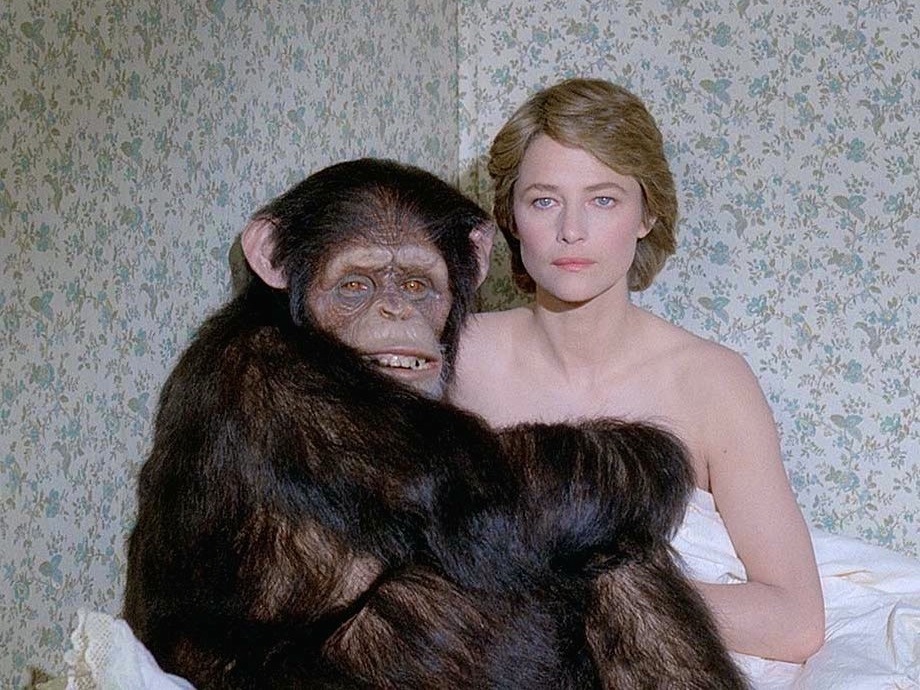
In Max mon amour (1986), Nagisa Ôshima treats madness with absolute seriousness, allowing the absurd to slip quietly into everyday life. What initially appears as a bourgeois provocation, a woman in love with a chimpanzee, gradually reveals itself as a precise experiment in looking, desire, and dignity. Filmmaker Nina de Vroome, drawing on Serge Daney, describes cinema as a “museum of gazes”, and reads Max mon amour as a radical reconfiguration of that gaze, not the human mastery over the animal, but an unsettling coexistence in which difference itself becomes present. Daney: “Not to break continuity, but to allow a rupture to appear within it on the conveyor belt of presence, by internalizing the difference into a presence in itself.”
This fragile balance is sustained by Ôshima’s austere style and his refusal to interpret his own film. In an interview, Charlotte Rampling recalls how he insisted on letting the story unfold “in a very realistic manner, without artifice”, adding that “life is only one take”. Rehearsals were minimal, the camera captures only what is necessary. Rampling’s unwavering seriousness, her ability to evoke love without irony or sensationalism, anchors the film’s ambiguity. As Daney wrote, the spectator must overcome jealousy and accept that this love concerns them, yet remains fundamentally none of their business.
Film Pages