

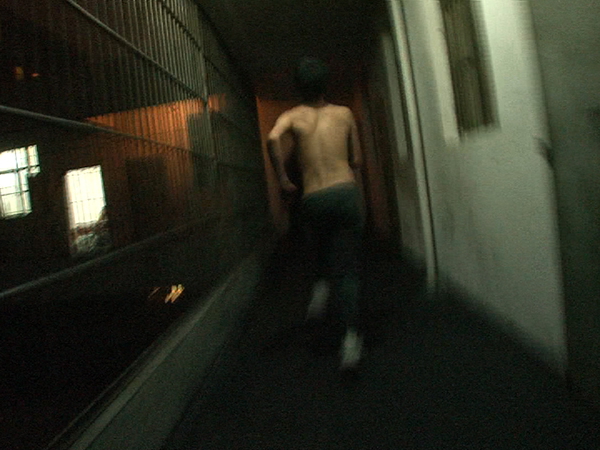
For ’Til Madness Do Us Part, Wang Bing stayed for months in a psychiatric institution in a provincial town in South China and edited about 280 hours of film into this four-hour documentary. In the badly maintained spaces where the men stand, sleep, talk, quarrel, wash or urinate close together, Wang’s camera observes them with absolute respect and endless sympathy.
EN
Emmanuel Burdeau and Eugenio Renzi: What made you film at the mental hospital of ’Til Madness Do Us Part?
Wang Bing: It was autumn 2002, in Beijing, during the editing of West of the Tracks. One afternoon, because I felt very tired, I decided to take a break and go for a walk with friends. During our walk, we visited a mental hospital in the north of Beijing. Its architecture is in 1950s Soviet style. There are a lot of trees. Everything around it is countryside. No one seemed to be there that day. The doors were open. The wind was strong, and the leaves from the trees made their way into the hallways... As if no other human being had ever entered the place.
Wang Bing in conversation with Emmanuel Burdeau and Eugenio Renzi1
“The point is to know how you deal with the characters in front of you, how you deal with their bodies. Where you put your camera, but also how much time you spend with them. And there is a certain madness in Wang Bing’s film about the asylum. It might seem quite unbearable to stay in front of those people for four hours. But what is important is the time taken by Wang Bing. The point is to turn what seems like symptoms of delirium or madness into some form of action. In a way, it’s also about the capacity of the bodies, of the persons themselves. There’s a scene at the beginning with just a form under a sheet. There seems to be some kind of discussion between two persons about whether they just go to bed or they do something else. And it seems that Wang Bing’s decision coincides with the decision of these people, which is to do something rather than simply staying in bed. What Wang Bing does is spend time to transform what can be a manic ritual into some form of action, and to transform their discourse into a history that is told.”
Jacques Rancière2
“Here, where the patients camp, wash themselves, urinate, smoke, cuddle, or insult each other, we spend with them the most of the four hours of ’Til Madness Do Us Part. Despite being only part of the whole, the circular terrace metaphorically represents the whole psychiatric hospital and every mental illness. In one of the most beautiful scenes of the movie, a young patient runs the perimeter one, ten, twenty times, stopping from time to time, forcing himself to continue, as if the circle, instead of bringing him to the same exact spot, could lead him to the exit, once.”
Eugenio Renzi3
“In the course of the film landmark events come and go – the release of a long-term inmate, the fireworks of New Year – and with each of these comes a glimmer of hope for respite, for something to change, but we always return to the same thing, the same pattern, to pacing the halls. At first the film is jarring, raw, frightening; then, desensitized by repetition, the shocking becomes routine, and one squirms at the recurrence of familiar scenes, which seem to add nothing to what we’ve already learned, though of course they do by the mere fact of their repetition; finally, there is a sort of passive acceptance.
When the credits rolled I was actually shaken, for after so much time in the booby hatch you begin to accept this world as the only one, to almost feel that this movie has become your life now, just circling, circling, circling, and that whatever else you had going on before is just a distant afterthought.”
Nick Pinkerton4
- 1
Wang Bing, Alors, la Chine. Entretien avec Emmanuel Burdeau et Eugenio Renzi, 2014. Fragment translated by Sis Matthé and published as “Alors la Chine Wang Bing about Feng ai [’Til Madness Do Us Part]” by Sabzian.
- 2
Stoffel Debuysere, “On the Borders of Fiction. A Conversation with Jacques Rancière,” Sabzian, 2017.
- 3
Eugenio Renzi, “The Denied Identity of the Nameless Voices,” Sabzian, 2013. Translated by Michael Blanga-Gubbay. Originally published as ‘L’identità negate delle voci senza nome’ in Il manifesto, 6 September 2013.
- 4
Nick Pinkerton, “Mad world,” Artforum, 2016.

