

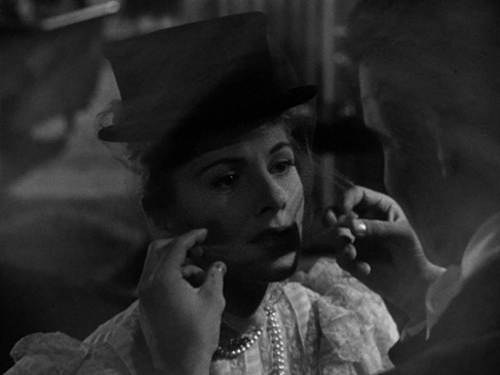
A pianist about to flee from a duel receives a letter from a woman he cannot remember, who may hold the key to his downfall.
EN
“Have you ever shuffled faces like cards, hoping to find one that lies somewhere, just over the edge of your memory? The one you’ve been waiting for? Well tonight when I first saw you, and then later when I watched you in the dark, it was as though I’d found that one face among all the others. Who are you?”
Stefan
“By the time you read this letter I may be dead. If this reaches you, you will know how I became yours when you didn’t even know who I was or even that I existed.”
Lisa
“I think, and this is nearly an axiom with me, that there are as many creators to a film as there are people who work on it. My job as director consists of making, out of this choir of people, a creator of films.”
Max Ophüls1
“Film, of course, unlike opera, is a medium of resurrection, where images can come back to haunt us from a distant past; the melodrama of this film exploits this fully. In many operas’ episodic raising and falling of curtains, the potential for the tragic heroine’s happiness always lurks behind a latent revelation, a pulsating recognition, or simply the elusive, right timing. But in opera, these concerns inhabit a social landscape (as they do in other melodramas). In Max Ophuls’ film, the landscape of turn-of-the-century Vienna is instead transformed into a stage of Lisa’s desire: doorways, stairs, streets and trains are the cinematic vehicles that enact oneiric entrances and departures, moments pregnant with the psychic promise of happiness – in the imagery of the film, happiness is a fairground – that will not be realised, and thus Lisa meets the same fate as her operatic forebears.”
Carla Marcantionio2
- 1Andrew Sarris, Interviews with Film Directors (New York: Discus, 1969), 360.
- 2Carla Marcantionio, “Letter from an Unknown Woman,” Senses of Cinema, May 2006.

