

30 May 2026
7 Walks with Mark Brown (Pierre Créton & Vincent Barré, 2024)
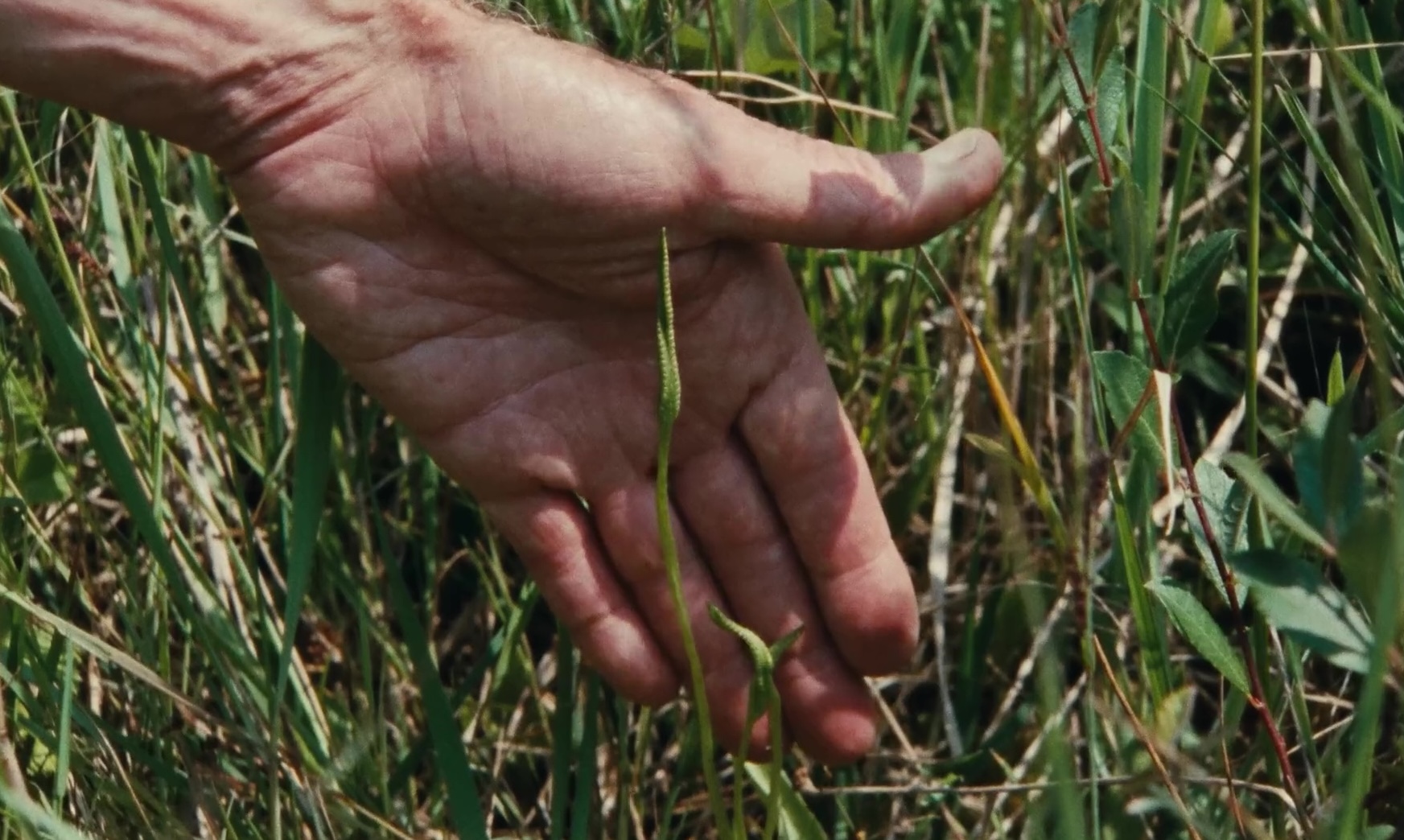
While the city hums and groans under the heat, I look for some relief in the Bozar cinema with 7 Walks with Mark Brown (2024). In the first part of the diptych, “Le tournage,” botanist Mark Brown guides filmmakers Pierre Créton and Vincent Barré through the Normandy countryside. Every now and then he stops, which signals to the film crew that they should spring into action. As they set up the 16 mm camera, Brown explains that we’re lucky to have come across this Adder’s tongue, a 300-million-year-old fern that has a symbiotic relationship with mushrooms. When the camera starts rolling, everything else falls silent. Five people stand motionless around the camera, peering at the grass. It turns out that the utmost concentration is required to capture this rare little plant on film.
The second part of the film, “L’herbarium,” shows the results of the excursion. Flowers and plants fill the screen one by one, carefully framed, swaying in the soft evening light that caresses their leaves. The images are accompanied by Brown’s deep voice, which soothingly envelops the viewer in a blanket of Latin names and descriptions of the plants’ unique characteristics. Unlike the viewers sitting next to me, who willingly let themselves be lulled to sleep, I am deeply moved by the unexpected beauty of what I see – to the point of tears.
As I leave the theater afterward, my dazed gaze falls on a dandelion sprouting in a crack in the sidewalk. I stop, just like Mark Brown. I try to apply the way of seeing that the film taught me and study the little plant attentively. But I feel no emotion. Despite the aura of this living flower, the experience feels less fulfilling than that of the mechanically produced versions on the screen.
The cinematic images are made. This seems clear from the first part of the film, in which the crew itself appears on screen. You see them focusing, measuring the light, framing the shot, and waiting for the right moment. They consult with one another and with Mark Brown, who tells them what to look out for. The film portrays them as image-makers who engage actively with the world through the camera.
The carefully chosen frame delineates a space within which our attention is held for a certain time. Unlike everyday, functional viewing, this forced focus offers the possibility of an aesthetic experience. The edges of the image act like pruning shears, cutting away extraneous stems, branches, and leaves to allow that one chosen plant to bloom. The limited depth of field introduces nuances, distinguishes forms and structures, but also emphasizes visual relationships with the surrounding rocks, grass, sea. On the edge of abstraction, the veins of a leaf become a network of tunnels for industrious ants, and a pistil a resting place for a butterfly. The plants are transformed into images within a mise-en-scène tailored to their size.
This mise-en-scène is shaped by a gaze – that of the film crew, but also that of Mark Brown, whose obsession colors the image. In that respect, the cinematic images are no different from the charcoal drawings Brown makes of the flowers: they externalize a subjective perception. In the theater, we become participants in this perception. We do not look directly at; we look along with. Guided by the trained gaze of Brown, Créton, and Barré, we learn not only where but also how to look. Through their eyes, reality takes on different dimensions and things gain depth.
That is precisely where the beauty lies, in the way the encounter between the filmmakers, the botanist, and the plants is expressed in the image. It is an encounter that implies awe, obsession, a drive to classify, appropriation, but also tenderness – connotations that the flower can evoke only as an image.
When Brown looks through the camera’s viewfinder himself, he is speechless. The scientist, who has spent his entire life trying to capture the world around him in words, discovers that same world becoming image.
Although the dandelion in front of Brussels Central Station doesn’t really move me, I did notice it, and without any defined frame. Even after leaving the cinema, Mark Brown continues to guide my looking by pointing things out. With cinema as an exercise in attention, my everyday gaze, film after film, becomes less and less lost.
Image from 7 Walks with Mark Brown (Vincent Barré & Pierre Creton, 2024)

