

A Conversation
Jacq Firmin Vogelaar and Frans van de Staak
Frans van de Staak: This film really started with nothing. I had very vague, barely articulated ideas about what it had to become. I did have a much more burlesque film in mind, with short, interlocking incidents and briefer shots. Ultimately, due to the considerable length of the scenes, which fortunately have a certain coherence, it did not become a montage film. The film does lead somewhere (nowhere, namely) because eventually it dissolves back into nothing.
Jacq Firmin Vogelaar: What we started with was not nothing. We did have a very useful starting question, albeit rather abstractly formulated, which was: What is the influence of space or spaces on actions, behaviours and body postures?
Van de Staak: That’s a very difficult problem for a filmmaker, because film is a flat surface and within it, you see a pseudo-space whose spatiality and experiential content may vary.
Vogelaar: The spaces in this film are often very indefinable and are primarily produced or constructed by the texts and the movements, so through the actors’ play a speech act emerges that simultaneously is a space. In a normal film image, the situation is usually immediately made clear, and you see concretely where something takes place, but here it’s actually the other way around, and the text gives a certain function and decor to an unspecified space. Frans primarily chose an indefinable space of action, like a meadow or a Bijlmer1 building passageway, whereas I preferred to start from a well-defined and preferably public setting, such as a factory, a theatre or a hotel, which I then tried to abstract. But that difference in orientation is not smoothed out in the film.
Van de Staak: On the one hand, there are the actors, who create and name their own space through their texts and actions, and then there is the space that is already specified simply because you recognise it as a wall or as a situational setting. Jacq says people are controlled by that already specified space, as if they stand there like a sort of schlemiel [fool] with their own experiential space opposite to it. Perhaps he’s right, but I protest against that, because I think this film’s protest is, among other things, to show that it is possible to create spaces opposite to that, with very different dimensions, and then you may say that people are slaves to a space that is already specified...
Vogelaar: No, they behave in accordance with such a specific space or situation because they have no other option when directed by an architectural plan, like that of a factory hall or of a waiting room: the function of a building assigns people a certain role in that building.
Van de Staak: I have always had the illusion that this film could show people who in fact do not conform to the function of such prespecified spaces, while Jacq wants to show how those people actually function in everyday reality.
Vogelaar: Yes, Frans wants to be guided much less by the concreteness of the space, and to have it concretised more by the text, the figuration or the patterns of people’s movements. I opted for very specific locations, those that already define particular situations, to make something happen there that interferes with the expectation pattern, as in the hotel room scene.
Van de Staak: One of the premises of my filmmaking has always been (and I have partially given that up in this film, and it paid off) that a film image never shows the real space. The film image is two-dimensional, a flat surface, and you get the third dimension through the gestures, with their own recognisability, that are enacted. However, that movement with its own space of textual and bodily actions must generate a meaningful tension with that decorative space. I object to recognisable locations, like a hospital, because they carry a certain spatial idea, are already specified by that idea, and will play too big a role because of this demarcation. The location becomes a subject in itself, and so the tension within the film image disappears. I think Jacq acts from a sort of anger against the functioning of people in an imposed space where they have to behave according to rules and laws. It’s an anger directed at that space, whereas I am not that interested in anger and make films more from desire, a desire to just let people see, regardless of their environment. In the film, you can also see people who are not at all subordinate to a specified space and, because of that, their own spatiality is much stronger.

Vogelaar: I think this is a core issue to address: my relationship to that space springs from a resistance against the pressure that comes from that specification, the designation that presumes a situation, a space, but also the physical presence of others, while Frans is more likely to step aside and talk about people that are preferably walking on a grassy field and who either suggest or produce this or that situation. When I see a grassy field, I think of a more realistic situation.
Van de Staak: Football, for sure.
Vogelaar: No, I think of a pushchair. That’s something specific you can do a lot with, for example letting a boy push that pushchair into the water, as in the park scene. Just as I don’t fear those clearly visible and recognisable locations, I also don’t fear a narrative text, because I think it offers interesting possibilities. If you recognise something immediately, you can then deviate from it in a kind of pendulum swing, and a tense relationship arises between what you expect and what happens. Therefore, I prefer to start a story and make everyone think, “Oh, now I know how it’ll go,” and then, as soon as they are on that track, to derail the story. But that only makes sense if they are on that track first, and I have the impression that Frans wanted to derail from the very beginning.
Van de Staak: I would rather not talk about derailment, because I am not looking to put them on a certain track, but rather to turn to abstraction within the flat surface without frills and furbelows, while Jacq, by starting stories and derailing or truncating them, brings a figurative element into the film. But the combination of his approach (the introduction of ever-new tracks that he then breaks off again by abstracting them) and my way of working did produce something new, like the anatomical theatre scene. That’s where we found each other in this film.
Vogelaar: It is the difference between the multiplicity and multi-track nature of my way of writing and Frans’ tenacity to consistently try one thing on a single track. He works like a kind of dancing procession: forwards and backwards, but one step further each time, while my motricity is to always fan out much more and follow different tracks simultaneously. But we can find each other again, because I also keep returning to one point and want to continue from there.
Van de Staak: Jacq wanted to leave anecdotes unconcluded in order to deprive them of meaning, to strip them of their usability. He used so many tracks at once to open up the case and short out the meaning the story could acquire henceforth. That’s why, in psychological terms, relationships are not elaborated: the storylines are broken down and one anecdote transplants itself into the next, and by breaking that one down again, the lines can never merge and the story cannot narrow down to an actual ending or outcome. I am much more inclined to use abstract, musical, behavioural patterns, while Jacq wanted to place actors in a situation that he determined himself. In the anatomical theatre scene, a fortunate combination of abstract movement patterns surfaced through the woman’s pacing backwards and forwards, turning around in a chair and, opposite to that, the described situation that woman is in. This allows you to look at that scene in many different ways: in an abstract-musical way, but that woman’s behaviour can also be interpreted in light of the situation she possibly finds herself in, even though she does not literally find herself in that situation, because it is rather akind of image of a woman who is or could be in such a situation. At the same time, I would even like to show that she is an actress playing herself.
Vogelaar: That transparency of acting produces an ambiguity that is even more reinforced by the fact that half of the text is spoken off-screen. On the one hand, the audience can think she is rehearsing a play scene with a text on tape which she then fills in, but on the other hand, that role is so vividly played, that you could also think, “It’s her,” and the voice on the tape must be a kind of interior monologue. But both interpretative possibilities show that her actions and gestures suggest she is just staging a situation, so that there is no question of actual immersion. At one point, she grabs one of the speakers as if it were a person and moves this machine-turned voice. The language really becomes a machine in the Bijlmer passageway scene, one of the many walking figures in the film. There you see something mechanical in the movement – the man walking straight ahead, two women revolving around him like cogwheels and uttering a text about walking, about thinking and about a machine which in turn contains smaller machines. There you effectively get hold of the themes of “text” and “image,” because you see those three people walking in a grammatical shape, as if they were a sentence without subordinate clauses. Although it is not the image I would like to create and Frans probably would have written that text differently, together it still turned into something new that I am not at all dissatisfied with. But the anatomical theatre scene, which the Bijlmer passageway scene builds up to, is a more interesting hybrid. I was fascinated by the constraining effect that this location (which I knew had previously been a dissecting room) had on me as the actors’ text supplier. The idea of dissection, as applied to the possible situations in this space, also played a role when I was writing the text. But what you see as a viewer of the film is an amphitheatre, within which looking is very important: someone is projecting a space with words you can’t see, so those sitting in the sections don’t look either. At certain moments, our opposing tendencies are balanced out: Frans produces a space through seemingly abstract movements and text movements, while I try to produce a concrete situation at first sight and then later try to undermine it.
Van de Staak: A number of themes are touched upon and to me (it almost sounds like a pretension that I hardly know if the film lives up to) anything could happen while you’re watching it. You feel that during the passing of the sun across the lawn, the drifting of a cloud in front of the sun and the rustling of the leaves, very important things could be taking place, or that, when those cyclists run after each other for inexplicable reasons, completely different events might occur.
Vogelaar: Many scenes show that you can never make relationships visible – relations eventually always turn out to be fictions, although everyone assumes they really exist. Giving them a name merely stuffs them with images, and such an interpretation is as arbitrary as any other. In the picture there are constantly people who you can assume have some connection to each other, but they are mainly reduced to a set of frictions. And just as there are no dialogues in the traditional sense, so there is no contact, not even in the text. There is no man touching a woman, quite the opposite. The women’s monologues are about looking, and the gaze is probably a much more intimate contact, but even with glances, no one touches each other. But there is a tension between those people, so you feel what happens but you don’t see it; connections in a negative sense are made present. When the two women in the Cruquius Museum scene ask the man questions and interact with him, you see a very aggressive relationship. There is no dialogue, but there is a breach – he is threatened. And that’s how he reacts to it, too.
Van de Staak: The film is partly about looking, and there is always an observer who is looking, who always finds its place in the relationship with the actors – but no one has to look at each other for that.
Vogelaar: That looking always happens because the camera is there: they are being looked at, and therefore they also react to the camera. In the anatomical theatre scene, this happens quite explicitly. In a place like that, looking is a central activity. People sit on the tribune and there is someone down there who at one point becomes aware that she is surrounded by glass walls and thus visible to others, but no one is looking down. And then you suddenly see the cut (it cuts to the second camera that looks at her) and she lies there like an insect on the ground. Only the pin is missing.
Van de Staak: Because no one is looking and the camera becomes the gaze, the audience actually engages in a dialogue with the film. Any absence of dialogue in the film can only enhance the dialogue with the audience. You can also interpret the off-screen texts like that, I believe: she is not the one saying it, but it is said for the audience.
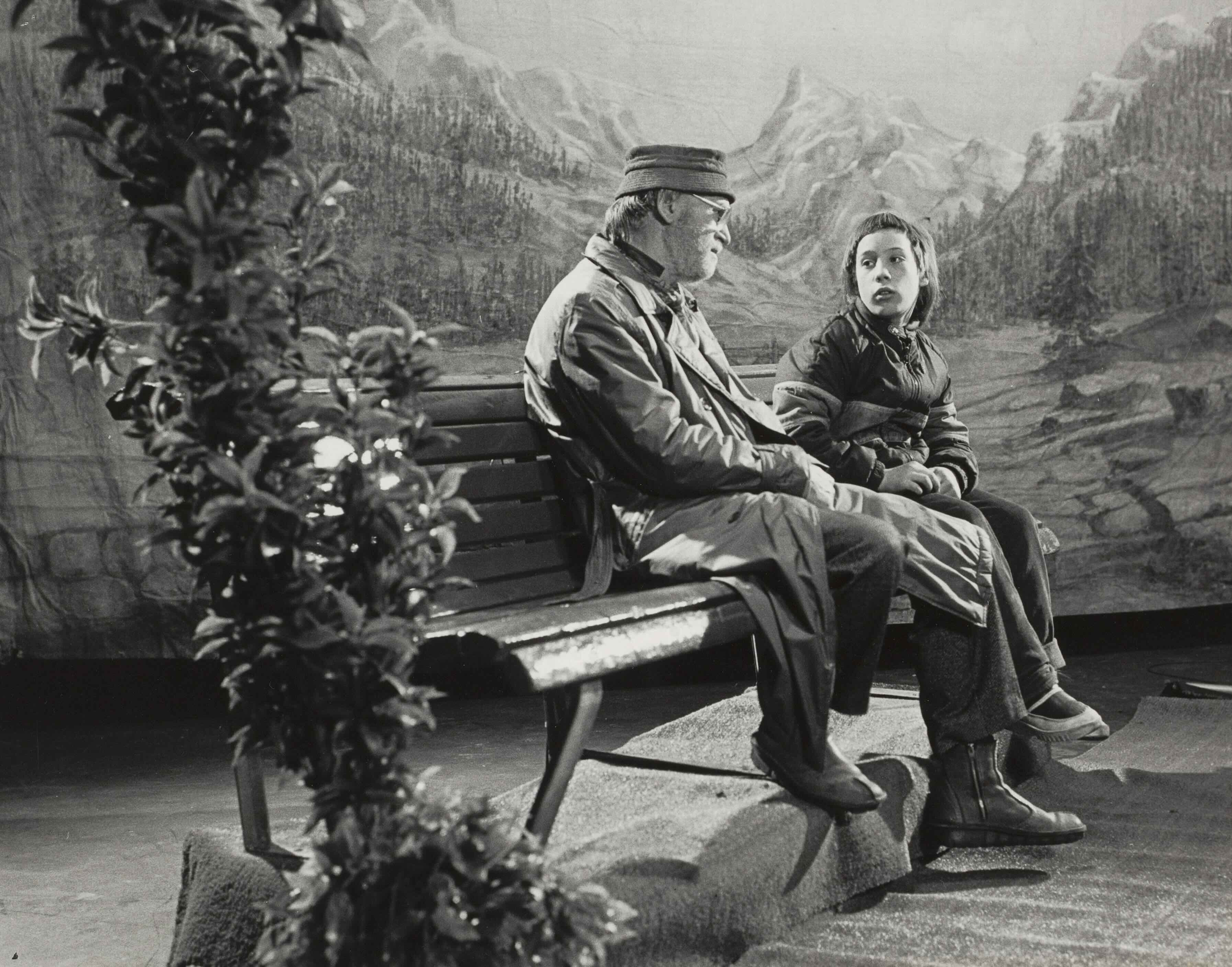
Vogelaar: The actors themselves are not actually in the film, either. They are the actants, the carriers of the text. They are not characters. They don’t represent people. They are language handlers that the camera turns into figures to be filled in. So, if they have any particularities, they get them from the camera that aggressively circles and voyeuristically observes them.
Van de Staak: And, especially when those language handlers listen to themselves, like Henk in the hotel room scene, they become interchangeable for the viewer. You accept this because you know that is not a real person but a person in the film, and therefore not an identifiable person. I also use the word “stand-in,” because the actors are in fact all “stand-ins” for another actor and (as substitutes of each other) they shape the film text. Those texts are often about emotions, and then you’re always balancing between actors being mere “material” and needing that human influence. In a certain way, they are material, but somewhere they have to give just this glimpse that, even though something eludes them, they want to be there anyway.
Vogelaar: That’s exactly what I find precarious. Those non-actors that Frans favours are so vulnerable because, despite their best intentions, they show themselves. An actor who plays himself as an instrument a n d who leaves himself behind is therefore able to show emotions and to bring these second-hand emotions authentically.
Van de Staak: I once made a film with only professional actors. That was really awful. Precisely because they are not language handlers at all, because they do not want to be material, and they only fill in the texts with clichéd elements and clichéd gestures, so when you’re working with a professional actor, you’re constantly sighing. Like, “God, how much do I have to let them unlearn before I get anywhere?” Apart from the occasional exception, it is horrendous!
Vogelaar: What I do think is a contradiction is that Frans asks non-actors to do things that only top actors can do. For example, at a certain moment, to make that one clumsy move. Only the very best can do that.
Van de Staak: There are no real film actors in the Netherlands at all. Perhaps the very best actors can do it, but below that it all falls to rubble.
Van de Staak: The way the actors stand there is as important as the text they utter – everything must become equally important, and therefore meaningless, because then it dissolves into itself. The texts you hear in the film are no longer the texts you read, although just as many images can be associated with them. The text has disappeared in the film, has sunk into it. In combination with these film images, you can say that this text materially no longer exists. The sounds, the words that are spoken do exist, and they correspond to the written texts. But the moment they are spoken in the film, they become different from the ones on paper and then no longer exist. It is not because the images disturb the text, but because the text and the images, to the extent you can separate them, push each other aside.
Vogelaar: After the anatomical theatre scene, I thought, “Now that text has disappeared from the paper, I can throw it in the rubbish bin.” This is something I never experience as a writer, because it is only when it is written down that I can pass it on, so in that sense, the text is sucked up by the film instead of just being used as dialogue.
Van de Staak: Yes, but by that disappearance I mean that they make each other insignificant. That the text no longer exists any more at that moment must be seen rather materialistically. You should not wonder whether the image sufficiently illustrates the text, because as soon as you hear a text, and you see an image with it, it is already a unit; that image is already saturated with that text, and they dissolve into each other.
Vogelaar: Normally, there is no “text” in film, except for the subtitles. Usually, talking serves as a filler for the sake of simulating reality, because people who don’t talk are not realistic. But this film does feature texts that stand on their own, and you could ask yourself the question, “Where does that text disappear into the picture?” The text does not even disappear into the picture, it’s blown up by the image into something you see as if in quotation marks. It is not the text that is portrayed. It is not illustrated – the people shown in the image utter the texts. Then several things happen at once: you hear the text, but you also see the text in the form of a person who cannot handle the text, who handles it too well, or who talks it away because they don’t understand it. So, you see a text treatment; you see words wriggling in the actor’s mouth, the text taking control of their voice. In a single case, someone speaks from within themselves, and the ease with which those sentences are spoken stands in almost painful contrast to the word combinations that come out of their mouth as Fremdkörper [foreign bodies]. When the text truly becomes the subject, the actor disappears behind the spoken words.
Van de Staak: Not only the actors disappear; the themes must also disappear, because if they got stuck in your throat, then it would have become an ordinary film. And I am very attached to that park scene with that cloud disappearing in front of the sun, because that’s where everything really dissolves into nothing.
- 1Bijlmer is a district in southeast Amsterdam, constructed in the 1960s and 1970s as a modernist housing project inspired by ideals of high-rise living and green spaces [translator’s note].
Images from Het vertraagde vertrek (Frans van de Staak, 1983) | © Neeltje Hin
This text was originally published as “J.F. Vogelaar en Frans van de Staak. Een gesprek,” in Wolfsmond 8, 1983. The English translation is a shortened version of the original conversation and was published in Frans van de Staak. The Word as Archipelago (2025), the first monograph in English on Van de Staak’s work, which followed an eponymous retrospective hosted by the Spanish film festival Punto de Vista.

