

Reporting on Eternity: TV Visits the Musée Rodin
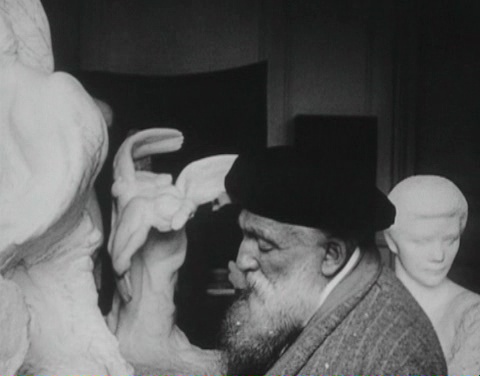
Stellio Lorenzi’s Visite au Musée Rodin [Visit to the Musée Rodin] constitutes one of those rare programs in which you can experience the new thrill of “pure television.”
As with pure poetry of course, television’s grace is bestowed only on those who earn it, first of all, by honestly serving their subject.1 The exceptional qualities of Stellio Lorenzi’s program are perfectly definable. We can easily imagine the splendid film for which this TV visit to the Musée Rodin might serve as something like the dress rehearsal.2 The auteur threw himself into his subject, coming up with a preliminary layout that is not inferior at all to the kind of découpage made for a film. He understood how to group the presentation of the sculptures into consistently valid categories, whether historical (Rodin’s beginnings), thematic (hands), or logical (the various stages of the monument to Balzac). Best of all, this presentation never confined itself to description, to just turning its light on the stone or the bronze; the framing, the camera movement, and the montage were wedded to the movement and rhythm of thought. Finally, the commentary added a dimension to the image. Without sidestepping the explanations necessary for a decent presentation of the artworks, and without ever lapsing into poetic esotericism, the commentary was as self-effacing as possible in confronting the literary texts that had more or less directly inspired Rodin: Dante, Baudelaire, Villon… and this juxtaposition not only made for the most effective of commentaries by way of contrast, but also, reciprocally, it enriched the texts themselves. Added to this was the intelligence of a musical score selected in the same spirit, for example the organ playing over the sequence of hands, or the chorale for Les Bourgeois de Calais.3
My praise here would apply just as well to the “film” that Stellio Lorenzi might direct using the same découpage (and it would be a shame if he doesn’t make such a film). Now – and this is the stunning lesson of such a program – this live report, instead of reducing the quality of the spectacle, actually makes it more effective than the most polished film. This is an observation much more paradoxical than one would at first have thought: that “live” television is of interest only if the subject of the reportage has duration, if it concerns an event that is temporal in nature. One can never attend the same football match twice; and even a theatrical play is not entirely identical to itself on each performance. But the plastic arts are exactly arts that are not temporal, and it is hard to see what could be added to these marble and bronze forms by the substitution of the television camera for the film camera, which has all the advantages of the former and none of its drawbacks.
This may well be the case; yet our gaze alongside Stellio Lorenzi’s on this petrified humanity was hardly timeless [intemporel]. The bumpy tracking shots of the Orticon camera, the groping attempts to frame, the simple, brutal illumination of the spotlights, the slight hesitations of the montage, all this made us participants in the show’s creation. I do not mean to say that the technical imperfections of live shooting constitute a spectacle in themselves – such a claim would be absurd. I would even add that these imperfections work favorably only on account of the care taken in the show’s production. Live television may distinguish itself technically from telecinema by only indeterminable differences, enough for us to have the feeling of living with the image, of discovering it at its birth. The contrast between theater and cinema is often based on the physical presence of the actor, perpetually renewed on the stage but fixed once and for all in film. Television gives rise to a new notion of presence, void of all visible human content – nothing, in short, but the presence of the spectacle to itself [la présence du spectacle à lui-même]. A tracking shot, in television, never passes through the same place twice. No two framings are alike, any more than there are identical leaves on trees. Let us savor the image that we will never see twice.
- 1“Pure poetry” in France is associated with Stéphane Mallarmé and became a watchword after Abbé Brémond’s famous lecture with that title and Paul Valery’s short reply “Sur la poesie pur” (both from 1925). Cinéma pur was used the next year by Henri Chomette, René Clair’s brother. Bazin was never favorably disposed toward the term and would soon write a key essay with the title “Pour un cinéma impur.”
- 2From 1947 into the mid-1950s, the film on art was a genre Bazin particularly revered. This TV program thus seemed to him to line up alongside Resnais’s many shorts (on van Gogh, on Picasso’s Guernica), some of which were also “visits.”
- 3Rodin’s most well known sculpture, The Burghers of Calais, is a group.
Image from Ceux de chez nous (Sacha Guitry, Frédéric Rossif, 1915)
This text was originally published as ‘Une Reportage sur l’éternité: La visite au Musée Rodin’ in Radio-Cinéma-Télévision, 148 (16 November 1952) and more recently in Hervé Joubert-Laurencin, ed., André Bazin. Écrits complets (Paris: Éditions Macula, 2018). The English translation first appeared in Dudley Andrew, ed., Andre Bazin’s New Media (Oakland: University of California Press, 2014).
Many thanks to Dudley Andrew.
© University of California Press, 2014

