

Sensitivity of Celluloid
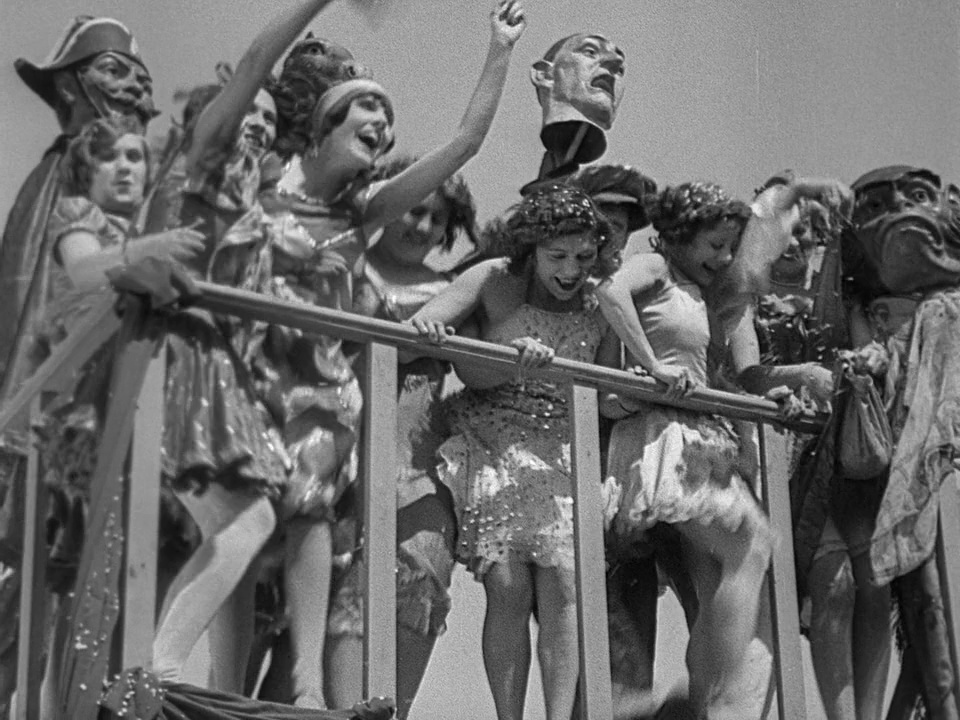
The eye of Man, “in the present state of Science,” is hardly more sensitive than his heart. This observation would be depressing were it not that we still have some reason to place our hopes in cinematographic celluloid.
The adjective “Hypersensitive” bestowed on the latest commercial emulsion need not be taken as fatal. No doubt, the precedent set by the term “supervision,” which ultimately consecrated the O.K. of O.K.’s1 of the Mise en Scène, gives us some cause for concern. Yet, while our colleagues who own shops and merchandise may, out of self-interest, be misled about the virtues of a superficial label with no future – just as the spectator may do out of laziness, mysticism, or a taste for suicide – you, disinterested laboratory scientists, concerned with experimental facts and unburdened by preconceived names, can no longer be deceived, ever since that day when one of your esteemed colleagues, wishing to have his dog’s hair curled, vainly called it a poodle.
And it is precisely these true benefactors of Cinema whose help we beseech.
S.O.S.!
You, who still do not know that Cinema is a great Art, that Cinema is Life, that Cinema is a serious Business.
However, I do not forget that you abandoned the first beloved epileptic images to the C.I.N.E.M.A.T.O.G.R.A.P.H.Y., and that – like mommy and daddy – you stoically deprived us of slow motion and other tricks, only to better protect us from “pure Cinema.” Even yesterday, at the advent of the one hundred percent, did you take the precaution of eliminating the tenors, the ministers, and the rest?2
I also know that your colour will be without aniline, your relief not without flatness, and your television, by way of fading, conformist to Power.3
… But, since there is nothing left to hope for from the hopes of Cinema!
Are we not still comparing theatre and cinema; invoking this or that painter when faced with moving visions; speaking of music – and musicians! – as a solution to every sonic problem; examining the cinematographic field through the framework of some literary page, as though it were a transparent map?
We have been proclaiming for too long that cinema is young, not to have ourselves become old men.
And at that age, one earns a living only by lottery.
Who places a bet? Against the filmmakers.
For the unknown troglodytes of the test tube.
Both are, of course, our equals.
I am indeed explaining myself poorly. Who places a bet?
Against the men of the Cinematograph.
For the Matter, revealed and imposed by Chance in the presence of the human catalyst, as it is commonly said.
Then let us abandon here, as we have already in all other domains, our Superiority to Things, to the Machine.
Let us cease to assert that this or that Director, this or that Star, this or that Production Manager will finally – will finally, what??? – when Criticism, increasingly facile, makes independent and advertising pages so costly.
Let us take our place as soon as possible among the auxiliaries, and if the harshness of the times forces us to earn a living, let us remain skilled technicians.
Skilled technicians, but in the manner of those Blacks4 who, without knowing it and against their will, participate in the most beautiful of adventures, as carriers.
Charged with bringing image- and sound-recording equipment to the natural locations of spontaneous events, the most difficult part of our task would, it is said, now be not to forget to retrieve them a little later, while our aperitif at the corner bistro demands all our intelligence, our will, our talents, our tastes.
Such was my thought on that all too dark evening of 2 September 1932, in Paris, in front of Bullier,5 where Maxime Gorki,6 Willy Munizemberg,7 Marcel Cachin,8 Schwernik,9 and Henri Barbusse,10 among others, were to report on their mandate as delegates to the World Congress against War,11 held in Amsterdam a few days earlier under the presidency of Romain Rolland.12
About 25,000 people, of whom only 7,000 were able to enter the hall.
In the street, a crowd of curious onlookers and activists, calm, somewhat sad, silent, waited under the protection of police officers.
And at 9 p.m., an official whistle: the charge!
The riders, horses trained and probing the path with their sabres; the special brigade, where France hides its athletes. The mobile guard, paradoxically wearing helmets. The batons, which are not aubergines but wood, with which they warm themselves, on skulls immediately split open. Fists on the nose, which gives way; on the eye, dangling from the optic nerve, I believe, like our fathers’ pocket-watch on a chain. The Freudian kick to the lower abdomen of women and men. “Move along!”
9:15 p.m.
“Rest! Count to four!” No deaths were reported among the “demonstrators”; no injuries among the officers of our Police.
Weak gas lamps to illuminate this scene of Urbanity!
When then, in the absence of men, will the cinematographic celluloid cease to remain insensitive to such spectacles?
- 1O.K.: An American expression used exclusively by French filmmakers, and which means: O.K. [Note by Jean Vigo]
- 2This probably refers to the arrival of sound film, following the era of silent cinema and transitional forms such as part-talkies or films with music but no spoken dialogue. Vigo ironically alludes to all those figures who essentially exist through their voice and who would be eliminated by cinema. [Translator’s note]
- 3“Aniline” refers to a synthetic dye, historically associated with early colour processes, such as hand-coloured film. Vigo is referring to a colour that is supposedly natural, yet stripped of expressiveness and “danger.” He also likely alludes here to the first experiments with 3D and television. [Translator’s note]
- 4Vigo used “Blacks” here as an archetypal, colonial image of his time, to emphasise the role of technicians as essential but invisible. [Translator’s note]
- 5Le Bullier (full name Bal Bullier) was a famous dance hall and meeting place in Paris, in the Montparnasse district. [Translator’s note]
- 6Maxime Gorki (1868-1936) was a Russian writer, playwright, and political thinker. [Translator’s note]
- 7Willi Münzenberg (1889-1940) was a German communist propagandist, organiser, and publisher, one of the most influential figures in the international communist network during the interwar period. [Translator’s note]
- 8Marcel Cachin (1869-1958) was a French socialist and later communist politician, and a key figure in French communism. [Translator’s note]
- 9Nikolai Shvernik (1888-1970) was a Soviet politician and trade union leader, a close associate of Stalin, and active for many years in the trade union movement and the Communist International. [Translator’s note]
- 10Henri Barbusse (1873-1935) was a French writer and pacifist, author of Le Feu (1916), active in communist and pacifist movements. This was a strongly left-wing and pacifist group, connected to the international anti-war movement. [Translator’s note]
- 11In 1932, the Soviet Union organised the “World Congress Against the Imperialist War” in Amsterdam. The event aimed to take a stand against “war and imperialism.” [Translator’s note]
- 12Romain Rolland (1866-1944) was a French writer, pacifist, and Nobel Prize laureate. [Translator’s note]
Image from À propos de Nice (Jean Vigo, 1930)
Written in September 1932 in Nice at the request of Henri Storck and published in Brussels in the magazine Sésame on the following 1 December.

