

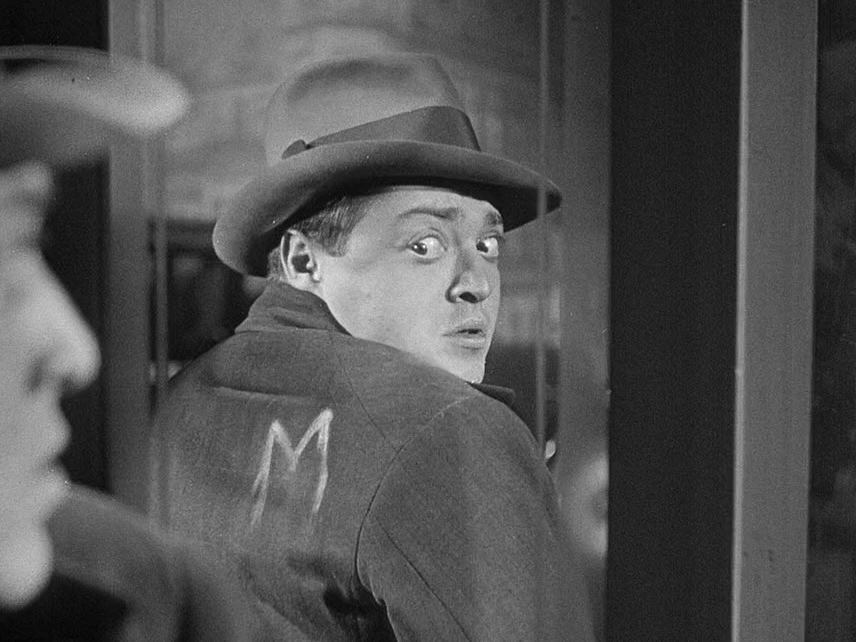
When the police in a German city are unable to catch a child-murderer, other criminals join in the manhunt.
EN
“His is the cinema of the nightmare, the fable, and the morality tale.”
Andrew Sarris1
“The subject, as always with Fritz Lang, is the idea of responsibility. In his films, there are those who know they’re guilty (it's stronger than them, it’s pathological: from Mabuse to M passing by the ‘lipstick killer’ of While the City Sleeps) and those who believe themselves innocent. But, from the silent serials to his American films made on command, through the big machines of UFA, Lang always drove in the same nail: there are no innocents. There might have been, but there are no longer. Innocence is provisional, wanting proof of it is already being guilty. Being sure of oneself, succumbing to the cold passion of ideas and ideologies, having the superior and smirky air of those who have expected everything, who have answers to everything, who are ‘mad of everything’ is a dangerous state. Dangerous for others.”
Serge Daney2
“Lang’s sympathies always lie with the little man, the man of low condition, who, by whatever means at his disposal, is willing to combat the dogmas of a stultified society.
I am speaking, of course, of M, Lang’s first sound film (deliberately passing over the minor films that followed Metropolis). It is significant, particularly in view of Lang’s interests and the fact that sex murder generally carried the death penalty, that Peter Lorre, through his defense counsel, pleads his cause in terms which cannot fail to place responsibility squarely upon an indifferent and narrow-minded society. More interested in revealing himself than in evoking the excuse of his insanity, which in intellectual circles would constitute an extenuating circumstance, Lorre bares his wounds to a horrified bureaucratic, bourgeois world which looks upon him as an aberration, a little dreg in the cup of creation. At the end of the film the ‘vampire’ is snatched from the jaws of his mock judges and brought to a conventional court. But these magistrates in Lang’s view are no more qualified to pass judgment than the underworld, and their verdict is never revealed.”
Georges Franju3
- 1Andrew Sarris, cited on the website of BAMPFA.
- 2Serge Daney, “Implausible Truth,” sergedaney.blogspot.com, 11 June 2019. Translated by Steve Erickson.
- 3Georges Franju, “The Style of Fritz Lang,” KINO SLANG, 16 August 2018. Originally published in French in Cahiers du cinéma, no. 100 (November 1959). Revised by the author from an article that first appeared in CINEMAtographe (March 1937). Translated by Sallie Iannotti.

