

Up, In, Out, Down
On Hong Sangsoo’s What Does That Nature Say to You? (2025)

“A good story can be told in a few sentences,” it says in the newspaper. In other words, a good story has a core that’s so clear and distinct that it can be summarized concisely without detracting from it – a few sentences suffice to indicate what it’s really about. The story of Hong Sangsoo’s What Does That Nature Say to You? (2025) can also be summarized simply: In the course of a single day, a young man drives up a mountain, enters a house, goes back outside, and then drives back down the mountain. The question is whether that says it all.
A film begins and comes to an end. In other words, a film is a common journey in which characters as well as viewers share the starting point and the destination. Just like the characters, who usually act to achieve a certain goal, the viewer also tries to understand the world they find themselves in as best they can. Where is the story that is unfolding before our eyes heading? The story is often nothing more than a series of actions to reach that final destination, with the characters acting as guides, carrying the viewer’s gaze along with them. The end of the film marks the completion of the action, and vice versa.
In What Does That Nature Say to You?, the story begins at the bottom of a mountain. A young couple is sitting in a car. Through the window, they see the young woman’s mother driving away. They get out, he smokes a cigarette, and together they look at the house up on the mountain, her parents’ house. The young man drops off his girlfriend; he’s not planning on staying. Then she invites him to take a closer look at the house. After all, her parents aren’t there. “If you want to take a quick look, go ahead.” They leave the first base of the film, at the bottom of the mountain, and move on to the next. The car drives up. The father appears at the top: he’s home after all. Now there are three of them at the top of the road. The father discovers that the young man, Donghwa, is his daughter Junhee’s boyfriend. He shows interest in Donghwa’s old car and drives it down a bit. Once again, there are two of them up at the top, the father is down below. This is the drama as it has unfolded so far. “When my father comes back, he’ll invite us in”, says Junhee. “Is that OK with you?” Donghwa sees no reason to object: “Of course, it’s just meeting your father.” The story of the film continues, but in a different direction than anticipated. Donghwa doesn’t just drop Junhee off, he also meets her warm-hearted father and is even invited into the house. There, he discovers that she has a sister who is going through “a difficult period”.
Hong divides the film into eight parts, indicated by numbers, which don’t follow any logical sequence but rather form a series of episodes. In the second part, the couple moves inside. Junhee says that her father has invited them to stay for dinner tonight; her mother will also be there. Donghwa has not only moved spatially, he will also, contrary to plan, spend more time in the house on the mountain.
A film begins and ends. There’s a line between that beginning and end point. No matter how fragmentary, episodic, or non-linear a narrative may be, the film is always viewed and considered chronologically, from A to B. Unlike in many of Hong's other films, the chronological order of events is not disrupted in this film: a young man goes up and down a mountain. But what happens along the way is less straightforward. At every moment, Hong allows countless narrative lines to emerge. Behind every door, every word, every glance, a new one can unfold. Because of this constant branching, nothing ever really happens that ultimately determines the direction of the line. There’s no preconceived plan for going up, in, out, and back down. The only line that inevitably forms is that of a day and a night. The inevitability of the circadian rhythm also determines how the final journey takes shape: “Are you staying for dinner?” “Are you staying the night?” Unintentionally, this creates a situation in which “something” seems to happen.
“Would you like to come outside for a cigarette?” the father asks Donghwa. “Would you like to come upstairs?” the sister asks Junhee. Outside, near the chickens, the father talks to Donghwa about his poetry, while inside, in her room, the sister asks Junhee questions about their relationship. Then the father invites Donghwa to go a little higher up the mountain and smoke one more cigarette before they go back down and inside.
Step by step, an erratic story emerges, whose movement is not compulsive but follows a game of shifts, derived from the structure of a floorplan. The young poet moves from base to base: from the car at the bottom of the hill to the driveway next to the house, from the sofa inside to the chicken coop in the garden. From a distance, the setup seems classic: as in Meet the Parents, Jay Roach’s 2000 romantic comedy, a young man meets his in-laws at his girlfriend’s parental home. But unlike in the Hollywood film, where a comical conflict between father and son-in-law drives the narrative, this is not an “official” visit. “It’s nothing – he just came along because he gave me a lift”, Junhee tells her sister. At no point does a drama arise that brings the film to a climax. Donghwa can leave at any moment and leave the whole situation for what it is. What has been built up narratively can always be undone. Hong preserves the flexibility of his intention. The meandering conversations between the family members and Donghwa create an opaque thicket that never breaks down into clear narrative nodes.

Because it’s not that nothing is happening. The viewer constantly projects a possible orientation: Is there animosity between father and “son-in-law”? Is the couple getting along well? Do they have wedding plans? Are the parents pleased with their potential future son-in-law? Is it a problem that the mother, like Donghwa, is also a poet? What will happen to the supposedly depressed sister, who doesn’t actually seem depressed? Does Donghwa himself have a problematic relationship with his father, a famous lawyer? All these questions open up paths for a story that ultimately presents itself more as a maze of possibilities, in which there may be no ultimate exit.
Yet Hong seems to constantly point the way, for example by using the dialogue of his characters to provide keys that seemingly unlock the meaning of his intention. “A little vagueness is OK with me.” This is how the third part begins. Is this the poet speaking, describing his limited vision, or is he acting as a ventriloquist for Hong’s vision of cinema? Which thread should the viewer follow? “Living while pursuing beauty is a good thing, isn’t it?” says the young poet later. Is this Hong speaking, wanting to convey his own artistic ethics of life?
Every story is ultimately disguised ventriloquism, a game between what can be seen and heard and what the filmmaker actually wants to say. What happens is not what it means; the second flows from the first. Hong turns this around: What it means is what happens, and it’s not entirely clear what happens. The only thing that’s certain is that a young man goes up the mountain, enters a house, and leaves again the next day. Hong doesn’t actually want to say anything at all.
The father suggests that the sisters and Donghwa go out for lunch somewhere. A new path opens up, even if temporarily: They’re expected back for dinner in the evening. So they’re not really leaving the house on the mountain behind. What will this outing bring? Will the conversation with the sister during lunch cause a conflict? In their conversations with each other, the characters are constantly walking a tightrope, with every uncovered secret, every unauthorized remark or confession threatening to upset the fragile balance, not only in the careful interaction between the characters but also in the film itself. Everything remains on the surface. This lack of direction remains locked in the form of the film. The long, uninterrupted shots offer no compass and provide a cumulative montage of meandering conversations in which little is set up or needs to pay off.
During a visit to a temple, Junhee receives a phone call from her father, who asks them to come back to the house on the mountain. Her mother is already home and has started cooking. Donghwa will therefore have to stay for dinner. Nevertheless, this dinner provides a certain point of convergence. Everyone sits around the table and talks about poetry, the young couple’s relationship, and Donghwa’s relationship with his father. When asked what he is looking for in his poetry, Donghwa gives a cryptic answer about two trees he had seen earlier that day, one at the temple, the other in the garden on the mountain, once planted for Junhee’s grandmother. “Those trees are possibly connected to me in some way. It’s really mysterious, truly.” This unexpected, candid revelation seems to resonate with the title – What Does That Nature Say to You? – but perhaps also with Hong’s fascination with Cézanne, a painter who departed from the concrete world but wanted to break away from both academic realism and a one-sided subjective point of view. He wanted to paint what appeared to him, looking beyond time, searching for a construction and forms that could exist permanently. In other words, like Hong, he was looking for an image that was not one-sidedly metaphorical and retained its direct connection with material reality.

Yet even Donghwa’s poetic interlude does not lead to a major breakthrough. The father suggests watching the sunset on top of the mountain with Donghwa and Junhee. Back down at the table, the conversation continues smoothly until the alcohol kicks in. A comment from the sister about his famous father causes Donghwa to lose control of himself. Throughout the film, he has done his best to not say anything meaningful, but here an opening seems to form when he calls out to the sister: “Is that really the only way you can see me?” Is this question also directed at us? Although the characters are portrayed as depressed, introverted, candid, polite, or poetic, this does not always correspond to how they present themselves.
At night, while trying to sleep off his drunkenness, Donghwa wakes up and walks into the garden. He shines the light of his mobile phone on a leaf of a tree to get a better look at it. He walks further into the garden and hears Junhee’s father playing the guitar inside. He stumbles, but gets back up. No one seems to have heard him. The next morning, he leaves early. He tells his girlfriend to tell her parents that he’s sorry. He drives down the mountain, away from the house. But not quite. On the motorway, the car breaks down, he has bad luck. He calls someone to pick up the car. Is it Junhee or someone else? “Yes, I’ll just leave it open, OK?” A new path emerges, and he lights a cigarette. “Maybe I should sell the car after all”, he says, and the film ends.
Donghwa ultimately spent a long day with his girlfriend, her parents, and her sister. The word “ultimately” is important here: When the film ends, after the time between the beginning and the end has passed, a long day has gone by that was not meant to happen that way. If Donghwa had simply dropped his girlfriend off, this ultimate film would never have unfolded as it now exists. Hong organises a film like an accident, a story that arose by chance and offers nothing more than the adventure of the narrative movement itself. What literally happens is also the only thing ultimately worth mentioning: A young man drives up a mountain, enters a house, goes back outside, and then drives back down the mountain. Everything he experiences in the meantime seems meaningless. Not because nothing happens, but because there is hardly anything meaningful to say about it.
Somewhere in the middle of the film, Donghwa shares his view of life with his girlfriend:
– Growing up, getting sick, dying... we don’t do any of that. It just happens. It just happens. It simply happens. We know nothing. No matter how hard we try to understand, we can’t. We never will. So feel things intensely, be grateful. That’s all there is.
This is a wisdom that also seems to resonate with Hong’s own work. In his films, there’s no need to search for something that can’t be understood; above all, the film must be felt. But perhaps that’s too hasty a conclusion. As Junhee lets Donghwa – and with him, the viewer and the critic? – know:
– Just don’t speak so absolutely about something. That’s also a way of pretending you know something. Do you know everything?
– No, I’m not saying it’s certain. I’m just saying that I don’t know anything, that I don’t understand it.
– That’s still a conclusion. Why do you like not knowing so much? And what about everything you do know? Sometimes it just seems like you're using “not knowing” as a way to escape.
– Junhee, these are just thoughts I keep coming back to.
No more, no less.
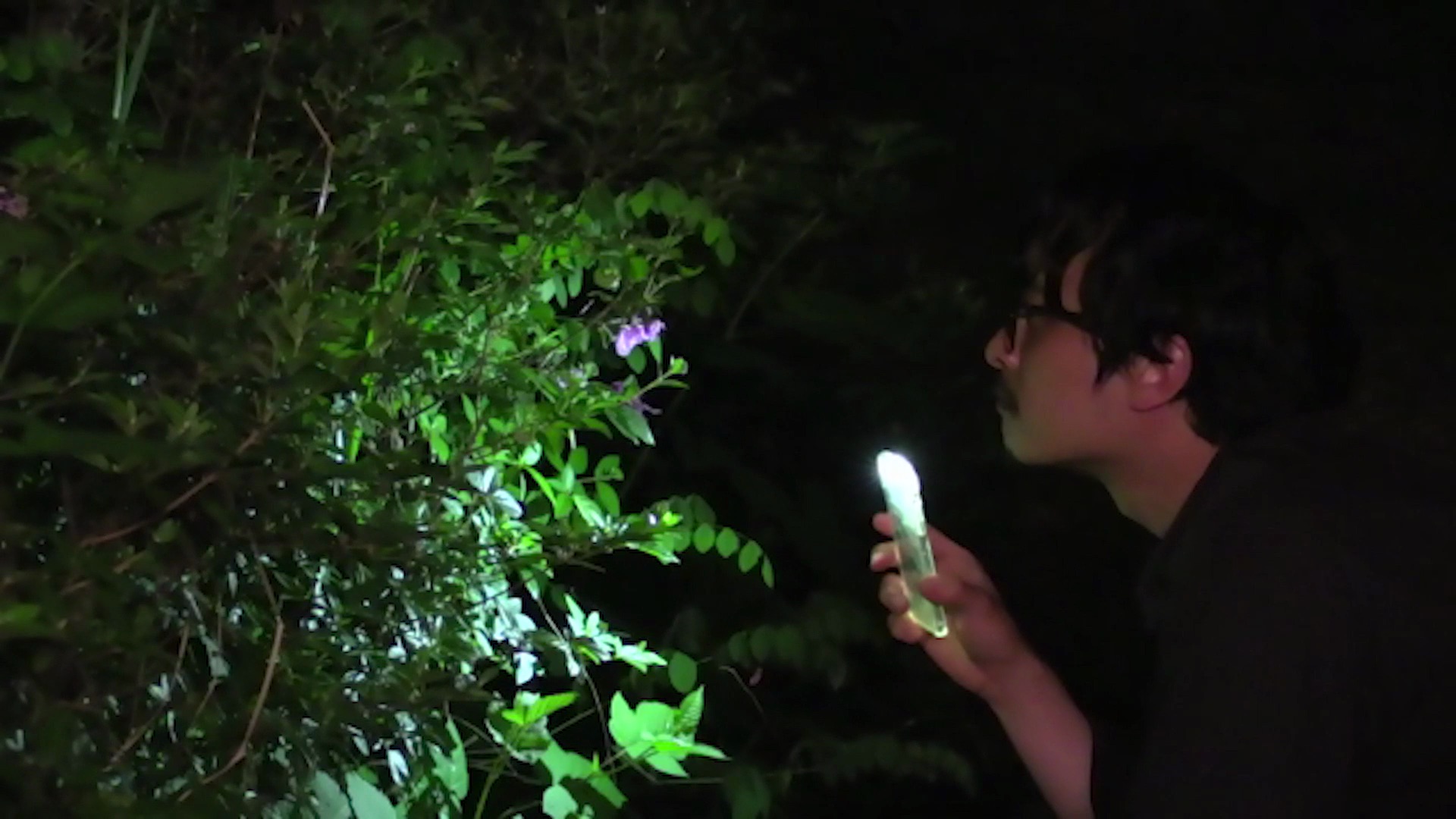
Images from Geu jayeoni nege mworago hani [What Does That Nature Say to You] (Hong Sangsoo, 2025)

