

Gestures That Are Never Paid
Anne-Marie Miéville’s Papa comme maman (1977)
I.
It’s tempting to read the name of the production company that Jean-Luc Godard and Anne-Marie Miéville established in December 1973 allegorically. Sonimage – two terms, designating basic components of cinema, are merged into one, maintaining their distinct meaning, but also creating something new – a semantic couple that transcends the individual parts. 1 + 1 = 3. In French grammar (if I’m not mistaken, French is not my langue maternelle), the “son” – apart from its meaning as “sound”, can also be a possessive pronoun that refers to both genders and is not restricted to its masculine form: it could be his, but also her image, son image à lui or son image à elle. Not male or female, but something below, beyond or in between. In the title sequence of Ici et ailleurs (1975), the word IMAGE blinks, while the words MON, TON and SON in their characteristic video font provide multiple possible connections. Sonimage – connected, and yet apart – just like the act of montage always dissociates and associates at the same time. Finally, as Antoine de Baecque reminds us, the term also contains the pun “Sony mage”, hinting at the intimate connection between technology, the image and magic.1
When Ici et ailleurs (1974) was released in 1976, Miéville and Godard had already been working together for four years. Their collaboration started in 1972 and, from the very beginning, was accompanied by major changes in Godard’s trajectory. In June 1971, he had suffered from a serious motorcycle accident that slowed down and interrupted his frenetic activity for several years. The collaboration with Jean-Pierre Gorin and the Groupe Dziga Vertov was coming to an end; Antoine de Baecque speaks of a “brutal breakup after five collective years,”2 The working relationship with Jean-Pierre Beauviala on the one hand, and the serious commitment to video and its multiple production opportunities on the other hand started. Together with Miéville, Godard relocated to Grenoble; following the 16 mm interventionist work between 1968 and 1972, video now took centre stage as the preferred medium of experimentation. In the work that followed, starting with the abandoned project Moi Je (1973) and then the re-organization of the footage shot in Palestine for Jusqu’à la victoire and the act of transforming it via the catalyst of video into Ici et Ailleurs, Godard and Miéville started to explore new tools by unwrapping and rebuilding the images and sounds, by inventing new forms of montage and writing on the images. It is a shift on many levels: from the global to the local, from film to video, from the metropolis to the periphery; finally, from an interventionist politics to more subtle forms of pedagogy. “I left Paris in ’73, and that was the end of ’68,” Godard said in retrospect, maybe ironically quoting the Soviet practice of the five-year plan.3
II.
If 1973 was the end of 1968, it also was a new beginning. A quote that has inspired the title of Jerry Whites illuminating book on Miéville and Godard, contains a suitable metaphor for their collaboration. “The Straubs work in tandem, on the same bicycle, one in front of the other. We have two bikes.”4 On tandems or as a team of two cyclists, by foot or in other communal vehicles: The film history of the working couple remains to be written. It would have to include important precursors like Maya Deren and Alexander Hammid, but the couple as a model for living and working together really takes off and proliferates after the caesura of 1968. In experimental cinema, Birgit and Wilhelm Hein or Dore O. and Werner Nekes come to mind. In the more essayistic vein, one could also think of Laura Mulvey and Peter Wollen who turned to filmmaking in 1974. What kind of model do these associations follow?
First, they merge the personal and the professional, or better still: they respond to the dissatisfaction of dissociating the two spheres in the first place. Of course, this desire was not new. Godard was constantly looking to combine his personal relations and his working life. In a different register, this holds true for his engagements with Anna Karina and Anne Wiazemsky. However, in those cases, the hierarchies between director/actress (in front of instead of behind the camera) and the dubious model of the “muse” prevailed. On different levels, the working relations with Gorin and Beauviala also attest to this desire. And yet, the work-relation with Anne-Marie Miéville is of a different character. For the first time in Godard’s career, living and working go hand in hand, the home becomes the artisanal workplace, where domestic activity is at the same time a public and political act.
Godard’s and Miéville’s relocation to Grenoble was followed in the summer of 1977 by their final move to Rolle at the shores of Lake Geneva. This was yet another important step away from the metropolis to the periphery. Always fascinated with contradiction and paradox, Godard claimed: “I move to the periphery in order to find my centre.”5 This move, above all, follows the will to become independent on the level of production. Not only do Miéville and Godard continue to accumulate video equipment to build up their workshop; more and more, the landscapes around Lake Geneva also start to inspire and enter the images. On a different level, changes in scale start to mark this phase which, one might say, culminates and ends with Soft and Hard (1986). No longer do revolution, international coalitions, or global politics obsess the filmmaker; he, or better, the couple is now preoccupied to get a grip on the domestic, on family ties and the local politics of neighbourhoods.
III.
With his study On Communication, his PhD thesis submitted in 1998, Michael Witt opened a new chapter in thinking about Godard by focusing exclusively on AMM and JLG’s work with Sonimage.6 According to Witt, this period spanned roughly seven years; a phase which he recognises as “a unique attempt to play out a decentralised collective experimental audio-visual practice.”7 Apart from the abandoned project Moi Je, it led to the three films Ici et ailleurs (1974), Numéro deux (1975) and Comment ça va (1976), and the two TV series Six fois deux (1976) and France tour détour deux enfants (1979). Among the abandoned projects, the ambitious plan to help set up a national TV channel in independent Mozambique, hints at the different character of projects pursued by Sonimage. Witt emphasises the astonishing productivity of the production company in its Grenoble period. No less than nineteen hours of material were produced in Grenoble, only the series France tour détour ensued after the relocation to Rolle. Witt deserves credit for emphasizing the “absolute centrality” of Anne-Marie Miéville in this period and beyond it. “Miéville and Godard are equally implicated at every stage of the Sonimage project, producing a uniquely and genuinely collaborative body of work.”8
During the Sonimage-period, Anne-Marie Miéville also made the forty-minute program Papa comme maman for Swiss television. For Jerry White, there is no doubt that this program belongs to the Sonimage-complex, even if Miéville made it on her own.9 For one thing, it uses the characteristic computer font for its credits. But more importantly, it also resonates with other Sonimage work produced in Switzerland, in particular France tour détour. Questions of growing up and the family as a basic social, political and educational unit are crucial issues that characterise both Papa comme maman and France tour détour. It is interesting to see how differently Miéville approaches the subject, how she makes use of television – in this case Swiss television and its French language branch SSR (Société suisse de radiodiffusion et télévision) as a means of production and distribution.
IV.
Papa comme maman, aired on November 18, 1977, was produced by SSR as part of the series “Écoutez-voir” – “une carte blanche donnée par la TSR à quatre cinéastes romands (Anne-Marie Miéville, Alain Tanner, Loretta Verna et Francis Reusser).” In combining the acoustic with the visual, the title of the series sounds like an exact analogy of Sonimage.10 Also, three of the four individual programs – those by Miéville, Verna, et Reusser) make ample use of the characteristic computer font established by Miéville and Godard in Ici et Ailleurs – I take this as an indication that Sonimage might have been involved in the production of the whole series. The premise of the series was technical rather than thematic. Building on an idea by Francis Reusser, the group of Swiss directors approached the TV channel with the suggestion to work with Super 8 and video. The technical setup thus combined three different media which all deviated from the established cinema standard and were thus hoped to facilitate potentially more democratic and emancipatory practices.11 In addition to the four programs, a fifth instalment, aired as the introduction, featured John Berger who was confronted with the finished episodes of “Écoutez voir” and had a conversation with their directors.12 If we follow Richard Brody’s account of the summer and autumn of 1977, this was a particularly charged period in Godard’s and Miéville’s life. It is the moment of relocation, and thus of returning to Switzerland; and in some respect, Miéville’s video is intimately connected to the early stages of France tour détour.13
At the time, “Écoutez voir” attracted public attention and was hailed as an exploration of a new type of Swiss television. The “revue trimestrielle” CINEMA made “Video & cie” its primary focus of the issue 4/77 which accompanied the broadcast. Apart from a short editorial to the issue by Martin Schaub entitled “Video – Zweck und Mittel” (“Video – but et moyen”) and essays by Jean Richner and Francis Reusser, the journal also features a dossier on “Écoutez voir”. It comprises the introduction to the program written by Reusser (who, as Tanner reaffirmed, had initiated the project), and an essay by François Albera called “La bande des quatre”.14 Reading the introduction indicates how much the initiative owes to Godard’s and Miéville’s previous work, to Numéro deux et Six fois deux in particular: “There was one, then two, then four. Professionals, half-timers, people who said they were. We had thought: once 4, this should free the word, change the way; break the habits and the solitary pleasures which define the authority and the control of the director. At the end of the day, or when counting, we found ourselves with 4 x 1 or 2 x than one, depending on the point of view, and it is the x sign that said the most. But 4 and x was already not bad for thinking and filming elsewhere than in the official dark rooms that always deliver the same identity photo; and identity challenges us because a passport does not say much about the other, even with an image; and speaking became the hard part of the relationship, the word of each ricocheted on a screen to be heard by the neighbour. And this screen we made it our own for a while, the time to create our bits of dialogue.”15
Identity, photography, questions of directorial authority – many of the points highlighted by Reusser resonate with the Sonimage project around 1975. As François Albéra points out, the series also follows the tactics of inscribing itself into the common broadcasting scheme but adapting it to their needs and thus extending the realm of possibilities: “their words can take place in the daily flow of TV, they will be seen and heard there and yet they do not submit at any moment to the televisual law.”16
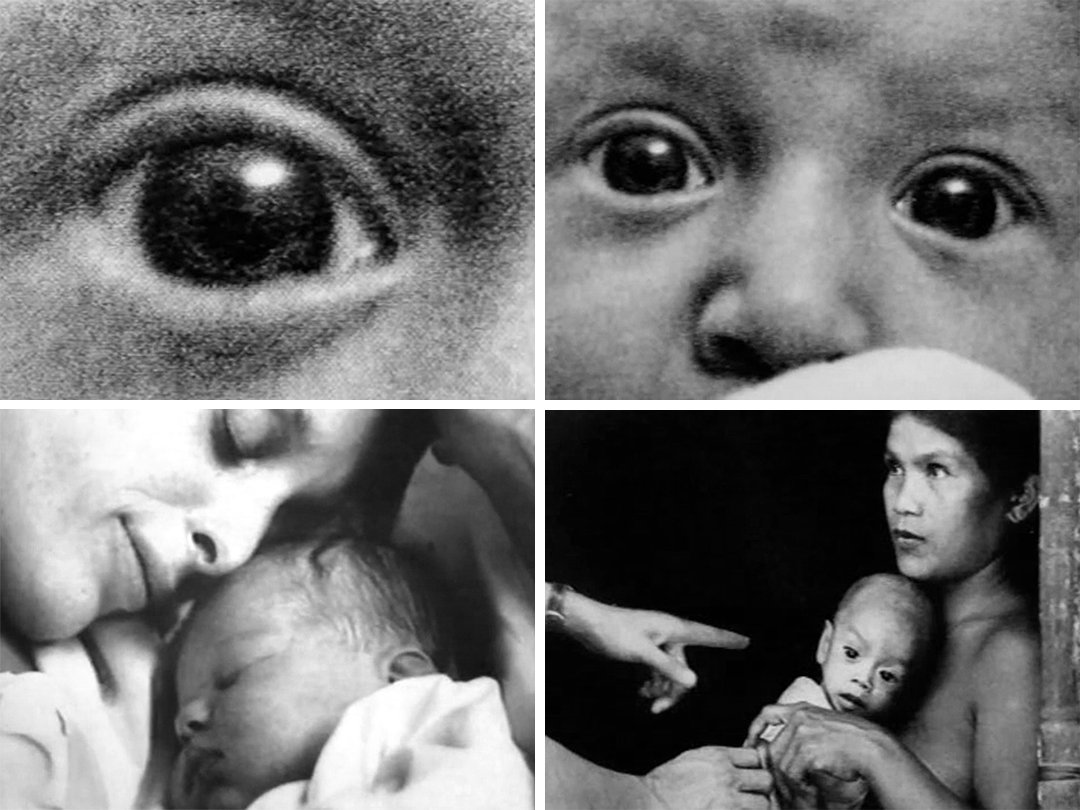
Miéville’s program starts with the super close-up of a child’s eye; this image, apart from explicitly denoting “vision”, reveals itself to be part of a series of photographs displaying scenes of maternal closeness and affection – women of different ethnicity carrying babies on their back, women breastfeeding or sleeping next to their children; ironing clothes or sitting at the dinner table. Then, suddenly, the image stops on a child’s face displaying violent injuries. For a painfully long time (more than two minutes), we are confronted with images of physical abuse, while Miéville’s voice provides facts: “Look, this one is all alone. You can’t see his mother. It must be said that he is beaten, and that the images of mothers beating their children, we never see them, we can’t find them anywhere. Yet, in our highly civilised country, parental violence kills more children than diseases like tuberculosis, polio, chicken pox, diabetes, appenticide.” Miéville finds drastic words and compiles a terrifying catalogue of violent acts: “Children are beaten, choked, suffocated, starved, bitten, burned, strangled, broken, and often killed by their parents. Not far from here, at home, in Europe.”
However, this is not the opening sequence for an investigation of child abuse, as we might expect. Quite the contrary. Miéville locates the responsibility neither in the social conditions nor in individual sadistic dispositions of the parents. Instead, the violence is seen as the result of “a mismatch, a gap, a huge chasm between the image of the role of the mother imposed by society, and the daily reality, the work of the mother.” It is this idealised image of motherhood that Miéville decides to investigate. In an interesting dialectical twist, her project is to look at motherhood by turning to a family where this role is void, or rather: filled by the father.
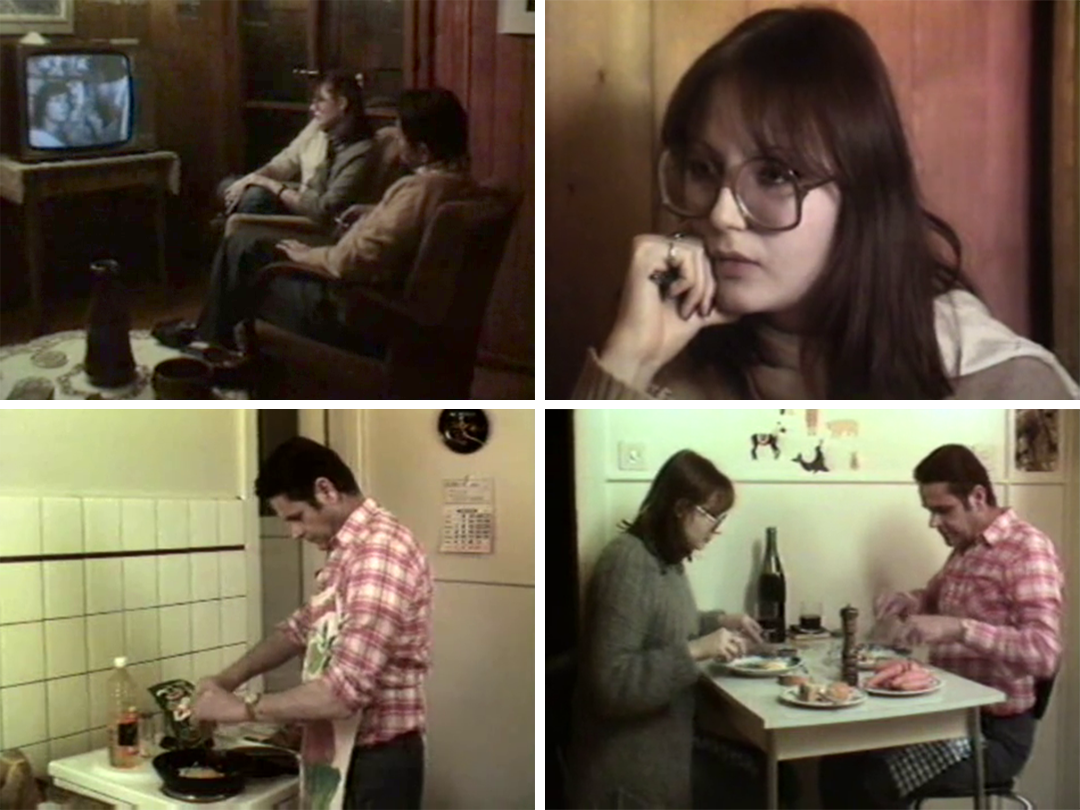
The remaining thirty-five minutes of Papa comme maman are dedicated to Olivia, a nineteen-year-old adolescent who lost her mother when she was three and was brought up by her single father. Miéville does not linger on the problems and failures of this constellation, but rather tells a successful case study that questions traditional role models and educational norms of motherhood. Even if his colleagues and friends discouraged him from bringing Olivia up on his own, her father has no problem in fulfilling roles which are conventionally coded as “feminine” – cooking and taking care of his daughter, educating her about menstruation, supporting her autonomy. The resulting lack of a female role model prevents Olivia from reproducing the clichés and from falling into the trap of reproducing customary expectations.
Papa comme maman is quite straightforward in its style. Situated between Six fois deux and France tour détour, it does not make use of the innovations the two series introduced to investigate their topics. Neither the extensive use of written text nor the manipulation of the image speed, especially the “ralenti” of France tour détour are featured in Miéville’s program. Its most prominent method is the interview. Two long sequences consist of statements by the single father and his nineteen-year-old daughter Olivia. A particularly beautiful shot shows Miéville and Olivia from a distance, sitting on a meadow, with the panorama of Lake Geneva and the mountains in the back. Except a montage sequence showing mothers pushing their baby strollers at the end of the program, this is the only outside shot, and in its openness, it connotes a touch of utopia. The second method complementing the interviews and alternating with them is the sober observation of quotidian scenes: Olivia making her bed, doing homework and washing the dishes; her father preparing lunch, both of them eating together and watching television. The short sequence in front of the TV set also points to the reflexive character which pervades all four programs. In every moment, Papa comme maman is conscious about its stance as a contribution to the programming schedule of public television. Towards the end of the program, this becomes most obvious. We see a TV set displaying a test image, while Miéville says in voice-over: “There you go. There were forty minutes to do for TV. This does not happen often, it’s not easy. You feel forced to make a speech, and I don’t have a message. I just wanted to say two or three things, based on situations that interest me, necessarily because they cross my mind. Since the condition of mother is mine too, and I encounter all these problems every day.” Synthesizing one of the results of the investigation, Miéville stresses what Olivia has won, despite the loss of her mother. Again, the personal and social question is reframed in terms of image-politics: “But she has also gained: other ways of making image associations.”
Another sequence of the program is equally close to the Godard/Miéville collaborations. White calls it “a kind of mini-manifesto for Godard and Miéville’s approach to communication.”17 It is a lesson on the possibilities, but also the shortcomings of montage. Following the long interview with Olivia, this segment which we have just seen is subjected to an auto-critique. Juxtaposing Olivia’s face talking with shots showing (and making us hear) domestic acts of doing the dishes, peeling carrots, washing clothes, Miéville asserts: “We’ve seen this” – the extreme close-up of her face – “we’ve seen this, but we haven’t heard this” – the sounds of domestic labor. In other words: While we are learning about the experiences that Olivia lacks due to the early loss of her mother, these very images also eclipse the material conditions of the family life, “the gestures that are never paid,” “les gestes qui ne sont jamais payés,” as Miéville argues later.
Miéville’s point is that in the complex of motherhood, the personal and public, the affective and the economic are constantly mixed. In this context, domestic labour and its transfer from one generation to another are revealed as something highly ambiguous. Ironing clothes, sewing buttonholes, cleaning the windows: on the one hand, those are (unpaid) forms of labour usually put on the shoulders of women (mothers), but at the same time, they are forms of practical knowledge that can be transmitted from one generation to the next. Miéville’s critique is targeted at the social imaginary, in which very different levels of “motherhood” are blended into each other: “What’s wrong is that in the current codes, all this is mixed up. Under the name of ‘maternal love’ we put together a whole bunch of headings that have nothing to do with each other, and especially not to pass themselves off as maternal love.” At this point, the political critique sets in: “There are a number of tasks that constitute an immense and unpaid work that the mother usually performs. And to support this monotonous and repetitive work, not recognised as such, it is mixed with love.”
As we might expect from Miéville, her proposition is to focus on the (misleading, wrong, violent) images and role models we attribute to the female sex, and to replace them with other, more adequate ones. Television with its wide exposure, is the medium most promising to engage with. Contrasted with France tour détour..., the vision expressed in Papa comma maman is lighter, more optimistic (despite the violent beginning). There is no generational antagonism between the children who are still open to learning things differently and the adults (the “monsters”) who are entirely corrupted. To some extent, this difference in tone is due to its protagonist. Even if the central topic is motherhood, Oliva is not the conventional child which is dependent on the care and responsibilities of her parents. As a nineteen-year-old, self-conscious young woman, she could well be a mother herself. This, and the unconventional mode of fulfilling the family roles by subverting classical gender stereotypes, formulates a promise to go beyond the traditions.
V.
Anne-Marie Miéville has always been notoriously shy about the specific character of her collaboration with Godard. In her later work, the films between Le Livre de Marie (1984) and Après la reconciliation (2000), we recognise elements that look (and sound) familiar from Godard’s work (the typography of the opening credits, the sounds, the abruptness of acoustic editing, for example), but they are entirely transformed. During the Sonimage years, Papa comme maman provides a unique insight into Miéville’s style since it is the only work she directed outside of the AMM/JLG framework. Compared to Six fois deux and France tour détour, the discourse in Papa comme Maman is more serene, less agitated and less aggressive. The adult world, the world of fathers and mothers, is nothing but a world of “monsters” in France tour détour. Focusing exclusively on the children and trying to explore their world seems to signal that it is any hopes on the older generation would be misled since it is completely corrupted by the consumer world. In Papa comme maman, Miéville manages to find a more positive constellation that challenges our clichéd notions of family roles. François Albera was sensitive to this when the series was broadcast: “From this point, both the woman (as mother, daughter) and the man (husband, son) are challenged by the program, since all the positions of the family institution change: the father is the mother, the daughter the son, the father’s companion, the father her friend, etc.” Even if this family constellation is built on (and compromised by) a fundamental lack – the lack of the mother – it provides an alternative model and contains elements of a social utopia. Once the traditional images of motherhood are dismantled, the “this gigantic scam” can be overcome, as Miéville’s final words proclaim before Barbra Streisand’s version of John Lennon’s Mother sets in. Her vision for the future is: The function of the mother will no longer be “this gigantic scam that consists in reproducing gestures that are never paid.”
Hitherto, Papa comme maman, after all Anne-Marie Miéville’s directorial debut, has remained largely unnoticed. It should be recognised as an important building block in the collective Sonimage adventure, and, most notably, as an early testimony of Godard’s and Miéville’s transition from France to Switzerland.
- 1
Antoine de Baecque, Godard (Paris: Grasset, 2010), 525.
- 2
Ibid., 517 (my translation, VP).
- 3
Jean-Luc Godard, interview with filmwärts, 1989, quoted in Elisbeth Büttner, “In the Image Workshop. Jean-Luc Godard, Anne-Marie Miéville and the Beginning of Sonimage”, in I said I love. That is the promise. The tvideopolitics of Jean-Luc Godard, ed. Gareth James and Florian Zeyfang (Berlin: b_books, 2003), 65.
- 4
Jerry White: Two Bicycles. The Work of Jean-Luc Godard and Anne-Marie Miéville, (Waterloo: Wilfred Laurier University Press, 2013), 13. Antoine de Baecque has the original quote: “Les Straub travaillent en tandem, sur la même bicyclette, lui devant, elle derrière. Nous, nous avons deux bicyclettes.” (de Baecque, 527.)
- 5
Quoted in Antoine de Baecque, Godard, 545.
- 6
Michael Witt, On Communication: The Work of Anne-Marie Miéville and Jean-Luc Godard as ‘Sonimage’ from 1973 to 1979 (PhD diss., University of Bath, 1998). The book accompanying a large retrospective in New York in October to November 1992 – Jean-Luc Godard: Son + Image, 1974-1991, ed. Lea Bandy and Raymond Bellour (New York: MoMA, 1992) – is another important document in this respect. However, focusing on a longer period and highlighting Godard and omitting Miéville from the title, it emphasises the auteurist perspective where Witt’s book is much more interested in doing justice to Miéville’s part in the collaborative work. An important early take on Godard’s TVideo period is Colin MacCabe, Godard: Images, Sound, Politics (London: BFI, 1980). For a concise look at the Sonimage period see Michael Witt, “On and Under Communication,” in A Companion to Jean-Luc Godard, ed. Tom Conley and T. Jefferson Kline (New York: John Wiley & Sons, 2014), 318-350.
- 7
Witt, On Communication, 8.
- 8
Ibid., 9-10.
- 9
White provides one of the very few closer looks at Papa comme maman in his book. White, Two Bicycles, 59–62.
- 10
I haven’t found any proof that the title was explicitly referring to Sonimage, but in my impression, Anne-Marie Miéville and Jean-Luc Godard played a crucial role. Ironically, Miéville is sometimes written out of the history of “Écoutez voir”. In one article on Loretta Verna (La Liberté, 5 July 2008), it says: “Après ses études, Alain Tanner et Francis Reusser la repèrent et la font participer à une série d’émissions pour la Télévision suisse romande qui verra aussi Jean-Luc Godard y contribuer.” In another article (Le Temps, 14 Juin 2008), we read: “En 1977, elle est embarquée dans un projet de télévision, Regarder voir. Aux côtés d’Alain Tanner, de Francis Reusser, d’Yves Yersin, elle réalise son épisode avec le comédien Jacques Probst, met en scène des personnes âgées, dont un ancien du Parti du travail.”
- 11
At this point, it would be interesting to contextualise this series with other attempts to critically intervene into the discourse of cinema and television by using sub-standard technology like video and Super-8. In Germany, for example, Hellmuth Costard hoped to professionalise the Super-8-format and to establish it as an inexpensive alternative to 16 and 35mm. Obviously, Godard was one of the role models; Costard’s attempt to involve JLG in his project resulted, amongst other things, in his film Der kleine Godard an das Kuratorium junger deutscher Film (1978). See Filmkritik Nr. 264, December 1978, and Wilfried Reichart’s contribution in Jean-Luc Godard: Documents, ed. Raymond Bellour, Nicole Brenez et al., (Paris: Centre Pompidou 2006), 292–299.
- 12
It seems that this first instalment, aired on Friday, 11 November 1977, has not been preserved in the RTS archives. Jerry White tried to find it for his book on Alain Tanner, and it has left no traces on the RTS-website, where the four programs are available for streaming. The remaining programs were aired on subsequent Fridays, usually around 10 pm: Friday, 18 November 1977: Papa comme maman (Anne-Marie Miéville); Friday, 25 November 1977: Temps mort, (Alain Tanner); Friday, 2 December 1977: Evidemment, la vie s’écoule, (Loretta Verna); Friday, 9 December 1977: Le Croyable et le Vrai, (Francis Reusser). Thanks to Jerry White for providing information.
- 13
As Brody writes: “On October, 26, 1977, Bertin [Manette Bertin, the INA producer] traveled to Rolle to hear of his plans for Le Tour de la France avec deux enfants. Upon her arrival, Godard insisted that she first watch a short video that Miéville had made, in which a young orphaned girl talks about her mother.” Richard Brody, Everything is Cinema. The Working Life of Jean-Luc Godard (New York: Metropolitan Books 2008), 399.
- 14
François Albera, « La Bande des Quatre. Anne-Marie Miéville/Francis Reusser/Alain Tanner/Loretta Verna », CINEMA, 23, nr. 4, november 1977, 23-30.
- 15
[Francis Reusser], « Écoutez-voir », CINEMA, 21-22.
- 16
François Albera, “La Bande des Quatre.” , 23-30.
- 17
Jerry White, Two Bicycles, 62.
Images from Papa comme maman (Anne-Marie Miéville, 1977)
A French translation of this text appeared in Décadrages in 2023. We thank the editors and the author for their kind permission.

